Hippocampe has been training divers in Porto-Vecchio since 1981. The center was founded by Karin Schuller, and in 2016 Wolf and Nadine, who had already been instructors there for about ten years, took it over. Its boats leave from the La Chiappa peninsula, south of Porto-Vecchio, and the Cerbicale Islands sit about 4 km offshore.
We rewrote this page after checking the club’s own website and the official Corsica tourism site. Anything we could not confirm there is gone. If you are planning a dive trip to southeast Corsica, here is what the club actually offers, and what you should ask before you book.
Where exactly is the Hippocampe dive center?
The center is inside the La Chiappa holiday village, a naturist resort at 20137 Porto-Vecchio, on a peninsula facing the Cerbicale Islands. You do not need to stay there to dive. The club’s FAQ says outside guests can stay clothed, register at the resort reception and leave an ID card or car keys as a deposit. Entry is free for the length of your activity.
Getting there takes about 15 minutes by car from Porto-Vecchio, according to the club. Follow the road toward Palombaggia for roughly 10 km, then the signs for “Villages Naturiste La Chiappa + Hippocampe”. The entrance is about 2 km further on.
The main season runs from April to the end of October, usually from 8 am to 6 pm. Outside those months, the club says you can still reach it by phone.
What will you see on the dives around the Cerbicale Islands?
You will mostly dive granite reefs inside a protected area, with plenty of fish and a lot of small life on the rock. The club lists about 25 sites between 3 and 40 m deep. All but one lie inside the nature reserve.
The Cerbicales are part of the Bouches de Bonifacio Nature Reserve. Visit Corsica, the island’s official tourism site, says the reserve was created in 1999, covers 79,460 hectares and is managed by the Office de l’Environnement de la Corse. The Cerbicale Islands themselves had been protected since 1981-1982. Groupers are among the threatened species the reserve shelters.
On its dive-site page, the club mentions barracudas, octopus, groupers, moray eels, red gorgonians, yellow encrusting anemones and “countless species of nudibranchs”. Large spider crabs show up in May and June. That is a list of what divers have seen there, not a promise. What you meet depends on the day.
| Site or area | Depth given by the club | Who it suits |
|---|---|---|
| Elephant Head (Tête d’Indien), Millenium, Matterhorn (Cervin) | 3 to 20 m | Beginners and confirmed divers |
| La Pinella wreck, Gulf of Porto-Vecchio | 12 m maximum | Scuba Diver / PE12 and above |
| Le Danger de la Vacca reefs (Abbys, Reef 2, La Fenêtre, Le Tombant, Le Doigt) | Not stated | Ask the club on the day |
| Helena Reef, Gorgonia, Reef 19 / Les Arches | From about 20 m | CMAS 2-star or PADI Advanced Open Water |
The Pinella wreck is the only site outside the protected zone. The islands of Forana and La Vacca give some shelter from the wind, which helps when the sea picks up.
Boat rides are short. The club’s pages give between about 5 and 15 minutes to reach the islands, depending on the page and the site.
Can you try diving for the first time with Hippocampe?
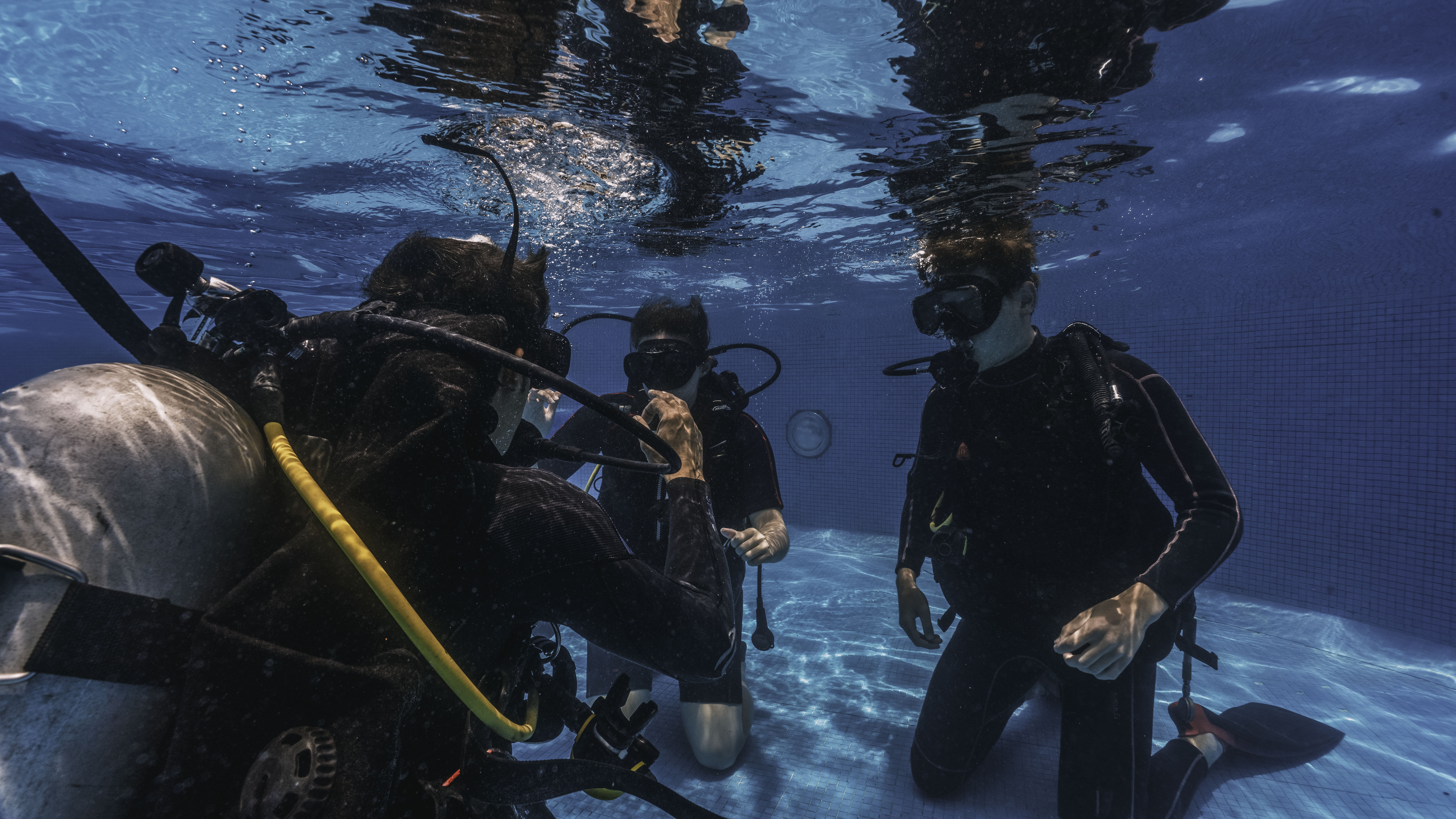
Yes. A try dive (baptême) is open from age 8, and you get an instructor just for you. The maximum depth is 6 m. You need to be able to swim, you fill in a medical questionnaire, and pregnant women cannot take part.
The club offers three formats: a “classic” boat try dive of about 25 minutes, a longer “royal” one of about 40 minutes, and a shore dive outside high season. Snorkeling trips are open from age 6 if the child can swim, and mask, snorkel, fins and wetsuit are included. The boat ride to the snorkeling spots takes about 10 minutes.
Nervous about breathing underwater for the first time? That is normal. Tell your instructor before you get in the water, and read our page on diving stress and how to manage it.
Which diving courses does the club teach?
The club teaches both the French system (FFESSM and ANMP levels) and PADI courses, from a first certification up to Level 3. A course can start on any day, the FAQ says, although specialty courses need a minimum number of participants and should be booked ahead.
- Children: bronze to gold programs from age 8, in the bay at 2 m or around the islands.
- Scuba Diver / PE12: from age 10, in under two days. You can then dive with a guide to 12 m.
- Open Water Diver / Level 1: prepares you for dives to 20 m, with theory and in-water training.
- Level 2: navigation, ascents, deeper diving and buddy skills. In the French system, it lets you dive autonomously to 20 m and with an instructor to 40 m.
- Level 3: the French level for autonomous diving to 60 m with buddies of the same level.
- PADI continuing education: Advanced, Rescue and Deep courses appear on the price list.
For any course, plan on bringing a medical document. The French page asks for a medical certificate and the English page mentions a medical self-disclosure. Ask the club which one applies to your course before you travel.
How much does diving with Hippocampe cost?
These are the prices displayed by the club on its rates page when we checked on October 3, 2026. The page does not show a year, so confirm them when you book.
| Activity | Price displayed by the club |
|---|---|
| 1 exploration dive, your own gear | €48 |
| 1 exploration dive, full rental | €58 |
| Classic boat try dive (about 25 min) | €75 low season, €85 high season |
| Royal boat try dive (about 40 min) | €125 low season, €130 high season |
| Shore try dive | €70 (low season) |
| Snorkeling | €45 |
| PADI Scuba Diver (3 dives) | €400 |
| PADI Open Water Diver (6 dives) | €620 |
High season runs from July 1 to September 30, and exploration dive packages cost a little more then. Multi-dive packages of 3, 6 and 10 dives are also listed. Exploration dives need at least a Scuba Diver or PE12 certification.
What should you know before you book?
Call rather than email in July and August. The club says it gets a lot of requests in high season and prefers phone bookings, on +33 7 50 27 49 56 or +33 7 75 21 68 43. Email (dive@hippocampe.de) and WhatsApp also work.
A few practical points from the club’s FAQ:
- There are two to four dive outings a day, depending on demand.
- Each outing is a single-tank dive, and the boat comes back to base between dives.
- The club dives on air only. No nitrox.
- Rental gear includes 10, 12 and 15 liter tanks, regulators, BCDs, wetsuits, masks and fins. Computers and lights are available on request.
- The team speaks French, German and English.
Summer in the Mediterranean can also bring jellyfish near the surface. It rarely spoils a dive, but it helps to know what to do: see our guide to jellyfish sting remedies.
One last tip. The reserve has its own rules, and your guide will brief you on them. Do not touch, do not feed, do not collect. It keeps the groupers coming back.
FAQ
Do you have to be a naturist to dive with Hippocampe?
No. The center is inside the La Chiappa naturist resort, but outside guests can stay clothed. You register at the resort reception and leave an ID card or car keys as a deposit, and entry is free during your activity.
What is the minimum age to dive at Hippocampe?
Try dives and children’s programs start at age 8. The Scuba Diver or PE12 course starts at age 10. Snorkeling is open from age 6 if the child can swim.
Does Hippocampe offer nitrox?
No. The club states that it dives on air only, with single-tank dives and a return to base between outings.
When is the dive center open?
The main season runs from April to the end of October, usually from 8 am to 6 pm. Outside the season, the club can be reached by phone.
Sources
- Dive sites (Hippocampe dive center, official website, accessed 2026)
- The Nature Reserves (Visit Corsica, Agence du Tourisme de la Corse, accessed 2026)