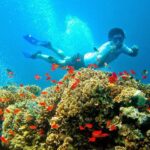
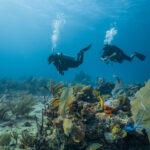
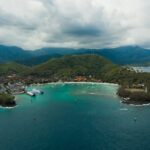
On June 10, 2010, Honduras designated the waters of Utila, Roatán, Santos Guardiola, and Guanaja as a marine protected area. The Bay Islands Marine National Park covers 647,153 hectares, making it the largest marine protected area in the country according to the Roatán Marine Park, the association that patrols part of these reefs.
Our previous page displayed rates without dates, visibility of 25 to 45 meters, and whale shark sightings limited to February-April. We removed what we could not verify.
Here you will find a grid for level, current, season, supervision, and fallback plan, the official cyclone dates, and what Paris and Madrid write about the islands’ safety.
Where to dive around Roatán and Utila?
The Bay Islands border the Mesoamerican reef system, off the Caribbean coast of Honduras. Roatán, the largest, hosts most of the centers and sites equipped with buoys, while Utila, smaller and further west, attracts for training and whale sharks. Guanaja remains more isolated and much less documented.
The most cited site in Roatán is the El Aguila wreck. It is a cargo ship about sixty meters long, deliberately sunk in the late 1990s to provide a site for divers. According to an article from the online magazine payamag.com dated February 7, 2026, Hurricane Mitch broke it into three pieces in October 1998. The wreck lies at about 32 to 34 meters. This figure comes from the local press, so treat it as indicative.
Mary’s Place in Roatán, Black Hills, and Black Coral Wall in Utila appear on almost every operator’s page, without any publishing a dated profile of the current or depth.
Our previous list added manatees at Jack’s Bight and a Halliburton wreck without island or date. Impossible to cross-check. We removed them (a short list is better than a copied list). And if the name Black Coral Wall intrigues you, our sheet on black coral explains how this animal lives and why we keep our distance from it.
What level and supervision are required to dive in the Bay Islands?
No Honduran authority publishes a minimum level per site, and we found no official dated data on currents. The marine park zoning sets usage limits, nothing on diver aptitude. For the rest, it is impossible to decide from here: the required level depends on the center, the site of the day, and the sea conditions.
| Criterion | What we know (dated sources) | What you should ask |
|---|---|---|
| Level | no official level per site, El Aguila around 32 to 34 m (local press, February 2026) | the required level for each site, in writing |
| Current | no official dated data | the expected current, drift direction, entry point |
| Season | hurricanes from June 1 to November 30, peak activity from mid-August to mid-October (NOAA) | the weekly forecast and cancellation policy |
| Supervision | anchoring on the reef prohibited in the park (Roatán Marine Park, consulted 10/3/2026) | the guide-to-diver ratio and the support boat |
| Fallback plan | hyperbaric chamber at Anthony’s Key, Roatán, open Monday to Saturday from 8 am to 5 pm and Sunday from 8 am to 12 pm (consulted 10/3/2026), no general hospital in Utila or Guanaja (Exteriores, 05/12/2026) | the procedure outside opening hours and evacuation delay |
For what level? Here, the question changes the booking.
A beginner diver can very well find their place on shallow reefs, provided the center says so and proves it, whereas a wreck at more than 30 meters requires different training and a different air margin. But the real question concerns the day’s outing, which no one can describe for you from France. Ask who chooses the site, at what time, with which support boat, and what happens if the sea worsens during the dive. Clear water says nothing about the current waiting for you on the return to the boat. Without an answer, skip it.
The current decides more than the photo.
Which season to choose facing cyclones?
The NOAA National Hurricane Center sets the Atlantic hurricane season from June 1 to November 30, with a statistical peak on September 10 and the strongest activity between mid-August and mid-October. Honduras is part of this. From December to May, the cyclone risk falls, without disappearing from other weather hazards.
The official sources do not say exactly the same thing. Madrid, in its fact sheet updated on May 12, 2026, lists the window from June 1 to November 30. Paris, in its security sheet updated on September 15, 2026, mentions a cyclone season from September to November. We retain the widest window, that of the NOAA, because a diving trip is booked months in advance and a departure in July is not immune to a tropical storm.
In short, the boreal winter reduces exposure.
Our old page announced a dry season from January to September and water between 25 and 29 °C. Due to the lack of dated records, we removed these figures. However, nothing prevents you from traveling during the cyclone season. You then need insurance that covers cancellation and interruption for weather reasons, and flexible dates. Allow a few days of margin.
What do we pay at the Roatán Marine Park and what rules apply?
The Roatán Marine Park is a non-profit association, separate from the national protected area. Its page consulted on October 3, 2026, presents a voluntary contribution of 10 dollars, in exchange for a bracelet or a token, sold in its West End shop and at partner centers. No validity period is indicated.
Several commercial pages speak of a mandatory access fee. We found no trace of this on the association’s website, so we write “voluntary contribution” and leave it at that. If your center adds it to the bill, ask if it is for this bracelet or another local tax. The distinction matters little in money, but a lot in clarity. The national park itself has three zones. The coastal zone extends up to 10 meters, the special marine zone up to 60 meters, and a buffer zone extends over 12 nautical miles.
Thus, the association lists six prohibitions in the national park, including net or harpoon fishing, the capture of lobsters and conchs, fishing of herbivorous species, and anchoring on the reef.
The rest is common sense, and our page on why you should never touch marine life details the reasons.
Can you see whale sharks at Utila?
Yes, it is possible, but nothing is guaranteed. A study published in 2013 in the Journal of Fish Biology records 479 reported encounters off Utila between 1999 and 2011, with 95 individuals identified thanks to the pattern of their spots. Observations occur throughout the year, with a peak in March and April, which accounts for 47.3% of unique encounters.
The figures also say something else. Most sharks are passing through: 78% were seen only in a single calendar year, and the modeled average residency duration drops to 11.76 days. The authors describe them at the surface, feeding on small fish driven by tuna, off the northern coast. A surface encounter is therefore done with fins, mask, and snorkel, from a boat looking for birds and ripples. The outing therefore does not resemble any dive on a fixed site.
However, these data stop in 2011 and promise nothing for your week of travel.
The study recommends a code of conduct to limit the effect of swimmers and boats on the animals. Ask the center which one it applies, how many swimmers it puts in the water at the same time, and what it charges if the outing comes back empty-handed. To understand the species before leaving, read our file on whale sharks.
Safety, chamber, and fallback plan: what to check before booking?
France Diplomacy classifies the Bay Islands, mainly Roatán, in a zone of heightened vigilance in its fact sheet updated on September 15, 2026. Madrid classifies them as a medium-risk zone. Tourism remains possible there, with caution detailed by both ministries more for the mainland than for the islands.
Paris recalls attacks on pleasure boaters off the Caribbean coast, between Tela and La Ceiba, and calls for the utmost caution at sea. This primarily concerns isolated sailboats.
On the healthcare side, the Paris health sheet, updated on June 30, 2026, rates public hospitals as mediocre and deems comprehensive insurance essential. However, Madrid specifies that there is no general hospital in Utila or Guanaja, which requires transfer to the mainland in case of a serious accident. In Roatán, Anthony’s Key Resort announces a hyperbaric chamber and a clinic managed by Cornerstone Medical Services, a member of DAN’s approved provider network. Its published hours end at 5 p.m. on weekdays and at noon on Sundays. So ask your center how to reach the chamber outside these hours, how long the trip from Utila takes, and who pays for the evacuation.
Bring everything back to the briefing on site.
Your safety sausage also counts in the fallback plan when the boat is looking for you on the surface, and our guide on the diving safety sausage explains when to deploy it. If you compare with another Caribbean island, our page on diving in the Cayman Islands applies the same framework. Traveling outside the hurricane season, with insurance that covers the chamber and evacuation, costs a bit more and closes off some dates. Would you book it that way?
FAQ
When to go diving in Roatán to avoid hurricanes?
NOAA sets the Atlantic hurricane season from June 1 to November 30, with the highest activity between mid-August and mid-October. From December to May, the cyclone risk is lower.
Is the Roatán Marine Park bracelet mandatory?
On the association’s website, consulted on October 3, 2026, it is a voluntary contribution of 10 dollars, in exchange for a bracelet or token. No validity period is indicated. If a center charges it as mandatory, ask them on what regulation they base this.
Is there a hyperbaric chamber in the Bay Islands?
Anthony’s Key Resort, in Roatán, announces a hyperbaric chamber and a clinic managed by Cornerstone Medical Services. The published hours are from 8 a.m. to 5 p.m. Monday to Saturday and from 8 a.m. to 12 p.m. on Sunday. Ask your center about the procedure outside these hours.
Are whale sharks seen year-round in Utila?
A 2013 study reports observations throughout the year between 1999 and 2011, with a peak in March and April. Most animals stay only a few days. No season guarantees an encounter.
Sources
- Tropical Cyclone Climatology (National Hurricane Center, NOAA, consulted October 3, 2026)
- Population structure and residency of whale sharks Rhincodon typus at Utila, Bay Islands, Honduras (Fox et al., Journal of Fish Biology, 2013)
{“@context”:”https://schema.org”,”@type”:”FAQPage”,”mainEntity”:[{“@type”:”Question”,”name”:”Quand partir plonger à Roatán pour éviter les ouragans ?”,”acceptedAnswer”:{“@type”:”Answer”,”text”:”La NOAA fixe la saison des ouragans de l’Atlantique du 1er juin au 30 novembre, avec l’activité la plus forte entre mi-août et mi-octobre. De décembre à mai, le risque cyclonique est plus faible.”}},{“@type”:”Question”,”name”:”Le bracelet du Roatán Marine Park est-il obligatoire ?”,”acceptedAnswer”:{“@type”:”Answer”,”text”:”Sur le site de l’association, consulté le 3 octobre 2026, il s’agit d’une contribution volontaire de 10 dollars, contre un bracelet ou un jeton. Aucune durée de validité n’est indiquée. Si un centre la facture comme obligatoire, demande-lui sur quel texte il s’appuie.”}},{“@type”:”Question”,”name”:”Y a-t-il un caisson hyperbare aux îles de la Baie ?”,”acceptedAnswer”:{“@type”:”Answer”,”text”:”Anthony’s Key Resort, à Roatán, annonce un caisson hyperbare et une clinique gérés par Cornerstone Medical Services. Les horaires publiés vont de 8 h à 17 h du lundi au samedi et de 8 h à 12 h le dimanche. Demande à ton centre la procédure en dehors de ces créneaux.”}},{“@type”:”Question”,”name”:”Voit-on des requins-baleines toute l’année à Utila ?”,”acceptedAnswer”:{“@type”:”Answer”,”text”:”Une étude de 2013 relève des observations toute l’année entre 1999 et 2011, avec un pic en mars et avril. La plupart des animaux ne restent que quelques jours. Aucune saison ne garantit une rencontre.”}}]}