This article provides information and does not replace the advice of a qualified diving medicine physician.
At Flower Garden Banks, a U.S. marine sanctuary in the Gulf of Mexico, any physical contact with rays and whale sharks is prohibited by regulation. NOAA, which manages the site, reminds visitors of this on its page dedicated to reef etiquette.
Imagine a hypothetical scene. Your buoyancy is poorly adjusted, your hand drifts toward the bottom and rests on a coral head, just long enough to regain your balance before moving on as if nothing happened. The gesture seems harmless.
But for the coral, it matters. Here we look at what contact damages, what can injure you, what the rules say, and how to keep your hands free.
Why does touching coral damage it?
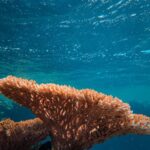
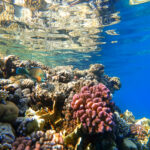
Because coral is an animal covered by a very thin living tissue, laid over its limestone skeleton. NOAA describes this tissue as delicate and easily damaged by touch. GBRMPA, the authority of the Great Barrier Reef Marine Park, specifies that physical contact can lead to disease and death of the coral.
The risk lies less in the force of a single gesture than in its repetition at a site frequented by many divers.
Think about the area most often touched. It is often the top of a coral head, the one that surfaces near the mooring or entry point, where dive groups stop to balance themselves before moving on. But a tissue injury is not always visible. GBRMPA specifically links contact to disease, and a scraped area remains an entry point. Animals resting on the seabed are in the same situation.
The cassiopea, this upside-down jellyfish living on the sand, is a good example. On reefs already affected by coral bleaching, every colony that remains healthy counts more (this is our opinion, and we stand by it).
What happens when you touch a fish?
You rub off the mucus layer covering its skin. This mucus serves as a barrier against microbes and parasites, and a hand or glove can remove part of it. NOAA adds that an animal cornered or surprised may react with a stress response.
The fish swims away without showing any sign, and that is precisely the problem.
Yet many travel photos show a turtle being stroked or a fish held in the palm. These images give the impression of a harmless gesture because the animal swims away and no one sees what happens next on its skin or in its behavior. GBRMPA asks to keep distance from wildlife. It also asks not to feed or chase them, as these actions disrupt natural behaviors. Feeding a fish to lure it in front of the camera falls into the same category. A photo is not worth this disturbance.
Operator pages selling an “interaction” with wildlife, often without explaining how it happens, raise the same question. You can ask the club how the approach is conducted and at what distance the guide keeps the group before booking.
Which marine animals can injure you if you touch them?
Several common reef animals carry venom or stinging cells. The stonefish and lionfish sting with the spines of their fins, and the blue-ringed octopus bites to inject a toxin that can be fatal, even when the bite hurts little. The fire coral, which is not a true coral, burns the skin at the slightest touch.
| Animal | Risk on contact | To remember |
|---|---|---|
| Stonefish | Sting from dorsal spines | Blends in with rock |
| Lionfish | Sting from fin spines | Does not always flee, keep your distance |
| Blue-ringed octopus | Venomous bite | Medical emergency |
| Fire coral | Stinging burn | Hydroid, despite its name |
| Pufferfish | Low risk to touch | Toxin dangerous mainly if eaten |
The stonefish poses a particular problem. It blends in with the rock, so a hand placed “to stabilize yourself” can fall on it without you having seen it. However, the previous version of this article mixed very different risks. The pufferfish, for example, is mainly dangerous when eaten, as its toxin is concentrated in certain organs. Touching it stresses it out. As for nudibranchs, most do not sting, but some species retain the stinging cells of the prey they eat.
If you are stung or bitten, immediately notify your guide.
For jellyfish, we detailed the actions that relieve in our article what to do in case of a jellyfish sting. A bite from a blue-ringed octopus or a sting from a stonefish requires urgent medical care, regardless of the initial pain felt.
What do the rules say in marine protected areas?
They vary from one site to another. At Flower Garden Banks, NOAA indicates that removing anything is against the sanctuary regulations, except for line fishing, and that any physical contact with rays and whale sharks is prohibited. On the Great Barrier Reef, the GBRMPA divides the park into zones with different rules.
Thus, a free activity in one zone may require a permit in the neighboring zone. The GBRMPA advises checking what is allowed in your zone, using its Eye on the Reef app for example. Anchoring follows the same logic. NOAA prohibits anchoring at Flower Garden Banks and reminds that an anchor can destroy decades, even centuries, of coral growth in an instant. In the French Mediterranean, the Port-Cros National Park publishes its own regulations for its marine areas. These evolve, so we do not reproduce them here.
For your next site, impossible to decide from here: read the park regulations and listen to the briefing, which should cover it.
A briefing that says nothing about local rules deserves a question. You won’t bother anyone by asking it.
How to adjust your buoyancy to avoid touching anything?
By working on your weighting and position before approaching the reef. NOAA asks to keep control of your buoyancy and to float just above the reef, without resting on it. It also advises avoiding resting on the sand, except in emergencies, because animals live there too.
However, in the hypothetical scene at the beginning, the hand moves to catch a loss of balance. Too heavy, your weighting pulls you down. An overinflated vest makes you rise, and you compensate by kicking downward, which stirs up the sand and brings your fins closer to the corals. If you are a beginner, ask the club for a weighting check before the first dive. A stabilization exercise, supervised and above a sand area chosen by the guide, takes a few minutes.
Also keep your accessories close to your body, because a console, an octopus, or a flashlight hanging at the end of its carabiner rubs the bottom without you feeling it, especially when you turn to look at your dive group.
To understand what you are protecting, our complete guide on coral explains how these animals live. Contact remains one impact among others, and the article on sunscreen and the seabed deals with another everyday action. The real cost of a good adjustment is just a few minutes at the surface.
FAQ
Is it serious to touch coral just once?
The GBRMPA indicates that physical contact can lead to disease and death of coral. A single gesture does not always have a visible effect, but it adds to those of other divers. The simplest is not to touch at all.
Can you collect shells in a marine protected area?
Often no. At Flower Garden Banks, NOAA indicates that removing anything is against the regulations, and the GBRMPA asks to limit yourself to photos. Elsewhere, check the local regulations before you go.
What to do if I accidentally touch an animal?
Move away gently without kicking downward, then stabilize yourself. If you feel a burning or pain, notify your guide and follow the onboard procedure. A stonefish sting or a blue-ringed octopus bite requires urgent medical care.
Can you feed fish to photograph them?
The GBRMPA asks not to feed wildlife, as it alters their natural behaviors. A fish used to being fed may come back to divers’ hands. Keep your distance and let the animal decide.
Sources
- Reef Etiquette (NOAA, Flower Garden Banks National Marine Sanctuary, accessed in 2026)
- Responsible Reef Practices (Great Barrier Reef Marine Park Authority, 2025)
{“@context”:”https://schema.org”,”@type”:”FAQPage”,”mainEntity”:[{“@type”:”Question”,”name”:”Est-ce grave de toucher un corail une seule fois ?”,”acceptedAnswer”:{“@type”:”Answer”,”text”:”Le GBRMPA indique que le contact physique peut conduire à la maladie et à la mort du corail. Un seul geste n’a pas toujours un effet visible, mais il s’ajoute à ceux des autres plongeurs. Le plus simple reste de ne pas toucher du tout.”}},{“@type”:”Question”,”name”:”Peut-on ramasser des coquillages dans une aire marine protégée ?”,”acceptedAnswer”:{“@type”:”Answer”,”text”:”Souvent non. À Flower Garden Banks, la NOAA indique que prélever quoi que ce soit est contraire au règlement, et le GBRMPA demande de se limiter aux photos. Ailleurs, vérifie le règlement local avant de partir.”}},{“@type”:”Question”,”name”:”Que faire si je touche un animal par accident ?”,”acceptedAnswer”:{“@type”:”Answer”,”text”:”Écarte-toi doucement sans palmer vers le fond, puis stabilise-toi. Si tu sens une brûlure ou une douleur, préviens ton guide et suis la procédure de bord. Une piqûre de poisson-pierre ou une morsure de poulpe à anneaux bleus demande une prise en charge médicale urgente.”}},{“@type”:”Question”,”name”:”Peut-on nourrir les poissons pour les photographier ?”,”acceptedAnswer”:{“@type”:”Answer”,”text”:”Le GBRMPA demande de ne pas nourrir la faune, car cela modifie ses comportements naturels. Un poisson habitué à être nourri peut revenir vers les mains des plongeurs. Garde ta distance et laisse l’animal décider.”}}]}