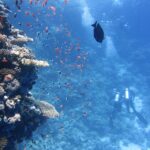
On April 15, 2024, NOAA confirmed a fourth global coral bleaching event, the second in ten years. Surveys covered the Atlantic, Pacific, and Indian Oceans, from Florida to the Red Sea, including the Great Barrier Reef and French Polynesia.
For a diver, these reports have a very concrete meaning. A pale reef. A bare gorgonian.
This guide sorts out what you can actually notice while diving, what requires measurements, and what the previous version of this page claimed without evidence.
What sign of warming do we see first on a reef?
On a tropical reef, the most visible sign remains bleaching. When the water stays too warm for too long, the coral loses the color given by the algae living in its tissues and reveals its white skeleton. NOAA monitors this thermal stress by satellite with its Coral Reef Watch program.
A white coral is not necessarily dead. In its April 2024 statement, NOAA reminds that if the stress causing bleaching decreases, corals can recover and the reef continues to provide services to the populations depending on it. If the heat persists, the risk of mortality rises. On site, you don’t know how long the colony has been suffering. A dated and localized photo is therefore worth more than a visual diagnosis, and you will find the coral bleaching mechanism detailed in our dedicated file.
Bright white sounds the alarm, without delivering a verdict at this stage.
But no region is safe. Even the Red Sea is on NOAA’s list, although its corals are studied for their resistance to climate change. Derek Manzello, coordinator of Coral Reef Watch, sums up the trend in one sentence: as oceans warm, bleaching becomes more frequent and severe.
What do Mediterranean gorgonians show after a heatwave?
In the Mediterranean, the first witnesses are sessile species like gorgonians, sponges, or red coral. A study published in 2022 in Global Change Biology recorded massive mortalities for five consecutive years, from 2015 to 2019, linked to marine heatwaves.
The work coordinated by Joaquim Garrabou brings together 33 research teams from 11 countries. It describes episodes affecting 50 taxa across 8 phyla, over thousands of kilometers of coastline. Among the cited species are the red gorgonian Paramuricea clavata, gorgonians of the genus Eunicella, red coral, the sponge Spongia officinalis, and Posidonia. The authors find a statistical link with heat. It explains why biologists closely monitor gorgonian walls, these walls covered with fans that so many divers come to photograph every summer.
These episodes are not new.
Thus, the study recalls that the most significant events had already struck the northwest Mediterranean in 1999 and 2003, with more than 40 species affected over thousands of kilometers of coastline. The novelty lies in the repetition. Five summers in a row, without a real break for populations to recover.
At what depth were these mortalities observed?
According to the 2022 study, mortalities were recorded from the surface down to 45 meters. The authors describe the range between 15 and 25 meters as the most affected. This is the depth of many recreational dives, placing divers in the front row to see the damage early.
Temperature, on the other hand, can be measured.
The study teams placed recorders along rocky walls, generally every 5 meters from the surface down to 40 meters, and these series feed the collaborative T-MEDNet database. Your computer also displays a temperature. It remains indicative (depending on the sensor and its position on your arm) and a single value says nothing about a heatwave. However, noted at each dive with location, date, and depth, it eventually draws a personal history that makes sense. This reading takes ten seconds upon exiting the water.
Be careful not to mix everything up. Warm and clear water can give a feeling of comfort, without saying anything about the current, your air consumption, or your margin for ascent. That is judged during the briefing.
Oxygen, new species: what can we really say?
Warmer water holds less dissolved oxygen, that’s basic physics. Yet the previous version of this article announced a 36% loss by 2100 without citing any study, and we found no trace of this figure in any of the sources consulted. So we removed it.
The same caution applies to species distribution. Tropical fish moving into temperate waters or more jellyfish on certain coasts—these observations circulate widely. However, nothing allows, from a single dive, to attribute an encounter to warming. An unusual species can arrive with a temporary current or in the ballast waters of a ship. Impossible to decide from here, and that is precisely why dated reports matter.
However, we removed the account of a group of divers who supposedly saw a colony of red gorgonians die in the Red Sea in 2022, because Paramuricea clavata is a Mediterranean species and we found no trace of this episode.
In short, fewer spectacular numbers. More verifiable facts.
How to make your observations useful to scientists?
What you see only has value if it is properly noted: date, site, depth, temperature read, and photo. Monitoring networks like T-MEDNet in the Mediterranean, or the Coral Reef Watch reporting form for tropical reefs, show that field surveys complement what satellites see.
The role of citizen divers starts there, well before any spectacular campaign. Before photographing a damaged colony, stabilize your buoyancy and keep enough distance so your fins don’t touch anything, even when framing close. A fin strike on an already weakened gorgonian helps no one. The rules for observing without disturbing marine life apply doubly on a site stressed by heat. Better a somewhat distant photo than contact.
And let’s be frank about the rest.
Picking up trash during a clean-up dive or limiting plastic pollution doesn’t cool the water, but removes other pressures that add to heat on already fragile reefs. The cost for you remains modest: five minutes after each dive to fill in your logbook.
FAQ
Is a white coral a dead coral?
Not necessarily. NOAA reminds that bleached corals can recover if thermal stress decreases. If it persists, mortality becomes more likely, and only monitoring over time can tell.
Is the temperature displayed by my dive computer enough to detect a heatwave?
No. It remains indicative and a single value says nothing about a heat episode. Noted at each dive with date, site, and depth, it becomes a useful history.
At what depth have Mediterranean gorgonians been affected?
The study published in 2022 in Global Change Biology reports mortalities from the surface down to 45 meters. The range between 15 and 25 meters appears as the most affected during the period 2015 to 2019.
What should I do if I see a bleached reef during a dive?
Keep your distance and buoyancy, then take a photo if you can do so without contact. Note the date, site, depth, and temperature read. You can then submit the observation to a monitoring network like Coral Reef Watch.
Sources
- NOAA confirms 4th global coral bleaching event (NOAA, 2024)
- Marine heatwaves drive recurrent mass mortalities in the Mediterranean Sea (Joaquim Garrabou et al., Global Change Biology, 2022)