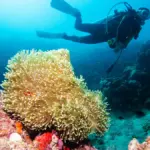
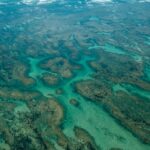
Summer 2024, Gulf of Aqaba. Surface water rises to 32.6 °C, 3.4 °C above normal, during a marine heatwave lasting 113 days. This is the highest thermal stress measured on the planet that year, according to Maoz Fine’s team at the Hebrew University of Jerusalem.
Elsewhere, such an episode would have killed a large part of the reef. There, most of the monitored colonies held on.
We revisited this article because the previous version described the Red Sea corals as an invincible block. The data from 2023 to 2026 tell a more nuanced story. The north holds, the center and south suffered, and even the refuge shows its first cracks.
Where does the idea that Red Sea corals resist heat come from?
It comes from a 2013 study by Maoz Fine, Hezi Gildor, and Amatzia Genin in Global Change Biology. The authors describe the Gulf of Aqaba, at the very north of the Red Sea, as a possible refuge for corals against warming, with an exceptionally high bleaching threshold.
Their explanation is based on geography. Coral larvae entered the Red Sea through the Bab el-Mandeb Strait, in the south, where the water is warm. Only genotypes capable of withstanding this heat would have passed this filter over millennia. The cooler north thus offers them a comfortable thermal margin. Their tolerance threshold far exceeds the usual summer temperatures they experience. Hence the term refuge.
And the study went far in its projection.
It estimated that this offset could delay bleaching in the gulf by at least a century. This is a hypothesis, built on aquarium experiments and oceanographic modeling. Nothing guaranteed.
What did the marine heatwaves from 2021 to 2024 in the Gulf of Aqaba show?
They broadly confirmed the hypothesis, with a caveat. Na’ama-Rose Kochman and Maoz Fine monitored several species during four consecutive summers of heatwaves, from 2021 to 2024. Their study was published in 2025 in Science of the Total Environment. It shows that most corals remained without massive bleaching.
The two species at the center of the monitoring are Stylophora pistillata and Pocillopora damicornis, two branching corals. The team also followed Seriatopora, Porites, and Cyphastrea. Porites remained metabolically stable. Cyphastrea, more sensitive, lost about 55% of their symbiotic algae at the peak heat of summer 2024, before recovering in January 2025, according to the published monitoring.
But the authors also write that bleaching now appears in shallow waters, a sign that this refuge might be nearing its limit.
The Mongabay report published in April 2025 gives a scale on the Israeli side. About 5% of the corals in the monitored area bleached in summer 2024, and most regained color during cooler months. Few, then. Except that it was the first time these supposedly invincible corals bleached in a documented way. Maoz Fine sums up the situation in one sentence: such conditions would have caused total death of any other reef.
Did the rest of the Red Sea bleach in 2023 and 2024?
Yes, and sometimes heavily. The Red Sea stretches over more than 2,000 km, and the tolerance measured in the Gulf of Aqaba does not apply along its entire length. The warmer center and south suffered starting in 2023.
On the Egyptian side, the NGO HEPCA monitored bleaching from summer 2023 starting in June, after a NOAA alert. Its report, released by the ICRI in 2024, describes a clear gradient. Little impact north of Quseir, with increasing intensity toward the south, with the highest rates around Wadi El-Gimal and Lahmi Bay, south of Marsa Alam. About 45 days later, nearly 72% of bleached colonies showed signs of recovery. The rest, just under 28%, were dead.
Yet the worst came a year later, further south.
Near Thuwal, Saudi Arabia, Natalie Dunn and Francesca Benzoni’s team monitored a series of reefs in the central Red Sea in 2024. The article, published in Climate Change Ecology (November 2026 issue), reports 88% of coral cover affected by bleaching. Between August 2024 and January-February 2025, live coral cover dropped from about 20% to 7%.
| Area | Period | Observed | Source |
|---|---|---|---|
| Gulf of Aqaba (Israeli side) | Summers 2021 to 2024 | No massive bleaching, peak at 32.6 °C in 2024, localized bleaching in shallow water | Kochman and Fine, 2025 |
| Egyptian coast, south of Quseir | Summer 2023 | Increasing bleaching toward the south, about 72% of bleached colonies recovering 45 days later | HEPCA, report released by ICRI, 2024 |
| Central Red Sea, Thuwal | 2024 to early 2025 | 88% of cover affected, live coral cover dropped from 20% to 7% | Dunn, Benzoni et al., 2026 |
Thus, the same branching species that hold in Eilat have almost disappeared in Thuwal. Pocillopora there lost 98% of their cover, and Acropora disappeared from monitored reefs. Massive Porites fared better, with a 30% decline. Genus matters less than latitude and the thermal history of the population.
Why talk about refuge rather than resistance?
Because the tolerance of these corals is a margin, and a margin is consumed. Gulf of Aqaba corals withstand temperatures that would bleach other populations. But each hotter summer reduces the gap between what they endure and what they can withstand, and the 2025 authors already see this gap narrowing.
The previous version of this article cited figures not found in the literature, such as tolerance 5 °C above average or 8,000 types of protective bacteria. These were removed. It also presented these corals as a gene bank ready to repopulate the Great Barrier Reef. Yet none of the studies cited here demonstrate this. Great Barrier Reef corals live under different light, salinity, and current conditions, and the subject remains debated (for Australian context, see our article on the Great Barrier Reef in Australia).
Climate is not the only pressure.
In the Mongabay report, Assaf Zvuloni from the Israeli Nature and Parks Authority emphasizes reducing local pollution. A reef already weakened by other local pressures will have less reserve when heat arrives. However, the gulf is shared by four countries: Egypt, Israel, Jordan, and Saudi Arabia. Coordinated management remains the forgotten condition of this whole refuge story. To understand what happens in coral tissue when it bleaches, our article on coral bleaching details the mechanism.
What changes if you dive in the Red Sea
It mainly changes your reading of promises. A reef described as “resistant” in a brochure may have bleached the previous summer, depending on its latitude. The north of the Gulf of Aqaba and southern Egypt did not experience the same summers, and no operator page will tell you the state of a specific reef at a specific date.
We have a firm opinion on this. A photo of vibrant coral dates nothing, nor does it say whether the site was affected in 2023 or 2024. If the reef’s condition matters to you, ask the center before booking and request dated observations. Impossible to decide from here for a given site. Our page on diving holidays in Egypt can help you locate the major areas.
In short, a resistant coral remains a fragile coral on contact.
And on site, behavior does not change with latitude. Keep your fins and hands at a distance, stabilize yourself before approaching, and avoid resting on the bottom. The reasons are detailed in our article on why you should never touch marine life. Regarding sunscreen, the scientific debate is more nuanced than often read, and we summarized it in our overview on sunscreen and marine environments. The cost for you remains modest: some practiced buoyancy and a few minutes of questions before paying.
FAQ
Do Red Sea corals really resist warming?
Those in the Gulf of Aqaba, in the north, have a heat tolerance significantly higher than average, according to Fine et al. (2013) and Kochman and Fine (2025). Those in the center and south suffered severe bleaching in 2023 and 2024. So we cannot speak of the entire Red Sea as a single block.
Have Gulf of Aqaba corals bleached before?
Yes, occasionally. In summer 2024, about 5% of monitored corals on the Israeli side bleached according to Mongabay, and most recovered. Kochman and Fine reported bleaching in shallow water in 2025 and estimate the refuge might be nearing its limit.
Could these corals save the Great Barrier Reef?
None of the studies cited here show this. Light, salinity, and current conditions differ greatly from one ocean to another. The subject remains open in research.
Does diving in the Red Sea damage these corals?
Direct contact with fins, hands, or equipment damages coral tissue, regardless of heat tolerance. Good buoyancy and constant distance reduce this risk. Climate remains the main threat, but a reef less stressed locally retains more reserve.
Sources
- Gulf of Aqaba as a thermal refuge: Insights from four years of intensifying marine heatwaves (Kochman and Fine, Science of the Total Environment, 2025)
- Extensive coral bleaching and mortality in the central Red Sea during the fourth global coral bleaching event (Dunn, Benzoni et al., Climate Change Ecology, 2026)