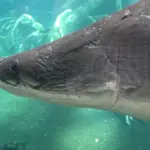
5.02 meters. That is the length of the largest Greenland shark examined by Julius Nielsen’s team. Their study, published in Science in 2016, attributes to it an age of 392 years, with a margin of error of 120 years.
These kinds of figures spread quickly, often rounded and stripped of their margin of error. The previous version of this page announced an 11,000-year-old sponge at 300 meters and a 500-year-old red coral at 800 meters depth. The first figure is a debated estimate, based on a specimen brought up from much deeper. The second is not supported by any study that we could find.
So we revisit the ranking by separating two things that lists often mix: measured age, counted on a dated archive, and estimated age, calculated from a model.
Which marine animal lives the longest?
If we stick to measured ages, the record goes to a black coral of the genus Leiopathes, dated to 4,265 years by radiocarbon off Hawaii by Brendan Roark and his team (PNAS, 2009). Among solitary animals, the title goes to an Icelandic clam nicknamed Ming, with 507 years counted on its shell. The Greenland shark dominates vertebrates, based on an estimate.
| Species | Announced Age | Method | Status | Study |
|---|---|---|---|---|
| Monorhaphis chuni Sponge | about 11,000 years | Growth model of the spicule | Estimated, debated | Jochum et al., 2012 |
| Black coral Leiopathes sp. | 4,265 years | Radiocarbon of the skeleton | Measured | Roark et al., PNAS, 2009 |
| Clam Arctica islandica “Ming” | 507 years | Annual shell growth lines, cross-checked | Measured | Butler et al., 2013 |
| Greenland shark | 392 ± 120 years (272 to 512) | Radiocarbon of the lens and growth curve | Estimated | Nielsen et al., Science, 2016 |
| Bowhead whale | about 211 years | Aspartic acid racemization in the eye | Estimated | George et al., 1999 |
| Spiny-eye rockfish | 205 years | Otolith reading | Estimated | Cailliet et al., 2001 |
| Green sea turtle | 70 years or more | Unknown, NOAA estimate | Estimated | NOAA Fisheries |
Deep siliceous sponges go further on paper. A specimen of Monorhaphis chuni, brought up from more than 1,000 meters depth in the East China Sea, was estimated at about 11,000 years by Klaus Peter Jochum’s team in 2012. This figure comes from a growth model of its giant spicule. No one has counted 11,000 rings. And other specimens of the same species, presented by the journal Eos in 2018, range from 5,000 to 18,000 years depending on the individual.
The Mediterranean red coral, meanwhile, is off the list.
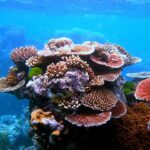
We found no publication giving it an age of 500 years. Black coral colonies, on the other hand, have their detailed profile on the black coral and its very slow growth, with rates measured by Roark from 4 to 35 micrometers per year. Other records of slowness are gathered in our 10 things to know about corals.
Greenland shark: where does the figure of 392 years come from?
It comes from the eye. The core of the lens forms before birth and does not renew, so its carbon-14 retains the trace of the birth year. By dating 28 females, Nielsen and colleagues obtained a lifespan of at least 272 years, and 392 ± 120 years for the largest.
Yet, 392 years remains an estimate. For the oldest sharks, radiocarbon alone is not enough, so the team combined it with a curve linking size to age, calibrated on the carbon-14 peak left by nuclear tests in the 1950s and 1960s. The result: a range of 272 to 512 years for the 5.02-meter female. The midpoint of the range made the headlines, while the lower bound counts just as much. It is already enough to place the species ahead of all other known vertebrates.
Another figure from the study: sexual maturity of females would occur at the earliest around 156 years, with a margin of 22 years.
A species this slow poorly tolerates any added mortality. Its slow swimming and life in the cold North Atlantic also earn it a place among the strangest sharks in the world.
Ming, the 507-year-old clam: why is its age more solid?
Because it was counted. Arctica islandica deposits one growth ring per year on its shell, like tree rings. Paul Butler’s team at Bangor University recounted these rings and cross-checked them with other shells and radiocarbon dating, arriving at 507 years in a study published in 2013.
The animal was brought up alive in 2006 from the northern Icelandic shelf, along with about 200 other clams intended for climate research. It died on board, frozen for transport like the rest of the batch. So no accident. The first count, in 2007, gave 405 years. But the rings at the edge were so close together that they could no longer be separated, hence the century discrepancy later corrected.
Born around 1499, Ming was in his twenties when Magellan left Spain.
Butler and his co-authors present it as the oldest non-colonial animal whose age at death can be determined precisely. In short, the best-established figure on this list for a solitary animal.
Bowhead whale, rockfish, turtle: how reliable are the other records?
These are estimates, more or less solid. The bowhead whale owes its 211 years to a chemical analysis of the eye published in 1999. The spiny eye rockfish is credited with 205 years by reading its otoliths. For the green turtle, NOAA remains cautious: lifespan unknown, estimated at 70 years or more.
For the whale, J. Craig George and colleagues measured the racemization of aspartic acid in the lens, a slow chemical transformation that progresses with age. One male came out at 211 years. Three others exceeded 100 years. The AnAge database notes that these records may be overestimated. And old harpoon tips, made of stone or metal, found in whales hunted in the 1980s and 1990s, support a very long life without giving a precise age.
The rockfish is dated by the rings in its otoliths, those small calcified stones of the inner ear.
Thus, marine turtles close the list of quantified records. According to NOAA, female green turtles only reach maturity between 25 and 35 years. A reliable maximum age is still lacking.
Is the jellyfish Turritopsis really immortal?
Not in the usual sense of the word. Turritopsis dohrnii can, under stress or aging, transform its jellyfish back into a polyp and then start a new cycle. Stefano Piraino and colleagues described this reversal in the laboratory, in a study published in 1996 in the Biological Bulletin. However, no individual has a known age.
The mechanism has a name. Transdifferentiation: specialized cells change function and reform the tissues of a polyp, which then produces new jellyfish. But nothing proves that this cycle repeats indefinitely in nature, where a small jellyfish of a few millimeters mainly serves as prey for other plankton animals. The nickname “immortal jellyfish” promises more than the studies. Caution, therefore.
Due to the lack of known age, it does not appear in the table.
The complete cycle of the group, from larva to polyp then to jellyfish, is explained in our dossier on the jellyfish and its life cycle.
Why do these species live so long, and what threatens them?
Almost all live in cold or deep water and grow very slowly. This link is observed without a single explanation: slowed metabolism due to cold is the most cited hypothesis, but it fits poorly with a colonial coral that continuously renews its polyps.
However, this slowness comes at a price. A colony of Leiopathes that grows a few micrometers per year takes centuries to recover after trawling. Roark’s study lists deep trawling and coral trade among the threats to these communities. The same logic applies to a shark that reproduces after 150 years. For a recreational diver, the practical rule remains simple: do not touch corals or sponges you encounter, even if they seem indestructible, as explained on our page about why you should never touch marine life.
Longevity also involves other strategies, described in our 10 extraordinary defense mechanisms in marine animals.
Ultimately, a longevity record mainly indicates how long it takes to repair a loss.
FAQ
What is the longest-living marine animal?
The measured record belongs to a black coral Leiopathes, dated to 4,265 years by radiocarbon (Roark et al., PNAS, 2009). Monorhaphis chuni sponges are estimated to be about 11,000 years old, but by a growth model. Among solitary animals, the Ming clam reached 507 years.
How long does a Greenland shark live?
At least 272 years, according to Nielsen et al. (Science, 2016). The largest female studied, measuring 5.02 meters, was estimated to be 392 years old with a margin of 120 years, giving a range of 272 to 512 years.
Can the immortal jellyfish live forever?
Turritopsis dohrnii can revert to the polyp stage and restart its cycle, which was described in the laboratory in 1996. There is no indication that an individual escapes predators or diseases. No record age is attributed to it.
Which mammal lives the longest?
The bowhead whale. A male was estimated to be 211 years old by racemization of aspartic acid in the lens (George et al., 1999). The estimate is indirect and may be overestimated, but several indicators confirm lifespans beyond a century.
Sources
- Eye lens radiocarbon reveals centuries of longevity in Greenland shark (Somniosus microcephalus) (Nielsen et al., Science, deposited by the University of Oxford, 2016)
- Extreme longevity in proteinaceous deep-sea corals (Roark et al., PNAS, deposited by the Australian National University, 2009)
{“@context”:”https://schema.org”,”@type”:”FAQPage”,”mainEntity”:[{“@type”:”Question”,”name”:”Quel est l’animal marin qui vit le plus longtemps ?”,”acceptedAnswer”:{“@type”:”Answer”,”text”:”Le record mesuré revient à un corail noir Leiopathes, daté à 4 265 ans par radiocarbone (Roark et al., PNAS, 2009). Des éponges Monorhaphis chuni sont estimées à environ 11 000 ans, mais par un modèle de croissance. Chez les animaux solitaires, la praire Ming a atteint 507 ans.”}},{“@type”:”Question”,”name”:”Combien de temps vit un requin du Groenland ?”,”acceptedAnswer”:{“@type”:”Answer”,”text”:”Au moins 272 ans, d’après Nielsen et al. (Science, 2016). La plus grande femelle étudiée, longue de 5,02 mètres, a été estimée à 392 ans avec une marge de 120 ans, soit une fourchette de 272 à 512 ans.”}},{“@type”:”Question”,”name”:”La méduse immortelle peut-elle vivre éternellement ?”,”acceptedAnswer”:{“@type”:”Answer”,”text”:”Turritopsis dohrnii peut revenir au stade polype et recommencer son cycle, ce qui a été décrit en laboratoire en 1996. Rien n’indique qu’un individu échappe aux prédateurs ou aux maladies. Aucun âge record ne lui est attribué.”}},{“@type”:”Question”,”name”:”Quel mammifère vit le plus longtemps ?”,”acceptedAnswer”:{“@type”:”Answer”,”text”:”La baleine boréale. Un mâle a été estimé à 211 ans par racémisation de l’acide aspartique du cristallin (George et al., 1999). L’estimation est indirecte et peut-être surévaluée, mais plusieurs indices confirment des vies au-delà d’un siècle.”}}]}