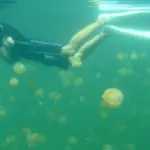
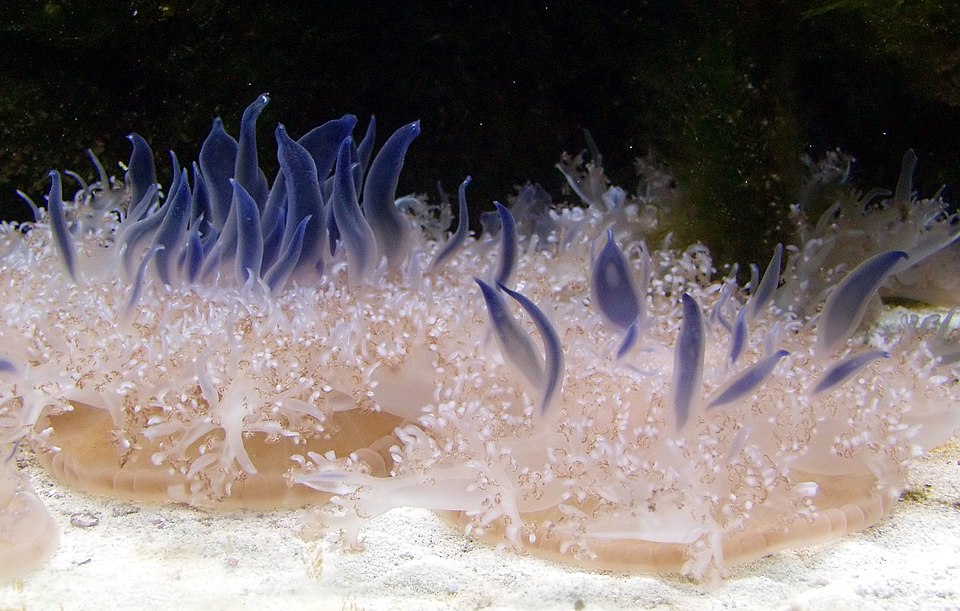
In December 2023, researchers counted between 80 and 100 jellyfish per square meter in the Aguadulce marina, near Almería, Spain. Every one of them was lying on the mud. Bell against the bottom, arms pointing at the sky.
These jellyfish belong to the genus Cassiopea, better known as the upside-down jellyfish. The nickname sums up their lifestyle pretty well.
This page sticks to that one genus: its partnership with algae, the mucus that stings at a distance, where it lives, and how it recently reached the Spanish coast.
Why does Cassiopea live upside down?
Cassiopea rests bell-down on the seafloor with its oral arms facing the surface because its tissues host microscopic algae called zooxanthellae. These algae photosynthesize. The more light they get, the more sugars they make, and part of those sugars feeds the jellyfish.
Reef-building corals work on the same principle, since they also live with zooxanthellae. The jellyfish provides a well-lit home. The algae pay rent in food. Cassiopea still catches plankton with its stinging cells, though. It also pulses its bell nonstop at a slow pace, and those pulses move water around it, which brings particles toward its arms.
In short, the posture is a solar panel, not a quirk.
Light drives almost everything else, too. That is why you find it in clear, shallow water where sunlight reaches the bottom all day. Its color varies from one animal to the next. In 2017, a Caltech team even described a nighttime resting state in Cassiopea that looks a lot like sleep.
Can Cassiopea sting you without being touched?
Yes. In 2020, a team led by biologist Cheryl Ames showed that Cassiopea xamachana releases mucus into the water packed with tiny stinging balls they named cassiosomes. That mucus explains the itching snorkelers reported in mangroves without ever touching a jellyfish.
Cassiosomes measure 100 to 550 micrometers. Their surface carries stinging cells, the nematocysts, plus cilia that let them move. At the center sit cells holding the same algae as the jellyfish. In the lab, these little masses killed brine shrimp larvae on contact. The researchers found them in five species of rhizostome jellyfish, the group Cassiopea belongs to, but not in the moon jellyfish they examined.
So the “stinging water” divers talk about has an explanation.
How bad is the sting? Pages copied from one another still claim it is often painless. The 2025 Spanish study instead ranks it among moderately stinging species, and your reaction depends on how much skin is exposed and how much mucus gets stirred up around you. This article is for information only and does not replace advice from a doctor trained in diving medicine. For first aid, see our roundup of remedies that relieve a jellyfish sting. And if you want to see how other sea creatures use stings, spines and toxins, read about defense mechanisms in marine animals.
| Cassiopea at a glance | What the research says |
|---|---|
| Common name | Upside-down jellyfish |
| Food source | Sugars from zooxanthellae, plus plankton caught with stinging cells |
| Stinging mucus | Cassiosomes of 100 to 550 micrometers (Ames et al., 2020) |
| Sting strength | Moderately stinging (Marambio et al., 2025) |
| Habitat | Warm, shallow, well-lit water: mangroves, lagoons, seagrass beds, sand or mud bottoms |
| Bell diameter at Almería | 4 to 30 cm |
| Density at Aguadulce marina | 80 to 100 per square meter (December 2023) |
| Mediterranean status | C. andromeda is non-native, first reported in Cyprus in 1903 |
Where does Cassiopea live: mangroves, lagoons and seagrass beds?
Cassiopea lives in warm, shallow, well-lit water: mangroves, lagoons, seagrass beds, sand or mud bottoms. You find it in tropical and subtropical areas from the Red Sea to the Caribbean, where it stays on the bottom, often in tight groups, sometimes dozens across a few square meters.
Harbors and marinas suit it as well. The water is calm and the bottom is often muddy. In the Aguadulce marina, researchers found the jellyfish mostly on the muddy central area, almost never on the rock walls lining the basin. For an observer, that changes the expected scenery. You look for it less on a pretty coral head than on a flat, rather dull bottom where nothing seems to move at first glance.
A featureless bottom can hide dozens of them.
One note on method while we are here. Mangroves and lagoons often have murky or milky water, and murky water tells you nothing about the tide or the current. Good visibility does not make a site any safer either.
Is Cassiopea andromeda invasive in the Mediterranean?
Yes, Cassiopea andromeda is a non-native species in the Mediterranean. Native to the Red Sea and the Indo-Pacific, it came through the Suez Canal, opened in 1869, and was reported in Cyprus as early as 1903. It then settled across much of the eastern basin.
For more than a century it stayed in the east, from Israel to Greece by way of Turkey and Egypt. Then sightings came in from Malta, Sicily and northern Tunisia. In March 2021, volunteer observers spotted it at Aguadulce. That is the westernmost record of the species in the Mediterranean, confirmed by genetic analysis, and the bells measured 4 to 30 centimeters across.
People hoped Spanish winters would hold it back.
They did not. The Almería population made it through every season during fifteen months of monitoring, with water measured around 14 °C in February 2024. Animals of all sizes lived side by side. A sign the species breeds on site. Its life cycle helps: the polyp attached to the bottom releases young jellyfish called ephyrae and can also multiply by budding, so a small colony of polyps is enough to restart a population. For background on why some jellyfish boom, read our piece on jellyfish invasions, their causes and consequences.
How can you watch Cassiopea while snorkeling without disturbing it?
When snorkeling, watch Cassiopea from the surface, without standing up or finning right above it. It lives in shallow, muddy areas, a single kick lifts sediment along with the mucus, and a rash guard or thin wetsuit limits skin contact with that mucus.
Nothing guarantees you will see one on a given date.
The real trap is the shallow depth. You can touch bottom, so you stand up, put your fins down, and a group of jellyfish ends up underneath. Keep steady buoyancy at the surface, hands close to your body. If a dive center or guide runs the trip, ask at the briefing where the areas to avoid are and when the tide turns. In a mangrove, that question makes the difference.
In the Mediterranean, the best view is often from a dock, never by swimming in a harbor open to boat traffic. If you spot one, photograph it with the place and date, then send the report to a citizen science program. That kind of report is what led to the detection of the Almería population. Do not pick it up or move it.
These precautions cost little: a rash guard in your bag and a few extra minutes to swim around the groups.
FAQ
Is the Cassiopea jellyfish dangerous to humans?
It is not ranked among the most dangerous jellyfish, but it does sting. Its mucus contains stinging cassiosomes that can irritate your skin without direct contact with the jellyfish. If you have a strong reaction, see a doctor.
Why is Cassiopea called the upside-down jellyfish?
It rests bell-down on the bottom with its arms facing the surface. This posture exposes the algae living in its tissues to light. Those algae supply part of its food through photosynthesis.
Can you see Cassiopea in Europe?
Cassiopea andromeda lives in the eastern Mediterranean and has been reported in Malta and Sicily. The 2025 study cited below places the westernmost record at Almería, Spain, and does not mention France. If you see one, note the place and date and report it.
Where can you see Cassiopea while snorkeling?
It lives in shallow mangroves, lagoons and seagrass beds in tropical areas, from the Red Sea to the Caribbean. Nothing guarantees a sighting on a given date. Stay at the surface and do not fin above the groups.
Sources
- Cassiosomes are stinging-cell structures in the mucus of the upside-down jellyfish Cassiopea xamachana (Ames et al., Communications Biology, 2020)
- The Westernmost Record of the Scyphomedusa Cassiopea andromeda (Forskål, 1775) in the Mediterranean: Marine Citizen Science Contributions to Invasive Species Detection and Monitoring (Marambio et al., Environmental Management, 2025)