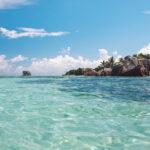
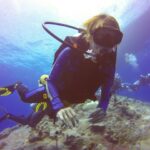
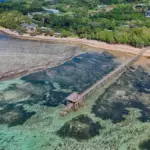
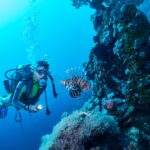
Along the coastal road of Bonaire, stones painted yellow mark the entrance to dive sites. STINAPA, the foundation that manages the national marine park, lists 88 marked sites between the west coast and Klein Bonaire.
This shore diving, done independently, has made the island famous. Our old page sold it with figures never sourced (water “around 28 °C all year,” more than 30 meters of visibility, an island “outside the cyclone zone”).
We have updated it with texts from STINAPA, the Dutch meteorological institute (KNMI), and European and Dutch authorities. What remains is based on dated facts.
How does shore diving work on Bonaire’s west coast?
You rent a vehicle, load your tanks, stop in front of a yellow stone, and enter the water from the shore. The west coast is sheltered from the trade winds, and the fringing reef starts close to the shore. STINAPA counts 88 marked sites on this coast and at Klein Bonaire.
The bonaire.com guide (consulted on October 3, 2026) describes entries mostly on coral rubble or sand, sometimes via concrete steps. Plan for sturdy dive boots. Our page on dive boots details the grip to look for with this kind of entry on a brittle and slippery surface. The same guide recommends a 4×4 for northern sites like Karpata or 1000 Steps. It also advises not to leave anything visible in the vehicle during the dive.
But autonomy has a price that the map does not show.
Without a boat or guide, you manage your own entry, navigation, air, and exit, and no one will come looking for you if you surface far from your landmark due to current or the day’s swell. Identify your exit before immersing. Note a return bearing. STINAPA also recommends a surface marker buoy, especially in shallow water, to be seen by boats (we find this advice more useful than any reef photo).
What STINAPA rules apply before your first dive?
Every user of the marine park pays the nature fee, valid for the calendar year, and each diver starts with a mandatory orientation dive upon arrival. Gloves and knee pads are prohibited, except for medical exemption. Two reserves on the west coast, Queen Maxima and King Willem-Alexander, are closed to diving.
The amount of the nature fee and the full list of rules are in our article on Lac Bay and the marine park rules, so we do not copy them here.
The disease causing loss of hard coral tissue, SCTLD, changes the daily situation. STINAPA temporarily closes affected sites. It also requests following a color code: green for healthy zones, yellow for caution, red for active disease. On the same day, you move from green to yellow then red, never the other way, to avoid transporting the disease from one reef to another. The rule is simple to follow. So, ask for the list of open sites during your orientation dive, then check it again during your stay.
Gloves? Our article on dive gloves explains why some parks ban them. And the principle remains the same everywhere, as we remind in why you should never touch marine life. Nothing is to be touched.
Klein Bonaire and the Hilma Hooker: for what level?
Klein Bonaire is an uninhabited coral islet, 800 meters from the west coast according to STINAPA, and its marked sites are reached by boat. The Hilma Hooker, sunk in 1984, rests at a depth of 30 meters. These two outings do not require the same level, and your dive center decides on site.
Klein Bonaire is a Ramsar site. STINAPA locates the main nesting areas of the hawksbill turtle, critically endangered, and the loggerhead turtle, endangered, for the entire island. Since 2021, a 500-meter buffer zone covers its fringing reefs. These turtles do not guarantee any encounters. You go there by boat, so the return time and briefing depend on the operator taking you.
For the wreck, the question of level weighs more heavily.
The Hilma Hooker sank on September 12, 1984, according to the Dutch heritage database MaSS, and it rests on a sand plateau at 30 meters, with its top at 18 meters. Our previous page credited it with a length of 70 meters, a figure not confirmed by any official source, so we removed it. However, the depth is enough to set the scene. This profile requires training appropriate to the targeted depth, strict air management, and a precise briefing. Your center will decide if it suits you.
Which season to choose and what does the hurricane risk say?
The hurricane season runs from June to November, peaking from August to October according to the KNMI. Bonaire is located on the edge of the exposed zone. The institute estimates that a hurricane passes within 150 kilometers of the island about once every ten years, compared to once every two years for Saba and Sint Eustatius.
Edge does not mean absence.
Our previous page placed the island “outside the cyclone zone.” The KNMI cites Hurricane Matthew, which passed very close to Bonaire in 2016, describing it as a fairly exceptional event for this southern island. It explains this by the latitude, around 12° north. For the future, it expects more intense hurricanes with sea warming, without an increase in their frequency. In short, the risk is low.
For water temperature and visibility, we found no official annual range to quote. Impossible to decide from here. Moreover, the west coast is sheltered from the trade winds, and it is the swell of the day, much more than the chosen month, that will decide your entries. If you aim for August to October, budget for travel insurance that covers cancellation due to cyclone.
What formalities and what emergency plan to prepare?
Bonaire is part of the Caribbean Netherlands, outside the Schengen area. The European agency eu-LISA excludes the Dutch Caribbean territories from the list of countries concerned by ETIAS, which the Dutch government presents as not yet operational. Visa rules depend on your nationality, on the official NetherlandsWorldwide website.
The guide bonaire.com (consulted October 3, 2026) indicates that a valid passport is required and mentions a tourist entry tax of 75 dollars per person from age 13. We did not find this amount on a government page. Check it before booking. Your STINAPA nature fee is paid separately. And plan for your passport rather than a simple identity card, unless you have confirmed otherwise for your nationality.
Regarding emergency services, the same guide gives 911 as the emergency number.
It also locates a hyperbaric chamber next to the Fundashon Mariadal hospital in Kralendijk and presents it as accessible 24 hours a day. However, in February 2023, the foundation managing this chamber suspended its permanent service due to a lack of diving doctors, and accident victims then had to be evacuated to Curaçao according to the BES Reporter news site. We found no more recent official status. So ask your center, from the orientation dive, if the chamber is operating that week, and also check that your insurance covers air evacuation.
For comparison, see our file on diving in Cozumel. And if a mask is enough for you, our best snorkeling destinations set expectations at the right level. The concrete cost of all these checks boils down to two questions asked on the first day, versus an evacuation to Curaçao if no one asked them.
FAQ
Is an ETIAS required to go to Bonaire?
No, according to eu-LISA, which excludes the Dutch Caribbean territories from the ETIAS list. The Dutch government indicates anyway that ETIAS is not yet operational. Check visa conditions according to your nationality on NetherlandsWorldwide.
Is Bonaire safe from hurricanes?
It is located on the edge of the exposed zone. The KNMI estimates that a hurricane passes within 150 kilometers of the island about once every ten years and cites Matthew in 2016. The season runs from June to November.
Can you dive in Bonaire’s marine reserves?
No. STINAPA closes the Queen Maxima and King Willem-Alexander reserves to diving, as well as, temporarily, sites affected by SCTLD. Ask for the updated list during your orientation dive.
Is there a hyperbaric chamber in Bonaire?
Yes, next to the Fundashon Mariadal hospital in Kralendijk, according to the bonaire.com guide. Its 24-hour service was suspended in 2023 due to a lack of diving doctors. Check its status with your center upon arrival.
Sources
- Diving, rules and regulations (STINAPA Bonaire, page consulted on October 3, 2026)
- Hurricanes in Caribbean Netherlands (KNMI, page consulted on October 3, 2026)
{“@context”:”https://schema.org”,”@type”:”FAQPage”,”mainEntity”:[{“@type”:”Question”,”name”:”Faut-il un ETIAS pour aller à Bonaire ?”,”acceptedAnswer”:{“@type”:”Answer”,”text”:”Non, d’après eu-LISA, qui exclut les territoires caribéens des Pays-Bas de la liste ETIAS. Le gouvernement néerlandais indique de toute façon que l’ETIAS n’est pas encore en service. Vérifie les conditions de visa selon ta nationalité sur NetherlandsWorldwide.”}},{“@type”:”Question”,”name”:”Bonaire est-elle à l’abri des ouragans ?”,”acceptedAnswer”:{“@type”:”Answer”,”text”:”Elle se trouve en bordure de la zone exposée. Le KNMI estime qu’un ouragan passe à moins de 150 kilomètres de l’île de l’ordre d’une fois tous les dix ans, et cite Matthew en 2016. La saison court de juin à novembre.”}},{“@type”:”Question”,”name”:”Peut-on plonger dans les réserves marines de Bonaire ?”,”acceptedAnswer”:{“@type”:”Answer”,”text”:”Non. STINAPA ferme à la plongée les réserves Queen Maxima et King Willem-Alexander, ainsi que, temporairement, des sites touchés par la SCTLD. Demande la liste à jour lors de ta plongée d’orientation.”}},{“@type”:”Question”,”name”:”Y a-t-il un caisson hyperbare à Bonaire ?”,”acceptedAnswer”:{“@type”:”Answer”,”text”:”Oui, à côté de l’hôpital Fundashon Mariadal, à Kralendijk, selon le guide bonaire.com. Son service 24 heures sur 24 a été suspendu en 2023 faute de médecins de plongée. Vérifie son statut auprès de ton centre à ton arrivée.”}}]}