
Between underwater mystery and forgotten heritage, Yonaguni-Jima fascinates with its enigmatic reliefs and contrasting theories. Faced with this monumental structure sculpted by nature or the hand of man, the boundary between geology and archaeology becomes blurred, sparking the curiosity of all those who dream of escape and ancient enigmas. By sharing my experience of this unique site, I invite you to uncover the secrets of its geometric shapes, explore the scientific debates, and offer practical advice for approaching this hidden gem of Japan, while reflecting on the impact of tourism on these fragile treasures.
What are the main characteristics of the Yonaguni rock formation?
The site of Yonaguni is located in the Ryukyu archipelago in Japan at precise coordinates, revealing a unique rock formation. This structure measures approximately 75 metres long and 25 metres high, composed of platforms, faults, and large angular steps. The smooth and minimally eroded appearance of the rock intrigues researchers and divers alike.
The formation features vertical walls, interrupted platforms, and low marine colonisation, intensifying the debate about its origin. The geometric shapes and regular arrangement of elements sometimes resemble architectural remains, which fuels the hypothesis of a submerged city. The contrast between the structure and the neighbouring rounded rocks accentuates this mystery.
Scientific dating indicates that the site has been submerged for about 5,000 years, but some experts suggest an age ranging from 2,000 to 10,000 years, based on geological analyses. This uncertainty about the age of the formation fuels discussions and arouses the interest of many archaeology enthusiasts.
Notable features of the Yonaguni structure
- Massive platforms and angular steps
- Smooth, minimally eroded vertical walls
- Presence of faults and straight channels
- Geometric shapes resembling walls or roads
- Proximity to heavily eroded rounded rocks
What are the main arguments for a natural or artificial origin?
The debate between a natural geological formation and a remnant of an ancient civilisation energises the scientific community. Some geologists, including Robert Schoch, consider that the rock formation is the result of natural fractures in the sandstone rock, favoured by tectonic movements and erosion. The mineral composition and the arrangement of the fissures support this thesis.
Other researchers, such as Professor Masaaki Kimura, propose the idea of human intervention. According to them, the presence of steps, channels, pillar holes, and sculpted shapes suggests ancient construction or modification by humans. Stone tools and engraved symbols discovered on the site reinforce these hypotheses.
The majority of experts agree that the structure could be a natural formation modified by humans or an ancient work whose current state makes identification complex. The absence of massive cut blocks and the strong erosion of the surroundings are key elements of the debate.
Arguments put forward by supporters of both theories
- Natural origin: sharp fractures characteristic of sandstone
- Natural origin: absence of massive cut debris
- Artificial origin: presence of straight geometric shapes
- Artificial origin: discoveries of stone tools and symbols
- Mixed origin: natural formation modified by humans
How does diving allow exploration of the submerged city of Yonaguni?
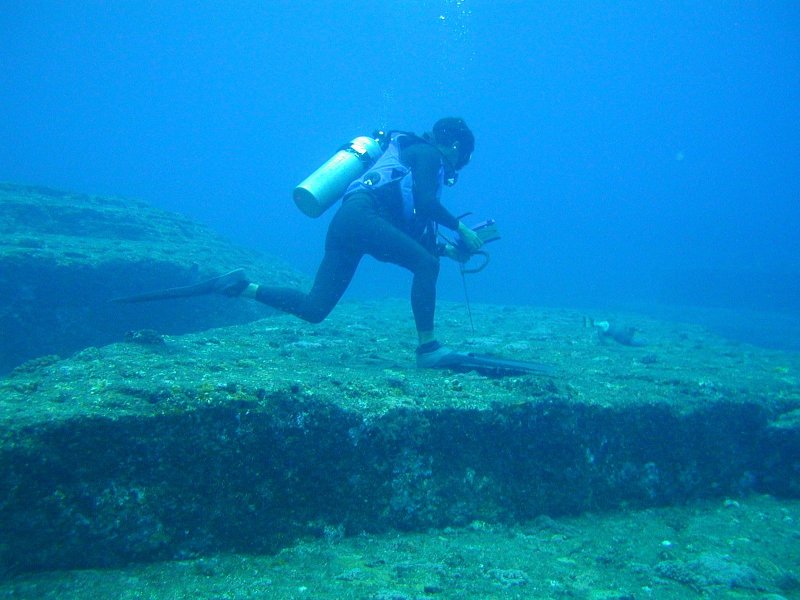
Diving on the site of Yonaguni offers a unique experience, reserved for experienced divers. Winter conditions, with strong currents and water temperatures around 23 degrees Celsius, make exploration demanding. An advanced level and at least 100 dives are recommended to access this underwater relic.
Divers can observe the arched gate, the upper terrace at 5 metres depth, and the base of the structure at 25 metres. Visibility, the verticality of the walls, and the sharpness of the geometric shapes enhance the impression of discovering a submerged city. The currents impose short but intense dives.
The marine fauna remains discreet, allowing better appreciation of the details of the rock formation. The feelings of mystery and discovery are reinforced by the monumental aspect of the structure and the absence of usual diving landmarks.
Tips for diving at Yonaguni
- Advanced level required and experience in deep diving
- Plan for a suit suitable for 23 degrees Celsius
- Prepare for strong currents and variable visibility
- Respect local safety instructions
Why does Yonaguni continue to fascinate scientists and enthusiasts?
The structure of Yonaguni intrigues by its complexity, uncertain origin, and the wealth of theories surrounding it. The debates between supporters of a natural geological formation and defenders of a submerged city testify to the scientific and archaeological interest in the site. Research continues with new dating and analysis methods.
The possibility of a relic of an ancient civilisation or a lost continent like Mu arouses public curiosity. Similarities with other mysterious sites around the world reinforce the myth of Yonaguni, which inspires explorers, researchers, and archaeology enthusiasts.
The uncertain dating, the presence of geometric shapes, and the complexity of natural processes involved in the formation of the site explain the diversity of interpretations. The fascination with Yonaguni rests on this mixture of scientific enigma and the dream of a submerged underwater city.
During an exploratory dive in 1985, Kihachiro Aratake discovered the structure of Yonaguni while searching for a site for hammerhead sharks, thus revealing this mystery of Japan to the world.
Among the mysteries surrounding Yonaguni-jima, sunken city or natural formation, a fascinating underwater enigma in Japan, it is interesting to compare these remains to the most impressive mythological creatures that populate Japanese legends.
What archaeological clues have been found at Yonaguni?
Research conducted on the site has identified marks on the rock that could suggest tools or human intervention. These traces, sometimes likened to engravings or grooves, fuel the debate about the possibility of a sunken city. Some fragments found nearby suggest ritual or domestic uses, although their origin remains debated by the scientific community.
Recent analyses have revealed the presence of regular patterns and alignments that could correspond to intentional spatial organisation. These observations strengthen interest in underwater archaeology at Yonaguni, where each new discovery reignites the debate on the boundary between natural and constructed remains. However, the difficulty of accessing the site limits the collection of new material evidence.
The influence of ocean currents on the rock formation
The powerful currents in the region play a decisive role in the evolution of the rock formation. The continuous action of water on the structure shapes the walls and accentuates geometric forms, making it difficult to distinguish between natural processes and human intervention. This marine dynamic contributes to the preservation and selective erosion of the site.
The role of modern technologies in studying the site
The use of 3D scanners, underwater drones and photogrammetric surveys allows precise mapping of the structure. These tools facilitate comparison with other similar formations worldwide and provide unprecedented data on the details of the rock formation. The contribution of these technologies renews the scientific understanding of the site.
Yonaguni’s place in contemporary Japanese culture
The site of Yonaguni inspires many artists, filmmakers and writers in Japan. Its aura of mystery feeds local legends and fictional works, reinforcing the collective fascination for this submerged remnant. The collective imagination seizes the structure to evoke lost civilisations or forgotten worlds.
Comparison with other famous underwater sites
Yonaguni stands out for the size and regularity of its rock formation, but other submerged sites around the world also present intriguing features. Comparisons with the remains of Atlantis or the ruins of Pavlopetri in Greece broaden the reflection on the diversity of underwater formations and their archaeological interpretation.
- Discovery of engraved patterns on the rock
- Use of underwater photogrammetry
- Influence of currents on the structure
- Comparison with other submerged formations
- Cultural resonance in Japan
What are the prospects for the exploration and understanding of Yonaguni?
The future of research at Yonaguni relies on the combination of new analytical methods and field observations. The integration of advanced technologies and international collaboration promise to provide unprecedented answers about the origin of this rock formation. The fascination with this site continues to engage divers, scientists, and enthusiasts of archaeology eager to uncover the secret of this submerged structure.
“The ocean keeps its mysteries for those who know how to explore it.”
Essential FAQ to prepare your exploration of Yonaguni-Jima
Can you visit Yonaguni without diving and are there other activities on the island?
Yonaguni offers non-diving visitors coastal trail hikes, spectacular viewpoints over the ocean, and the chance to see wild horses living semi-freely. The island also provides an immersion in local culture through gastronomy, small villages, and the traditions of its inhabitants, for an authentic experience away from the crowds.
What are the best times of year to dive at the Yonaguni site?
The period from November to May concentrates the ideal diving season, with increased visibility and the presence of schools of hammerhead sharks. However, weather conditions can be variable and currents strong. Rigorous planning and regular consultation with local professionals will help you choose the slot best suited to your level.
How to find accommodation in Yonaguni and what are the options for organising your stay?
Accommodation in Yonaguni mainly consists of small family-run guesthouses or minshuku, offering a warm welcome and insight into island life. Advance booking is strongly recommended, especially in high season. Most dive clubs offer packages including accommodation, meals, and sea excursions, greatly simplifying the organisation of your adventure.
Among the mysteries held by the ocean near Yonaguni-jima, the question remains whether this underwater structure is of human or natural origin, and to deepen your exploration of the imagination linked to the depths, discover the most impressive mythological creatures that populate marine legends around the world.