Isalo National Park covers 81,540 hectares in the southwest of Madagascar, between the Ihorombe and Atsimo Andrefana regions, according to the fact sheet from the Foundation for Protected Areas and Biodiversity of Madagascar (FAPBM). It is managed by Madagascar National Parks. It does not border the sea.
The previous version of this page was titled “Diving in Madagascar” and left some doubt. Let’s correct that. In Isalo, you hike through sandstone canyons and sometimes swim in freshwater pools. Scuba diving takes place on the coast, in Nosy Be to the northwest or around Tulear to the southwest.
We keep the page address to avoid breaking links. The text, however, starts from scratch.
Can you go diving in Isalo National Park?
No. Isalo is a sandstone massif located inland, with no access to the sea or coral reefs, and there are no scuba diving sites there. The only water activities are limited to swimming in a few natural pools fed by streams, on certain guided tours, when the guide allows it.
A misleading title does not create a reef.
The confusion comes from copied guides that attach the word “diving” to every Malagasy destination. Yet, the map is enough to settle the matter. The park extends around the village of Ranohira, along the RN7, on dry plateaus described by the FAPBM fact sheet as a “sandstone massif with canyons.” The waters you encounter there are streams, waterfalls, and pools. They remain fresh and shallow.
If your trip revolves around diving, Isalo thus becomes a land stop between two series of dives. It requires preparation.
What to do in Isalo: hiking, canyons, and viewpoints
In Isalo, the main activity remains guided hiking on circuits starting from Ranohira. The best-known lead to the Natural Pool, the Makis Canyon, the Rats Canyon, and towards Namaza, with the Blue Pool, the Black Pool, and the Nymphs Waterfall. Duration and difficulty vary depending on the circuit chosen with the guide.
The visit is done with a local guide, hired in Ranohira.
Regarding the terrain, the sandstone sculpted by erosion forms shapes that guides like to name, such as the Queen of Isalo near the RN7 or the Isalo Window, very popular at sunset. Regarding fauna, the FAPBM fact sheet lists seven species of lemurs, including the maki, 94 species of birds, and 77 species of reptiles, according to 2020 data. Seeing them depends on the time and luck. No serious guide can promise you that. The same document cites fires and wood cutting among the threats facing the park.
But the real question before choosing a circuit concerns your physical condition and the heat of the day, because the plateaus offer little shade and the climbs to viewpoints are often in full sun. Leave early. Bring more water than you think.
Entrance fees and guide rates change from year to year, and we found no official dated schedule to copy here. Ask for them at the park office in Ranohira.
Swimming in Isalo’s natural pools: precautions
Swimming is practiced in certain natural pools of the park, on circuits where the guide permits it. Before entering the water, consider the health risk: France Diplomatie reports that schistosomiasis, a potentially serious parasitic infection, is present in all freshwater bodies and streams in the country. The decision should be made with your doctor before departure.
Clear water says nothing about what it contains.
This point was completely missing from the old version, which praised the freshness of the pools without a word about health. Yet the same France Diplomatie fact sheet advises avoiding swimming in stagnant waters. Isalo’s pools are fed by streams, but their flow varies by season. No one can judge the condition of a pool on any given day from here. Your guide knows the terrain, your doctor knows the risk, and the opinion belongs to both of them.
If you swim, wear shoes with grip for the wet rocks and get out of the water as soon as the sky darkens over the plateaus.
Thus, the season also matters. May to October, the dry season, is often cited as a comfortable period for hiking and finding clear pools (approximate indication, without official dated record). Another point from the France Diplomatie fact sheet: uninhabited areas, including national parks, can be scenes of attacks. Stay with your guide.
Where to dive in Madagascar when coming from Isalo?
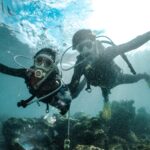
To dive, you need to reach the coast. From Isalo, the closest by road is Tulear (Toliara), with Ifaty to the north of the town and Anakao to the south, along a large reef. Nosy Be, to the northwest, is much farther and is generally reached by plane rather than by road. Each area has its own conditions, which should be checked with the centers.
The following table is indicative and does not replace the daily briefing or the advice of the local center.
| Area | Indicative level | Current | Season | Supervision to request | Fallback plan |
|---|---|---|---|---|---|
| Nosy Be and its islets (Nosy Tanikely, Sakatia) | Beginner supervised on sheltered sites, autonomous diver elsewhere | Variable depending on tide and site, impossible to decide from here | Cyclones possible from January to April (France Diplomatie) | Maximum announced depth, boat equipped with oxygen, evacuation procedure | Sheltered site, snorkeling or postponement |
| Ifaty and Mangily, north of Tulear | Beginner supervised in the lagoon, more experience on the outer slope | Reef passes, to be checked on the day | Cyclones possible from January to April (France Diplomatie) | Guide who knows the passes, boat that stays above the group | Diving in the lagoon or postponement |
| Anakao, south of Tulear | Variable depending on the site | Impossible to decide from here | Cyclones possible from January to April (France Diplomatie) | Center specifying the boat travel time from Tulear | Stay ashore if the sea rises |
The current decides more than the photo.
However, the question we advise you to ask first concerns neither the fish nor the visibility. Ask where the nearest hyperbaric chamber is and how long an evacuation takes from the chosen center. We found no up-to-date official list, so it’s impossible to decide from here. A serious center answers this question straightforwardly, even if the answer is long and unsettling. If they hesitate, you have your answer.
For Nosy Be, our guide on diving in Nosy Be and its sites details the area. The outings to the whale sharks promoted by some operators in the region do not guarantee any encounter, and a trip without sharks remains a normal outing.
On the reef, basic rules apply everywhere. Avoid touching marine life and think about the effect of sunscreen on marine environments before applying it.
Combining Isalo and diving: formalities, road, and margin
The simplest order: Isalo first, then the coast, then a margin without diving before the return flight. This way you avoid heading back to the plateaus just after your dives. The delays before a flight are set with your computer and your center, according to the recommendations of your training organization.
Regarding documents, the Madagascar sheet from France Diplomatie indicates a mandatory paid visa and a passport valid for at least six months after the application. Conditions evolve, so re-read it the week of departure. The same sheet strongly recommends insurance covering medical expenses and medical repatriation, otherwise access to care may be lacking, even in emergencies. Night travel is discouraged. Malaria is a matter to discuss with your doctor or an international vaccination center before leaving.
And the road matters more than you think.
Between Ranohira and Tulear, the RN7 descends to the coast in about half a day of travel, an indicative order of magnitude depending on road conditions and stops. Plan to drive during the day. To transport your equipment by bus, bush taxi, or domestic flight, a well-chosen dive bag avoids many breakages. In short, Isalo and diving combine very well on the same trip, provided you don’t pack everything too tightly.
This margin costs one to two extra days of stay. It prevents you from driving at night, diving tired, and taking the plane too soon after your last dive. Would you book it this way?
FAQ
Is there diving in Isalo National Park?
No. Isalo is an inland sandstone massif, with no sea or reef. To dive, you need to go to the coast, around Tulear or Nosy Be.
Can you swim in the natural pools of Isalo?
Some guided tours pass by pools where swimming is allowed, if the guide permits it. France Diplomacy reports schistosomiasis in all freshwater bodies and streams in Madagascar. Talk to your doctor before departure.
What is the closest diving area to Isalo?
By road, it is the Tulear coast, with Ifaty to the north and Anakao to the south, via the RN7. Allow for a good half-day trip, to be done during the day. Nosy Be is usually reached by plane.
Is a guide required to visit Isalo Park?
Yes, tours are conducted with a local guide hired in Ranohira. Prices and entrance fees vary, ask at the park office. Staying with the guide is also important for your safety.
Sources
- Isalo National Park (Foundation for Protected Areas and Biodiversity of Madagascar, 2021)
- Madagascar, travel advice (Ministry of Europe and Foreign Affairs, accessed October 2026)
{“@context”:”https://schema.org”,”@type”:”FAQPage”,”mainEntity”:[{“@type”:”Question”,”name”:”Y a-t-il de la plongée dans le parc national de l’Isalo ?”,”acceptedAnswer”:{“@type”:”Answer”,”text”:”Non. L’Isalo est un massif de grès à l’intérieur des terres, sans mer ni récif. Pour plonger, il faut rejoindre la côte, autour de Tuléar ou à Nosy Be.”}},{“@type”:”Question”,”name”:”Peut-on se baigner dans les piscines naturelles de l’Isalo ?”,”acceptedAnswer”:{“@type”:”Answer”,”text”:”Certains circuits guidés passent par des bassins où la baignade se pratique, si le guide l’autorise. France Diplomatie signale la bilharziose dans tous les plans et cours d’eau douce de Madagascar. Parles-en à ton médecin avant le départ.”}},{“@type”:”Question”,”name”:”Quelle zone de plongée est la plus proche de l’Isalo ?”,”acceptedAnswer”:{“@type”:”Answer”,”text”:”Par la route, c’est la côte de Tuléar, avec Ifaty au nord et Anakao au sud, via la RN7. Compte une grosse demi-journée de trajet, à faire de jour. Nosy Be se rejoint plutôt en avion.”}},{“@type”:”Question”,”name”:”Faut-il un guide pour visiter le parc de l’Isalo ?”,”acceptedAnswer”:{“@type”:”Answer”,”text”:”Oui, les circuits se font avec un guide local recruté à Ranohira. Les tarifs et les droits d’entrée changent, demande-les au bureau du parc. Rester avec le guide compte aussi pour ta sécurité.”}}]}