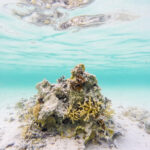
On March 8, 2017, during rough seas, the Azure Window collapsed into the sea at Dwejra, on the west coast of Gozo. Malta’s most photographed arch disappeared in a single morning. The Blue Hole, however, remained in place, just a few meters from the debris.
It is this water hole that most divers come to seek.
Our former page announced an entry “around 20 meters,” visibility “greater than 30 meters,” and water “between 16 and 20 degrees,” without any reference. It also placed the right centers at Ċirkewwa, which is on the island of Malta and not Gozo. We have redone everything based on the official Visit Malta sheet and a study published in 2022 in the journal Geomorphology.
Where is the Blue Hole of Gozo located and what does it look like?
The Blue Hole is located at the foot of the Dwejra point, in the municipality of San Lawrenz, on the west of Gozo. According to the Visit Malta sheet, it is a natural chimney about ten meters wide that descends to 26 meters. An arch opens further down.
The rest is discovered once in the water.
At the bottom of the hole, the tourism office indicates a large cave. Next to it, a passage called “the Chimney” is crossed through a nearly vertical fissure in the rock, one diver at a time, and opens around 8 meters. The site is presented as ideal for photography. But the sheet cites a maximum depth of 50 meters for the entire area, which changes everything for a diver limited to 20 meters. The figure describes the relief.
Thus, the Blue Hole itself does not exceed 26 meters, while the neighboring drop-offs continue much deeper. It is the briefing that must indicate where your dive group stops.
What remains of the Azure Window since March 2017?
The arch collapsed in March 2017. A team from the University of Malta mapped its remains through technical diving, over about 8,000 m² of seabed. According to the study published in 2022 in Geomorphology, the blocks are scattered between approximately 3 and 60 meters deep. The Blue Hole is cited as the most common entry point to the site.
These 60 meters are not an invitation.
The researchers reconstructed the fall with thousands of photos and a 3D model. Erosion had carved a notch at the base of the pillar, on the north side. The pillar tipped towards the southwest, then the rock bridge fell vertically while fragmenting. To cover the area, the team used a camera mounted on an underwater thruster. In short, the deepest part of these debris belongs to technical diving, with the training and equipment that come with it.
However, some of the blocks rest in the 3 to 20 meter zone, within reach of many certified divers, but nothing guarantees that your dive will pass there. Ask before you go.
What level is required to dive at the Blue Hole?
No Maltese authority publishes a minimum level for the Blue Hole. The chimney descends to 26 meters and the arch opens a few meters from the surface, so a first-level diver can stay in the upper part with a guide. The chimney passage and the cave require more ease.
| Criterion | What is known (dated sources) | What you should ask |
|---|---|---|
| Depth | Hole up to 26 m, maximum site depth 50 m (Visit Malta, consulted October 3, 2026) | Planned depth for your dive group, according to your certification |
| Access | Entry from shore after a difficult walk on coralligenous limestone (Visit Malta) | Walking distance with the tank, help carrying equipment |
| Closed passages | Chimney fissure crossed one diver at a time, opening around 8 m (Visit Malta) | If the guide plans the chimney or the cave, and at what level |
| Arch debris | Blocks between approximately 3 and 60 m (Caruana et al., 2022) | Which part is visited, at what depth |
| Conditions | No official dated record of current, temperature, or visibility | Cancellation rule when swell enters the hole |
| Fallback plan | No official source consulted on the nearest chamber | Oxygen on site, evacuation procedure, chamber, insurance |
The certification does not say everything.
A diver who has had their first level for a week does not have the same ease as another who dives all year round. Yet both carry the same card. In a narrow chimney where you pass one by one, buoyancy matters much more than the depth shown on paper. And a poorly placed fin kick quickly stirs up the sand from the bottom. Only the instructor on site can judge what you can do that day, by seeing your weighting and how you position yourself in the water.
If you doubt your balance, reread our guide on diving weights and buoyancy before departure, then do an easier first dive on the island.
How to access the Blue Hole and prepare your outing?
You reach Gozo by ferry from Ċirkewwa, in the north of Malta island, then Dwejra by road. The dive is shore entry. According to Visit Malta, you then have to walk on irregular coralligenous limestone, which the sheet describes as a fairly difficult walk. With a tank on your back, that counts.
Plan your feet accordingly.
Thick-soled booties prevent slipping on the rock, and our article on diving booties details the grip criteria. For the cave and the bottom of the chimney, a suitable diving light helps to read the relief and colors. You exit through the same hole. Ask at what pressure the guide plans to turn back. The surface marker buoy is mainly used if the group surfaces offshore, and our guide on diving SMBs explains when to deploy it.
However, the real question remains the sea conditions of the day, because a westerly swell entering the hole makes entry and exit much more delicate than a photo taken in calm weather suggests.
When to dive at Gozo and what can you see there?
We found no official dated source on water temperature or visibility at the Blue Hole. The ranges circulating online come from undated commercial pages. The Visit Malta sheet mentions various fish, starfish, and fireworms, without promise of any particular encounter.
Impossible to decide from here the best season.
The clearest water does not guarantee a safe outing, because the west coast of Gozo receives the offshore swell head-on. And the arch actually collapsed on a stormy day. Ask the center how many outings they cancel on average on your dates, and what they offer instead. If you are planning a stay on several sites, our selection of the best dive sites in Malta provides sheltered backup plans. And for a companion who does not dive, a sea trip remains possible, as shown by our article on boat rental in Europe.
Keep some margin in your schedule. Booking only one day for the Blue Hole, without a reserve day if the swell closes Dwejra, can cost you the dive you came for, and the ferry price with it. Would you book it that way?
FAQ
What is the depth of the Blue Hole of Gozo?
According to the Visit Malta sheet, the hole descends to 26 meters and the maximum depth of the site reaches 50 meters. The arch that opens to the open sea is a few meters below the surface. Your actual depth depends on your certification and the briefing.
Can you still see the Azure Window while diving?
The arch collapsed in March 2017. Its blocks rest between approximately 3 and 60 meters, according to the study published in 2022 in Geomorphology. The deep parts require technical diving.
Is the Blue Hole suitable for a beginner diver?
No official minimum level is published. The upper part of the hole and the arch remain shallow, but the shore access and entry require ease. The instructor on site decides according to the sea and your level.
Do you need a boat to dive at the Blue Hole?
No, it is a shore dive. Visit Malta describes a fairly difficult walk on irregular limestone rock before entry. Plan booties and ask for help to carry your tank.
Sources
- The Blue Hole & the Chimney (Visit Malta, accessed October 3, 2026)
- Reconstruction of the collapse of the ‘Azure Window’ natural arch via photogrammetry (Caruana et al., Geomorphology, 2022)
{“@context”:”https://schema.org”,”@type”:”FAQPage”,”mainEntity”:[{“@type”:”Question”,”name”:”Quelle est la profondeur du Blue Hole de Gozo ?”,”acceptedAnswer”:{“@type”:”Answer”,”text”:”Selon la fiche de Visit Malta, le trou descend jusqu’à 26 mètres et la profondeur maximale du site atteint 50 mètres. L’arche qui ouvre sur le large se trouve à quelques mètres de la surface. Ta profondeur réelle dépend de ton brevet et du briefing.”}},{“@type”:”Question”,”name”:”Peut-on encore voir l’Azure Window en plongée ?”,”acceptedAnswer”:{“@type”:”Answer”,”text”:”L’arche s’est effondrée en mars 2017. Ses blocs reposent entre 3 et 60 mètres environ, d’après l’étude publiée en 2022 dans Geomorphology. Les parties profondes relèvent de la plongée technique.”}},{“@type”:”Question”,”name”:”Le Blue Hole convient-il à un plongeur débutant ?”,”acceptedAnswer”:{“@type”:”Answer”,”text”:”Aucun niveau minimal officiel n’est publié. La partie haute du trou et l’arche restent peu profondes, mais l’accès à pied et la mise à l’eau du bord demandent de l’aisance. Le moniteur sur place décide selon la mer et ton niveau.”}},{“@type”:”Question”,”name”:”Faut-il un bateau pour plonger au Blue Hole ?”,”acceptedAnswer”:{“@type”:”Answer”,”text”:”Non, c’est une plongée du bord. Visit Malta décrit une marche assez difficile sur une roche calcaire irrégulière avant la mise à l’eau. Prévois des chaussons et demande de l’aide pour porter ton bloc.”}}]}