In November 2014, DAN’s (Divers Alert Network) magazine Alert Diver dedicated an article to weighting with a phrase that many copied guides forget: the amount of weight carried is not fixed.
This simple observation rules out ready-made formulas. Your weight depends on your wetsuit, your tank, the water, and you, and it changes as soon as one of these parameters shifts.
So we have completely revised this article. No equipment tests were conducted to write it, and each numerical reference points to its source.
How much weight do you need to dive?
No one can give you this number remotely. The right amount is measured in the water, through a surface test. The body weight percentages circulating online serve at best as a starting point for this test.
The previous version of this article stated that about 5% of body weight compensated for the natural buoyancy of the human body. We removed that. In the DAN article, 5% of body weight serves as a starting base for a 3 mm wetsuit, and 10% for a 6 mm one, values that the authors suggest adjusting over the course of dives. Your body, your tank, and your buoyancy compensator affect the result one way or another. Two divers of the same weight can therefore end up with very different weights.
The following table summarizes what influences the number, factor by factor, with what you need to check each time.
| Factor | Usual effect on weight | What to check |
|---|---|---|
| Thicker wetsuit | More weight | Neoprene compresses at depth and loses part of its buoyancy |
| Saltwater rather than freshwater | More weight | Redo weighing with each change of water |
| Steel or aluminum tank | Variable depending on model | Empty buoyancy indicated by the manufacturer |
| Tank emptying | It gets lighter during the dive | Check at the end of the dive |
| Buoyancy compensator, lights, accessories | Variable | Redo the test with any change |
But this table only indicates which way to adjust. It becomes useful when you rent equipment you have never worn or when you change your wetsuit according to water temperature. The final number will come from the weighing.
How to do the surface weighing test?
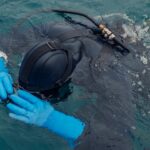
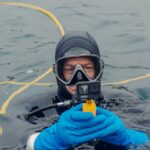
Place yourself in water where you cannot touch the bottom and completely empty your buoyancy compensator. According to the procedure described by DAN in 2014, the water should reach the level of your eyes when you breathe normally, then just pass above your head on exhalation before letting you rise.
The timing of the test matters as much as the action.
A full tank weighs more than an almost empty tank, since compressed air has mass that you consume during the dive. If you weigh yourself with a full tank, you risk being underweighted at the end, at the safety stop. Hence the interest of doing the test with an almost empty tank. Your pressure gauge tells you where you stand. DAN also suggests a check at the end of the dive: with an aluminum tank at 500 psi (about 35 bar), you should be able to stay stable around 15 feet, about 4.5 m, with an empty buoyancy compensator.
Do this check with your instructor or buddy beside you.
And if the weighing reveals a discrepancy, adjust in small increments then repeat. Then note the result with the wetsuit, tank, and type of water of the day, because this personal log will be worth more than any formula on your next outing under the same conditions. It will not exempt you from a new test.
Freshwater or seawater: why change weight?
Seawater is denser than freshwater, so it supports you more. With equal equipment, you need more weight in the sea than in a lake, quarry, or pool, and less when going the other way. The DAN article published in 2014 reminds freshwater-trained divers of this.
The difference remains modest on the scale of a liter. As a guideline, one liter of seawater generally weighs two to three percent more than one liter of freshwater, depending on its salinity and temperature. Yet your total volume, with wetsuit, buoyancy compensator, and tank, is large. This small difference therefore ends up being noticeable. No one can tell you by how much without a test, and the only reliable number will come from weighing done on site.
Keeping the weight from your last sea dive for a lake dive often means diving too heavy.
The same trap applies to the wetsuit. Cold water often requires a thicker neoprene or a drysuit, and therefore more weight to compensate for their own buoyancy, which also varies with depth. Change water and suit on the same day, and you start from scratch.
Where to place the weight and how to drop it?
Distribute your weight to stay horizontal effortlessly, and know exactly how to get rid of it. A belt can be released with a single gesture if nothing covers it. Integrated pockets on the jacket or harness can have several release points, and DAN advises discussing this with your buddy before entering the water.
Regarding position, the old article placed the weight “slightly below the sternum.” We removed this reference due to lack of source. The distribution is adjusted by trial: if your legs drop or you lean forward, your instructor can help you move some of the weight, for example to rear pockets when your buoyancy compensator device has them. Each jacket adjusts differently. Test this adjustment in calm, shallow water, then redo it with every equipment change.
Thus, the pre-dive check always includes the weight.
Your buddy must know where it is and how to release it. In an article published by DAN Europe in 2012, Rick Layton states it bluntly: better to lose equipment than to remain in trouble trying to keep it. A borrowed belt is not worth hesitating over.
Why is over-weighting dangerous?
Too much weight forces you to put more air in your jacket to remain neutral. This air changes volume with depth, so every meter gained or lost further changes your buoyancy, making control more delicate during ascent and safety stops. DAN Europe described this as early as 2012.
The DAN article published in 2014 adds a less visible effect. Too heavy, with an inflated jacket, you swim more upright and offer more resistance to the water. You exert more effort. You also consume more air. According to the authors, this extra effort can even increase decompression stress, which weighs heavily for an adjustment so simple to correct before the dive. In short, the extra kilo costs you air and margin.
An overweight diver also more easily touches the bottom, and elsewhere we explain why you should never touch marine life.
However, under-weighting is no better. Without enough weight, holding a safety stop with an almost empty tank becomes difficult, and a too rapid ascent may follow. The surface marker buoy signals your position on the surface, it does not correct poorly adjusted weight.
Redoing a weighing takes about ten minutes at the start of a trip. Keeping the weight from another water or another suit costs more later, in consumed air and lost margin during the stop.
FAQ
How many kilos of weight are needed with a 5 mm wetsuit?
No serious figure can be given without testing. The 2014 DAN article suggests 5% of body weight for a 3 mm and 10% for a 6 mm as a simple starting point. The final adjustment is made by weighing at the surface, ideally with an almost empty tank.
Is more weight needed in the sea than in a pool?
Yes, generally. Sea water is denser than fresh water and supports you more, so you need more weight with equal equipment. Redo the weighing with every water change.
Steel or aluminum tank: which requires more weight?
It depends on the model. The buoyancy of a full and empty tank is listed in the manufacturer’s data, and it changes during the dive as you consume air. Checking at the end of the dive remains the only way to verify it with your equipment.
How do I know if I am over-weighted during the dive?
You have to inflate your jacket a lot to stay neutral, you swim tilted and feel you are making more effort. DAN links these signs to higher air consumption. Report it to your instructor and redo a weighing at the next exit.
Sources
- Weight Up! (Divers Alert Network, Alert Diver, 2014)
- Out of Control (DAN Europe, Alert Diver, 2012)
{“@context”:”https://schema.org”,”@type”:”FAQPage”,”mainEntity”:[{“@type”:”Question”,”name”:”Combien de kilos de lest faut-il avec une combinaison de 5 mm ?”,”acceptedAnswer”:{“@type”:”Answer”,”text”:”Aucun chiffre sérieux ne peut être donné sans test. L’article de DAN de 2014 propose 5 % du poids du corps pour une 3 mm et 10 % pour une 6 mm comme simple point de départ. Le réglage final se fait par une pesée en surface, idéalement avec une bouteille presque vide.”}},{“@type”:”Question”,”name”:”Faut-il plus de lest en mer qu’en piscine ?”,”acceptedAnswer”:{“@type”:”Answer”,”text”:”Oui, en général. L’eau de mer est plus dense que l’eau douce et te porte davantage, donc il te faut plus de lest à équipement égal. Refais la pesée à chaque changement d’eau.”}},{“@type”:”Question”,”name”:”Bouteille acier ou aluminium : laquelle demande le plus de lest ?”,”acceptedAnswer”:{“@type”:”Answer”,”text”:”Cela dépend du modèle. La flottabilité d’une bouteille pleine et vide figure dans les données du fabricant, et elle change pendant la plongée à mesure que tu consommes l’air. Le contrôle en fin de plongée reste la seule façon de le vérifier avec ton équipement.”}},{“@type”:”Question”,”name”:”Comment savoir que je suis trop lesté pendant la plongée ?”,”acceptedAnswer”:{“@type”:”Answer”,”text”:”Tu dois gonfler beaucoup ton gilet pour rester neutre, tu nages incliné et tu sens que tu fais plus d’effort. DAN relie ces signes à une consommation d’air plus élevée. Signale-le à ton encadrant et refais une pesée à la sortie suivante.”}}]}