On October 10, 1996, Saint-Barthélemy obtained its marine nature reserve. Thirty years later, it covers 1,200 hectares of sea divided into five zones, and it is its rules that govern almost all the dives around the island.
Our previous page mentioned a 10-hectare reserve, water “constantly around 28 °C,” and dolphins recently spotted at the Colombier point. We reviewed everything with documents from the Territorial Environment Agency (ATE), NOAA reports, and dated local press.
What remains is shorter. It is also more useful for booking.
Diving in Saint-Barthélemy: for what level?
The island welcomes beginners as well as experienced divers, but no official document consulted ranks its sites by difficulty. The required level for each outing is therefore set with the club, at the briefing, according to the sea conditions of the day. The table below separates what is sourced from what you still need to ask.
| Criterion | What we know (dated sources) | What to ask the club |
|---|---|---|
| Level | 23 marked diving sites in the reserve, without official difficulty ranking (ATE, consulted October 3, 2026) | Maximum planned depth, required level or experience |
| Current | No official site-by-site data published | Exposure to the day’s wind, entry and recovery plan |
| Season | Atlantic hurricane season from June 1 to November 30 (NOAA) | Cancellation and rescheduling conditions |
| Supervision | Scuba diving prohibited in the reinforced protection zone, maximum 2 hours 30 minutes on a dive buoy (ATE) | Club authorization in the reserve, number of divers per guide |
| Fallback plan | Hyperbaric chamber off the island, current status unconfirmed (see below) | Oxygen on board, evacuation procedure |
So, for what level? No one can decide from here, because the reserve zones are not all equally exposed to the wind, and the same outing can be calm one morning and rough the next. A beginner can find their place if supervised. An autonomous diver must check what the club actually allows in the protected zones, because the reserve imposes its rules on all boats. The club knows.
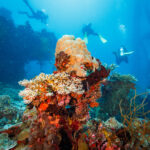
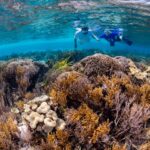
The current decides more than the photo.
And the water color tells nothing about the swell at the anchorage.
What does the Saint-Barthélemy Nature Reserve regulation say?
The reserve was created on October 10, 1996, and covers 1,200 hectares of sea according to the ATE, which manages it. It includes five zones: Fourchue, Colombier Bay, Gros Îlets and Pain de Sucre, Frégate and Toc Vers, Grand Cul-de-Sac. Diving remains allowed except in the reinforced protection zone.
In the simple protection zone, no coral, plants, shells, or crustaceans may be taken. Protected species must not be touched either, among which the ATE lists sea turtles, corals, sea urchins, starfish, sharks, and rays. Boat speed is limited to 5 knots. Jet skis and other motorized recreational devices are prohibited. The reinforced protection zone goes further, with a total ban on fishing, anchoring, and scuba diving.
However, the rule that affects divers the most concerns buoys.
Among the 23 diving sites, the ATE limits boats to 10 tons and 15 meters, requires one buoy per boat, sets the maximum time on a dive buoy to 2 hours 30 minutes, and prohibits gloves. Sailboats are not allowed to moor there. Pleasure craft anchoring is limited to Colombier and Fourchue bays, on about forty buoys.
Controls do exist. According to the Journal de Saint-Barth of January 30, 2026, the ATE conducted 2,794 inspections in 2025 and recorded 178 violations. The same article mentions fee adjustments that helped regulate demand. No amount was found on the official ATE pages consulted on October 3, 2026. So ask the club if a diving fee applies and if it is already included in the price.
In short, the club holds the authorization, and you pay in the end.
Which diving sites around Saint-Barthélemy?
The officially marked sites are mainly located in the reserve zones: Pain de Sucre, Gros Îlets, Toc Vers, Frégate, Colombier, and Fourchue. The ATE mentions 23 sites equipped with ecological buoys to explore wrecks and reefs. It does not publish depth or level per site.
Our previous text announced a 25-meter drop-off at the Pointe du Colombier and mentioned Roche Roube or the îlet Coco, but none of these details were found in any official source, so they were removed. The site names you will read at the clubs remain useful, but their depth and level are verified during the briefing. A list of sites copied from one guide to another is not worth a dated fact sheet. The briefing decides. The same caution applies to the wildlife.
Thus, the reserve protects seagrass beds and coral reefs, and the list of species protected by the ATE includes turtles, sharks, and rays.
This does not guarantee any encounters. And if you do have one, keep your distance. We explain why in the reasons why you should never touch marine life. For your skin, a carefully chosen cream limits your footprint on the corals; see our comparison of sunscreens less toxic for corals.
Then there is the mask and snorkel. The bays of Colombier and Fourchue are part of the reserve, with their seagrass beds. If you are primarily looking for a snorkeling destination, also check out our selection of the best snorkeling destinations in the world.
Which season to choose regarding cyclones?
The NOAA sets the Atlantic hurricane season from June 1 to November 30, with most activity between mid-August and mid-October. Saint-Barthélemy is right in this zone. From December to May, the cyclone risk is outside the official period, without saying anything about the swell on any given day.
On September 6, 2017, Hurricane Irma hit Saint Martin as a category 5. The National Hurricane Center report indicates that Saint-Barthélemy was in the southern eyewall and suffered significant damage. Eleven direct deaths are counted for Saint Martin and Saint-Barthélemy combined. This episode reminds us that a September stay can be ruined, and not just for diving. Our previous page promised water “constantly around 28 °C,” a figure we could not link to any dated source.
But the dry season does not guarantee calm seas.
For water temperature and visibility, ask the club for its recent monthly readings rather than relying on an average copied from one site to another without date or source. If you hesitate between several islands, compare with diving in Saint Martin, the neighboring island, or with Bonaire and its highly regulated marine park.
Booking outside the cyclone season often costs more, but postponement and cancellation insurance also cost.
Where is the nearest hyperbaric chamber?
We found no dated official source confirming a hyperbaric chamber in service in Saint-Barthélemy or Saint Martin. The Guadeloupe press (Le Courrier de Guadeloupe, 2018, updated in 2023) describes a chamber at the Pointe-à-Pitre University Hospital, whose current status remains to be verified, and a transfer there implies evacuation off the island.
This point changes your fallback plan. On a small island, onboard oxygen and the speed of alert are very important because definitive care may be far away. Before the first dive, ask the club what its protocol is in case of decompression accident, which hospital it calls, and how long an evacuation takes according to its experience. Also check that your insurance covers medical repatriation from the Antilles, and keep its number on you. And note the emergency numbers, 15 and 112.
However, the best chamber remains the one you do not need.
A slow ascent, a respected safety stop, and a safety sausage that you know how to deploy are part of the same plan.
Would you book it this way?
FAQ
Do you have to pay to dive in the Saint-Barthélemy Nature Reserve?
The local press mentions fee adjustments in the reserve in 2026. We found no amount on the official ATE pages consulted on October 3, 2026. Ask the club if a fee applies and if it is included in the dive price.
Can you dive everywhere around Saint-Barthélemy?
No. Scuba diving is prohibited in the reinforced protection zone of the reserve. Of the 23 marked sites, boats must use the diving buoys, one buoy per boat, for a maximum of 2 hours and 30 minutes.
What is the best time to dive in Saint-Barthélemy?
The Atlantic hurricane season runs from June 1 to November 30 according to NOAA. From December to May, this period is over, but the sea can remain rough. Ask the club for its recent temperature and visibility readings.
Where is the nearest hyperbaric chamber to Saint-Barthélemy?
We could not confirm any operational chamber on the island or in Saint-Martin. The Guadeloupean press describes a chamber at the CHU of Pointe-à-Pitre, whose current status remains to be verified. Ask the club for its evacuation procedure before diving.
Sources
- Regulatory zones (Territorial Environmental Agency of Saint-Barthélemy, accessed in 2026)
- Tropical Cyclone Report: Hurricane Irma (AL112017) (NOAA, National Hurricane Center, 2018)
{“@context”:”https://schema.org”,”@type”:”FAQPage”,”mainEntity”:[{“@type”:”Question”,”name”:”Faut-il payer pour plonger dans la Réserve naturelle de Saint-Barthélemy ?”,”acceptedAnswer”:{“@type”:”Answer”,”text”:”La presse locale évoque des ajustements de redevance dans la réserve en 2026. On n’a trouvé aucun montant sur les pages officielles de l’ATE consultées le 3 octobre 2026. Demande au club si une redevance s’applique et si elle est incluse dans le prix de la plongée.”}},{“@type”:”Question”,”name”:”Peut-on plonger partout autour de Saint-Barthélemy ?”,”acceptedAnswer”:{“@type”:”Answer”,”text”:”Non. La plongée en bouteille est interdite dans la zone de protection renforcée de la réserve. Sur les 23 sites balisés, les bateaux doivent utiliser les bouées de plongée, une bouée par bateau, 2 h 30 au maximum.”}},{“@type”:”Question”,”name”:”Quelle est la meilleure période pour plonger à Saint-Barthélemy ?”,”acceptedAnswer”:{“@type”:”Answer”,”text”:”La saison des ouragans de l’Atlantique court du 1er juin au 30 novembre selon la NOAA. De décembre à mai, on sort de cette période, mais la mer peut rester agitée. Demande au club ses relevés récents de température et de visibilité.”}},{“@type”:”Question”,”name”:”Où se trouve le caisson hyperbare le plus proche de Saint-Barthélemy ?”,”acceptedAnswer”:{“@type”:”Answer”,”text”:”On n’a pas pu confirmer de caisson en service sur l’île ou à Saint-Martin. La presse guadeloupéenne décrit un caisson au CHU de Pointe-à-Pitre, dont le statut actuel reste à vérifier. Demande au club sa procédure d’évacuation avant de plonger.”}}]}