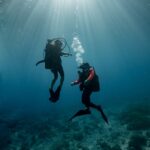
In France, the Sports Code limits air diving to 60 meters (article A322-76, June 2026 version published by the FFESSM). Beyond that, or even before if you want to keep a clear head, trimix takes over.
This mixture of oxygen, helium, and nitrogen addresses two flaws of air at depth. It also adds others, more subtle, which training sheets rarely detail.
Here we revisit the official thresholds, the FFESSM training program, its international equivalents, and what trimix really costs.
This article is informative and does not replace the advice of a competent diving medicine doctor.
Why is air no longer sufficient beyond 40 to 60 meters?
Because nitrogen becomes narcotic and oxygen toxic as pressure increases. According to DAN, narcosis is generally felt around 24 to 30 meters on air or nitrox. By calculation, the oxygen in air reaches the limit of 1.4 bar around 57 meters, then 1.6 bar around 66 meters.
Narcosis feels like intoxication.
It slows reasoning, blurs instrument reading, and makes a small failure much harder to manage. The threshold varies from diver to diver and day to day. Regarding oxygen, DAN considers 1.4 bar as a widely accepted limit during the bottom phase, and most training organizations accept 1.6 bar at rest during decompression. The Sports Code sets a legal ceiling of 1.6 bar and a floor of 0.16 bar (article A322-92). These are frameworks. They say nothing about your personal tolerance.
But air has a third, lesser-known flaw related to its density. The deeper you go, the thicker the gas becomes and the more effort each breath requires, especially if you kick against a current or if stress speeds up your breathing. Helium, a light gas, lightens this respiratory work.
Normoxic, hypoxic, triox: what does the oxygen fraction change?
The oxygen fraction sets the usable depth range. A normoxic trimix keeps about 18 to 21% oxygen and can be breathed at the surface. A hypoxic trimix goes below this threshold to limit toxicity very deep, but it becomes dangerous near the surface. Triox, richer in oxygen than air, targets moderate depths.
| Mixture | Oxygen fraction (indicative) | Common use | Breathable at surface? |
|---|---|---|---|
| Triox (hyperoxic) | more than 21% | moderate depths, less narcosis than air | yes |
| Normoxic trimix | about 18 to 21% | first trimix courses, up to 60 to 70 m depending on organization | yes |
| Hypoxic trimix | less than about 18% (TDI: less than 17%, DAN: hypoxic below 16%) | deepest dives of advanced courses | no, a travel gas is used for descent |
Labels vary by organization, so trust the analyzed percentage.
One calculation example is enough. With 10% oxygen, a mixture shows at the surface a partial pressure of 0.10 bar, below the legal floor of 0.16 bar. It only becomes compliant from about 6 meters, where absolute pressure reaches 1.6 bar. The descent is therefore done with another gas. DAN reminds that a hypoxic mixture breathed at the surface or shallow depth can cause immediate loss of consciousness without warning signs, hence the strict procedures for analysis and gas switching.
How is the equivalent narcotic depth (END) calculated?
END compares the narcosis of a mixture to that of air. Take a 18/45 trimix, i.e., 18% oxygen, 45% helium, and 37% nitrogen, at 65 meters. The absolute pressure there is 7.5 bar. Thus, counting only nitrogen, you feel at 65 meters narcosis close to that of air around 25 meters. Some organizations also count oxygen as narcotic, giving an END of about 31 meters for this mixture. Oxygen there reaches 1.35 bar.
Which FFESSM course to dive trimix in France?
FFESSM offers two qualifications. The Elementary Trimix Diver authorizes trimix up to 70 meters and corresponds to the PTH-70 aptitude of the Sports Code. The Trimix Diver opens all trimix mixtures up to 120 meters, with nitrox and pure oxygen in decompression (FFESSM Technical Training Manual, 2017 version).
| FFESSM Qualification | Main Prerequisites | Authority |
|---|---|---|
| Elementary Trimix Diver | 18 years old, level 3 or equivalent, confirmed Nitrox, 15 dives beyond 40 m | trimix up to 70 m (PTH-70) |
| Trimix Diver | Elementary Trimix, then 10 trimix dives including 5 between 50 and 70 m and 5 with ascent on nitrox or oxygen stops | all trimix blends up to 120 m, nitrox and pure oxygen in decompression |
The Sports Code complements this framework. It defines three aptitudes, PTH-40, PTH-70, and PTH-120, referenced in article A322-96. Its article A322-76 limits supervision with trimix or heliox to 80 meters, and beyond that, up to 120 meters, diving is only done autonomously. Article A322-97 requires a weighted descent and ascent line, a copy of the dive plans, and surface logistical support with an authorized person. These rules apply to establishments organizing diving in France.
However, having a qualification in hand never replaces the briefing from the dive director, who decides on the day.
Before going that far, a basic rescue foundation helps the whole dive group. Our sheet on RIFAP training and its specific first aid gestures in diving details the federal curriculum, and the one on Rescue Diver training to manage emergencies presents the approach of international organizations.
PADI TecRec, TDI, IANTD: what equivalences for trimix?
The major international organizations follow the same logic in two steps. At PADI, the Tec Trimix 65 course leads to 65 meters, then the Tec Trimix course to 90 meters. TDI offers Trimix Diver up to 60 meters then Advanced Trimix up to 100 meters. IANTD places Normoxic Trimix at 60 meters and Trimix at 100 meters.
| Organization | First trimix level | Advanced level |
|---|---|---|
| FFESSM | Elementary Trimix: 70 m | Trimix: 120 m |
| PADI TecRec | Tec Trimix 65: 65 m, Tec 50 and 100 dives | Tec Trimix: 90 m, 150 dives |
| TDI | Trimix Diver: 60 m, blends up to 18% oxygen, 100 dives | Advanced Trimix: 100 m, blends under 17% oxygen, 100 dives including 25 beyond 30 m |
| IANTD | Normoxic Trimix: 60 m, 100 dives including 30 beyond 27 m | Trimix: 100 m, 200 dives including 25 between 42 and 60 m |
These figures come from the curriculum pages published by each organization, consulted on October 3, 2026. All require a minimum age of 18. Yet, they do not align neatly, with 60, 65, or 70 meters for the first level and 90, 100, or 120 for the second. In France, what counts in a structure remains the PTH aptitude recognized by the dive director. The exact correspondence between a foreign card and a PTH aptitude is impossible to decide from here, as it depends on the structure and current regulations.
Request it in writing before booking a deep trip.
On a wall like the one at Reqqa in Gozo, which our selection of best dive sites in Malta describes beyond 60 meters, the question arises before boarding. And for a Red Sea trip prepared with our guide to diving vacations in Egypt, local rules add to your card.
How much does trimix really cost, in helium and equipment?
Trimix costs more than air or nitrox. DAN cites the price of helium and the difficulty of finding fills among its disadvantages, with increased heat loss. No rates are given here, as it varies depending on the filling station and the time. Ask for a price per fill before planning.
The equipment also weighs. In open circuit, a trimix dive is generally done with a back-mounted twinset and one or more decompression stages carried on the side, plus a travel gas if the bottom mix is hypoxic. Each cylinder must bear its oxygen percentage and maximum depth of use (article A322-93). This weight complicates entry and exit from the water. On a boat without a suitable ladder, the problem becomes serious (and trip sheets often forget this).
However, helium has its own limit.
DAN describes the high-pressure nervous syndrome (HPNS), which can cause debilitating tremors and a decline in mental performance during very deep dives. It also causes cooling. In short, trimix reduces narcosis without making the depth harmless.
Before signing up, consider the real cost. It is paid in decompression stop hours, in euros for helium at each fill, and in kilos to haul onto the boat.
FAQ
Does trimix eliminate narcosis?
No, it reduces it. Part of the nitrogen is replaced by helium, a non-narcotic gas according to DAN. The remaining nitrogen still has an effect, which is measured by the equivalent narcotic depth.
Do you need to be level 3 to dive with trimix?
At the FFESSM, yes: the two trimix qualifications require level 3 or equivalent, confirmed Nitrox, and a minimum age of 18. PADI, TDI, and IANTD set their own prerequisites, including at least 100 logged dives.
What is the maximum depth for trimix diving in France?
The Sports Code limits autonomous diving with trimix or heliox to 120 meters and supervised diving to 80 meters (article A322-76). These values remain regulatory ceilings and do not set any personal goal.
Why is a hypoxic trimix dangerous at the surface?
Its oxygen fraction is too low to reach the legal floor of 0.16 bar near the surface. DAN specifies that breathing a hypoxic mix at the surface can cause immediate loss of consciousness without warning. Therefore, a travel gas is used for descent.
Sources
- Technical Training Manual, Sports Code, June 2026 version (FFESSM, 2026)
- Breathing Gases (DAN, Alert Diver, 2017)
{“@context”:”https://schema.org”,”@type”:”FAQPage”,”mainEntity”:[{“@type”:”Question”,”name”:”Le trimix supprime-t-il la narcose ?”,”acceptedAnswer”:{“@type”:”Answer”,”text”:”Non, il la réduit. Une partie de l’azote est remplacée par de l’hélium, gaz non narcotique selon DAN. L’azote restant garde un effet, que mesure la profondeur équivalente narcotique.”}},{“@type”:”Question”,”name”:”Faut-il être niveau 3 pour plonger au trimix ?”,”acceptedAnswer”:{“@type”:”Answer”,”text”:”À la FFESSM, oui : les deux qualifications trimix demandent le niveau 3 ou équivalent, le Nitrox confirmé et 18 ans minimum. PADI, TDI et IANTD fixent leurs propres prérequis, dont au moins 100 plongées enregistrées.”}},{“@type”:”Question”,”name”:”Quelle est la profondeur maximale au trimix en France ?”,”acceptedAnswer”:{“@type”:”Answer”,”text”:”Le Code du sport limite la plongée en autonomie au trimix ou à l’héliox à 120 mètres et l’encadrement à 80 mètres (article A322-76). Ces valeurs restent des plafonds réglementaires et ne fixent aucun objectif personnel.”}},{“@type”:”Question”,”name”:”Pourquoi un trimix hypoxique est-il dangereux en surface ?”,”acceptedAnswer”:{“@type”:”Answer”,”text”:”Sa part d’oxygène est trop faible pour atteindre le plancher légal de 0,16 bar près de la surface. DAN précise qu’un mélange hypoxique respiré en surface peut entraîner une perte de connaissance immédiate et sans alerte. On descend donc avec un gaz de voyage.”}}]}