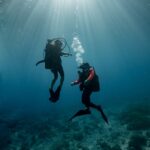
On the Palud beach, in Port-Cros, the national park has marked a route of about 40 minutes with fins with six explanatory buoys. No certification is required to follow it. A mask, a snorkel, and fins are enough.
That is the whole point of fin snorkeling, which the FFESSM calls underwater hiking and which many know as snorkeling or PMT, for fins, mask, snorkel. The entry point is low. But the sea still holds its wind and currents, even two meters from the shore.
Here, we have kept the good reasons to start, removed those that did not hold up, and added what the previous version forgot: how to begin without putting yourself in danger. To choose a location, our guides to the best snorkeling spots in France and the 12 best snorkeling destinations in the world take over.
Why start fin snorkeling?
Because it is the simplest way to look at the seabed by yourself. The equipment fits in a beach bag, the FFESSM describes the activity as accessible to everyone and practiced at any age, and you stay on the surface, in the open air, with the possibility to stop whenever you want.
The reasons to start can be summed up in a few lines. The initial budget remains modest compared to a scuba baptism. The whole family can share the same outing, provided everyone is comfortable in the water and the youngest are closely supervised. You learn to read the sea. And you discover coastal wildlife at your own pace, without any promise of encounters (an octopus shows up or not, and no one orders it).
In short, the activity requires little equipment.
The previous version of this article also promised an effect on all the muscles of the body and on stress. We found no serious source to quantify this, so we removed it.
| Often cited reason | What holds true | Condition to check |
|---|---|---|
| Accessible to all | FFESSM says it is practiced at any age | Be comfortable in the water, otherwise start with a guide |
| Simple equipment | Fins, mask, snorkel, often a wetsuit | A leaking mask spoils the outing |
| Family outing | Several guided trails in Var accept children from 8 years old | An adult supervises each child at all times |
| Wildlife discovery | Marked trails explain what you are looking at | No species is guaranteed |
| Gateway to diving | You get used to the mask and fins | Scuba diving requires its own training |
What equipment is needed to start snorkeling?
You need fins, a mask, and a snorkel, then a wetsuit as soon as the water cools or the outing lengthens. The FFESSM also mentions the full-face mask, which combines mask and snorkel. Add a visible signaling buoy and sun protection that is water-friendly.
Start with the mask. Place it on your face without the strap and inhale slightly through your nose: if it stays on by itself, it fits the shape of your face, and this is a simple test to do in store. The fins must fit without squeezing, because a foot cramp far from shore quickly spoils the outing. The snorkel remains as simple as possible. Yet, it is often the wetsuit that is forgotten, even though it protects from cold and rubbing on rocks, and helps you float.
For the skin, the Port-Cros national park underwater trail booklet advises avoiding oils and sunscreens in favor of environmentally friendly lotions. We lean towards a mineral filter and a long-sleeved lycra, which reduce the amount of product to apply. Our page on sunscreen and the seabed details the filters involved and their effect on corals.
The buoy, meanwhile, primarily serves to make you visible to boats.
What safety rules should be respected in fin snorkeling?
The first rule: never go alone. The FFESSM reminds that apnea should never be practiced alone and that both teammates watch each other, even when the outing is supervised. Then, inform someone on shore, check the wind and current before entering, and stay within reach of the shore.
The wind determines more than the color of the water. A turquoise sea with an offshore wind can push you out to sea without you feeling it, because you swim with your head in the water and lose your bearings. The Port-Cros National Park guidebook advises against swimming on days of strong mistral wind. Yet the mistral often rises under a perfectly clear sky, which easily deceives when you look at the sea from the beach. Clear water says nothing about the current.
Keep a margin. Start facing the wind or the slight current, so that the return is easier, and turn back before fatigue, not when it arrives. If a jellyfish stings you, our sheet on actions that relieve a jellyfish sting saves you from dubious remedies.
In case of trouble at sea, dial 196 to reach the CROSS, and 112 remains valid from the beach.
From what age and with what supervision?
There is no single minimum age. The FFESSM presents snorkeling as practiced at any age, while the guided underwater trails in the Port-Cros guidebook welcome children from 8 years old. The real filter remains comfort in the water.
The old article stated “from six years old” without source. We removed it. For a child, the useful question concerns their swimming ability and the presence of an adult who watches only them throughout the outing. A floating wetsuit helps the youngest. However, it is up to the guide or instructor on site to say if a site is suitable for your child, not a web page.
For adults who want to progress, the FFESSM offers a qualification for autonomous snorkelers. It requires a valid federal license and a medical certificate of no contraindication to snorkeling. Minors must add authorization from their legal guardian. Training is done in two or three specific sessions, or over several outings, and concludes with a snorkeler card.
Thus, going through a club or a RandoSub point puts you next to a trained guide, which matters especially the first times.
Where to do your first snorkel hikes?
Start on a marked underwater trail or a sheltered cove, with shallow depth, easy entry, and a supervised beach if possible. The Port-Cros National Park guidebook lists ten partner trails in the Var, from La Palud to Baie du Niel, some with free access, others with a guide.
These trails have a concrete advantage. Buoys or submerged panels explain what you are looking at, and some, like Anse Magaud or Domaine du Rayol, operate with a guide and provided equipment. At Pampelonne, the announced average depth is around 2 meters. But a marked trail does not eliminate wind or fatigue. Opening periods and guided visits change from year to year, so check them with the municipality or park before leaving.
Once in the water, keep your hands to yourself. The Port-Cros guidebook asks not to take anything and not to disturb animals, and our page on the reasons why you should never touch marine life explains the cost of a simple contact.
The current decides more than the photo of the trail.
Does snorkeling lead to scuba diving?
Often, yes, but not automatically. You get used to the mask, snorkel, and fins, you learn to breathe calmly with your head in the water and to read the surface, which makes a first baptism less disorienting.
Switching to scuba adds managing air and pressure. It requires supervised training, like the FFESSM level 1 that we present in our guide to FFESSM level 1 training. And nothing forces you to take the step. You can remain a snorkeler all your life, and the FFESSM autonomous qualification shows that the activity has its own path. You choose according to your desire, without pressure.
What snorkeling really costs you is a bit of time: a few short outings, supervised if possible, before swimming in pairs without a guide.
FAQ
Do you need to know how to swim well to snorkel?
You need at least to be comfortable in the water and able to return to shore if you lose a fin. A wetsuit helps you float, but it does not replace comfort. If you have doubts, start with a guide on a supervised trail.
Can you go snorkeling alone?
No. The FFESSM reminds that apnea should never be practiced alone and that both partners watch over each other. Also inform someone on land about your route and your return time.
What sunscreen should be used for snorkeling?
The Port-Cros National Park advises avoiding oils and sunscreens in favor of environmentally friendly lotions. A long-sleeved lycra reduces the skin surface to protect.
What is the difference between snorkeling, PMT, and underwater hiking?
None in essence. The FFESSM refers to underwater hiking and specifies that it is also called snorkeling or finned hiking. PMT refers to the equipment: fins, mask, snorkel.
At what age can a child start?
The FFESSM does not set a single age and speaks of an activity practiced at any age. The guided trails of the Port-Cros National Park accept children from 8 years old. Comfort in the water and adult supervision matter more than age.
Sources
- The autonomous underwater hiker (FFESSM, 2024)
- The booklet of partner underwater trails of the Port-Cros National Park (Port-Cros National Park, 2024)
{“@context”:”https://schema.org”,”@type”:”FAQPage”,”mainEntity”:[{“@type”:”Question”,”name”:”Faut-il savoir bien nager pour faire du snorkeling ?”,”acceptedAnswer”:{“@type”:”Answer”,”text”:”Il faut au moins être à l’aise dans l’eau et capable de revenir au bord si tu perds une palme. Une combinaison aide à flotter, mais elle ne remplace pas l’aisance. Si tu doutes, commence avec un guide sur un sentier encadré.”}},{“@type”:”Question”,”name”:”Peut-on faire de la randonnée palmée seul ?”,”acceptedAnswer”:{“@type”:”Answer”,”text”:”Non. La FFESSM rappelle que l’apnée ne doit jamais se pratiquer seul et que les deux équipiers se surveillent mutuellement. Préviens aussi quelqu’un à terre de ton parcours et de ton heure de retour.”}},{“@type”:”Question”,”name”:”Quelle crème solaire utiliser en snorkeling ?”,”acceptedAnswer”:{“@type”:”Answer”,”text”:”Le parc national de Port-Cros conseille d’éviter les huiles et les crèmes solaires au profit de laits respectueux de l’environnement. Un lycra à manches longues réduit la surface de peau à protéger.”}},{“@type”:”Question”,”name”:”Quelle différence entre snorkeling, PMT et randonnée subaquatique ?”,”acceptedAnswer”:{“@type”:”Answer”,”text”:”Aucune sur le fond. La FFESSM parle de randonnée subaquatique et précise qu’on l’appelle aussi snorkeling ou randonnée palmée. PMT désigne le matériel : palmes, masque, tuba.”}},{“@type”:”Question”,”name”:”À quel âge un enfant peut-il commencer ?”,”acceptedAnswer”:{“@type”:”Answer”,”text”:”La FFESSM ne fixe pas d’âge unique et parle d’une activité pratiquée à tout âge. Les sentiers guidés du parc national de Port-Cros acceptent les enfants à partir de 8 ans. L’aisance dans l’eau et la surveillance d’un adulte comptent davantage que l’âge.”}}]}