Take a deep breath, feel every heartbeat, and push your limits—this is what awaits those who wish to master apnea. When the desire to hold one’s breath longer clashes with the reality of lack of air, frustration sets in and doubt creeps in. Overcoming this barrier requires much more than mere willpower: it involves adopting precise techniques, training both body and mind to function differently.
Thanks to experience gained through extended stays in more than fifty countries, either in total immersion or luxurious settings, I share here a structured path to transform your approach to apnea. Understanding the basics, structuring your progress, and strengthening your confidence: every step counts to reach that unique sensation of freedom underwater.
What are the essential foundations for holding your breath in freediving?
Controlled breathing forms the basis of all progress in freediving. This skill develops through specific exercises that increase lung capacity and better manage the sensation of air shortage. The learning relies on techniques of deep ventilation, hypoventilation, and packing, which aim to optimize the amount of oxygen available before immersion.
Concentration and mindset play a central role in the success of sessions. Practitioners incorporate relaxation and meditation to calm the mind and lower the heart rate. This work prepares the body to tolerate dyspnea and promotes tolerance to hypoxia and hypercapnia.
Main pillars of breath-holding
- Mastery of breathing and ventilation exercises
- Development of lung capacity through stretching and packing techniques
- Mental management through meditation and relaxation
- Increase in tolerance to hypoxia and hypercapnia
- Application of ventilation control techniques
How do physical preparation and flexibility optimize apnea performance?
Physical preparation dedicated to freediving includes swimming, running, muscle strengthening, and aerobic power. These activities promote endurance and overall strength, two essential elements to extend apnea duration and improve underwater performance.
Flexibility and stretching target the diaphragm, rib cage, shoulders, and lower limbs. This routine increases mobility and lung capacity while facilitating equalization during descent.
Physical exercises and stretches to prioritize
- Physical preparation work in swimming and muscle strengthening
- Stretching focused on the diaphragm and rib cage
- Endurance exercises to optimize recovery
- Regular relaxation practice to improve flexibility
Which equalization techniques allow safe deep diving?
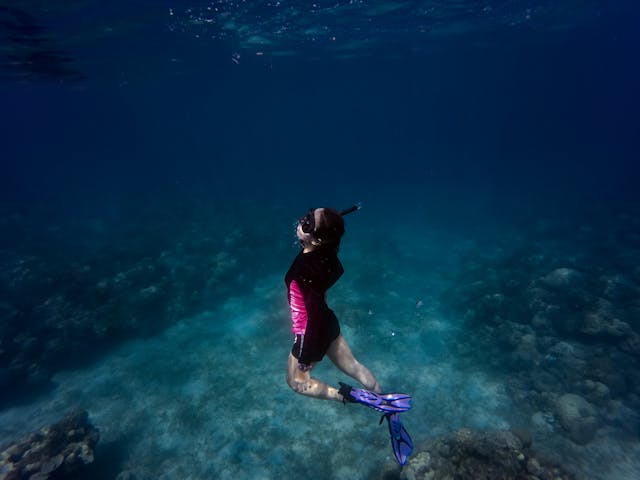
Pressure equalization is essential during deep freediving. Several maneuvers exist: the Valsalva, Frenzel, Voluntary Tubal Opening, and Mouthfill. Each of these methods requires precise control of the airways and perfect body awareness to avoid any discomfort or injury.
Progression in these techniques relies on regular practice on land or in a pool. The use of accessories like the Otovent facilitates the perception of clicks in the ears, proof of good equalization.
How important is safety and supervision when learning freediving?
Safety remains a priority in freediving. Supervision by certified instructors in clubs or schools approved by SSI, PADI, or FFESSM ensures reliable and progressive training. These professionals understand the risks related to hyperventilation and blackout, and ensure learning is adapted to each level.
Group practice promotes tolerance to effort, control of physiological parameters, and safe progression. Supervision allows for validating skills and adjusting goals for each session.
Which equipment and environments should be favored to progress effectively in freediving?
The choice of suitable equipment, such as fins, monofins, wetsuits, and safety accessories, optimizes each freediving session. These tools facilitate progression and allow focusing on technique and power without material constraints.
Training in controlled environments, like Deepspot or dedicated pools, offers ideal conditions to work on lung capacity, ventilation, and hypoxia safely. The stability of these locations encourages awareness of effort and setting precise goals.
Recommended equipment and environments
- Fins and monofins: Improve power and technique
- Wetsuits: Maintain temperature and promote concentration
- Safety accessories: Buoys, lifelines, Otovent
- Deep pools: Simulate progression in natural environments
- Certified clubs: Specialized supervision for safety
During an immersion at Deepspot, a beginner freediver managed to double their breath-hold duration after three weeks of structured and supervised training.
To progress in learning freediving and improve your breath-holding capacity through advanced techniques, also discover 10 good reasons to start fin hiking to vary the pleasures and enrich your aquatic experience.
For those who wish to master the art of underwater breathing, it is essential to follow a freediving training course to learn how to hold your breath effectively with advanced techniques.
How to develop increased tolerance to hypoxia during freediving training?
Working on hypoxia tolerance helps improve the duration and quality of each freediving session. Specific training protocols alternate between breath-holding and recovery phases to accustom the body to functioning with reduced oxygen levels. This gradual adaptation results in better management of the respiratory discomfort threshold and a notable progression.
Controlled breathing exercises, combined with increased body awareness, promote the optimization of oxygen distribution to essential muscles. Establishing regular routines helps strengthen lung capacity and elevate overall freediving performance.
Adopting a structured approach, integrating deep relaxation phases and heart rate control, improves physiological adaptation. The increase in hypoxia tolerance translates into better stress management underwater and rapid progression for each practitioner level.
Breathing exercises to increase lung capacity
Series of deep breathing exercises, practiced daily, stimulate lung power and thoracic flexibility. The combination of techniques such as pranayama and heart coherence refines the perception of respiratory control and accelerates progression in freediving.
Mental training and underwater visualization
Concentration and mental visualization of the different stages of immersion strengthen safety and stress management. These methods develop body awareness and allow anticipation of sensations related to oxygen decrease during diving.
- Daily practice of heart coherence
- Static apnea sessions in the pool
- Visualization exercises before immersion
- Alternation of hypoventilation and recovery
- Monitoring heart rate during training
How to choose a freediving training suited to your goals and level?
Identifying a suitable course is based on evaluating your own expectations, whether it is performance seeking, the pleasure of discovery, or improving safety. Recognized schools offer differentiated paths, from beginner to expert, with modules focused on technique, progression, and physical preparation.
Individualized programs include swimming sessions, relaxation, and mental training. This personalized follow-up optimizes progression while ensuring safe and gradual learning of equalization and respiratory control maneuvers.
Support from qualified instructors guarantees regular assessment of skills and adaptation of exercises according to progress. Access to different environments, such as the pool, the deep pool, or the sea, fosters harmonious progression adapted to each practitioner’s profile.
Criteria for selecting a freediving school
Favoring a certified structure, equipped with experienced supervision and suitable equipment, provides solid foundations for effective progression. The learning environment must allow practicing safety and developing technique under optimal conditions.
Personalizing training according to goals
Defining clear objectives, whether it is increasing lung capacity, improving equalization, or strengthening mental strength, guides the choice of modules and sessions. Adapting the training program maximizes the effectiveness of individual progression.
- Analysis of personal needs and expectations
- Initial level assessment by a professional
- Choice of a certified school or club
- Scheduling sessions according to objectives
- Regular monitoring of progress
- Program adjustment based on results
Why does freediving training transform the perception of the body and mind?
Regular practice of freediving develops an unprecedented body awareness and mental control. Learning breath control, optimizing lung capacity, and acquiring relaxation techniques allow one to explore personal limits and experience a unique sensation of freedom. This gradual transformation is accompanied by better stress management and increased confidence in one’s abilities.
“To dive freediving is to dive within oneself.”
FAQ for progressing calmly in freediving
How to manage stress during the first freediving immersions?
Favor slow and deep breathing before immersion, then focus your attention on positive sensations, such as the fluidity of your movement or the temperature of the water. Training relaxation outside the water and practicing visualization also helps transform apprehension into confidence, making each descent more pleasant and relaxed.
What signs indicate that a breath-hold should be interrupted to stay safe?
Involuntary diaphragm contractions, disorientation, a black veil before the eyes, or a feeling of euphoria are signals never to ignore. It is then advisable to ascend calmly while respecting safety, as these signals often precede advanced hypoxia. Listening to your body and respecting its limits ensures sustainable and serene progress.
Is freediving suitable for all ages and profiles?
Freediving is suitable for anyone in good physical condition, regardless of age. Training adaptation and personalized support allow progression at one’s own pace. Specialized clubs often offer introductory sessions or adapted courses, allowing gradual integration of the discipline, whether one is a curious beginner or an experienced athlete.