On August 11, 2026, the Australian Institute of Marine Science (AIMS) published its annual report on 121 reefs of the Great Barrier Reef. Hard coral has regained ground in the north and center. In the south, it is retreating.
This report comes after two difficult summers. In 2024, mass bleaching affected the largest area ever recorded on the reef, according to the AIMS report of August 2025.
So this page has been completely revised. The old figures have been corrected, the new ones are dated, and those that could not be verified have been removed.
What is the actual size of the Great Barrier Reef?
The Great Barrier Reef stretches about 2,300 kilometers along Queensland and covers 344,400 km², according to the marine park authority (GBRMPA). It includes some 3,000 reefs, about 600 continental islands, and 300 coral cays. It is the largest reef system in the world.
Fauna figures have been revised upwards since the first version of this article.
| Reference | Value published by GBRMPA |
|---|---|
| Length | about 2,300 km |
| Area | 344,400 km² |
| Coral reefs | about 3,000 |
| Islands and cays | about 600 continental islands and 300 cays |
| Hard corals | about 450 types |
| Fish | about 1,625 types |
| Mollusks | more than 6,000 varieties |
| Sharks and rays | 136 varieties |
| Sea turtles | 6 species |
| UNESCO listing | 1981 |
You will find elsewhere “350 coral species” or “1,500 fish.” These values circulate from guide to guide without dates. However, inventories progress as teams describe new species, and GBRMPA today publishes higher counts for hard corals, fish, and mollusks. An undated fauna figure ages quickly. So we keep these values as orders of magnitude.
How was the reef formed?
The current reef is young on a geological scale. Ancient phases of coral growth date back several hundred thousand years, but the living structure observed today settled after the last sea level rise, less than 10,000 years ago (approximate order of magnitude).
The previous version of this page mentioned 18 million years. No serious source linking this figure to the current living reef was found, so it was removed.
But the principle remains simple. Polyps, small animals related to jellyfish, deposit limestone. They live in colonies and stack their skeletons generation after generation. When the sea rose at the end of the last glaciation, they colonized the flooded coastal plain. The reef followed the water.
If you want to understand how a polyp builds its skeleton, our comprehensive guide on corals covers the subject in detail.
What do the AIMS 2025 and 2026 reports say about the reef’s condition?
The AIMS report published in August 2026 shows an increase in hard coral in the north (35.1%) and center (31.6%), and low stability in the south (26.4%). The previous year had been marked by record declines, especially in the south, after the 2024 mass bleaching.
| Region | Hard coral 2025 | Hard coral 2026 |
|---|---|---|
| North | 30.0% | 35.1% |
| Center | 28.6% | 31.6% |
| South | 26.9% | 26.4% |
To properly read this table, it must be placed in context. According to the AIMS report of August 2025, the 2024 bleaching was the fifth mass episode since 2016, with the largest extent ever measured on the Great Barrier Reef. A sixth episode followed in 2025, mainly in the north. The south had then lost nearly one-third of its hard coral in one year (relative value). It was the largest annual decline recorded for an entire region.
And 2026 has not erased everything.
AIMS researchers write that the late summer monsoon brought clouds and cooled the water, which probably limited bleaching despite temperatures still above average. Category 5 cyclone Narelle struck the north in March 2026. The crown-of-thorns starfish remains present. No severe infestation was noted, but five established outbreaks were recorded and a fifth wave is emerging in the north. Our article on vinegar tested against crown-of-thorns starfish details one control method, and the one on the giant triton, natural predator of this starfish presents a slower approach.
In short, a good year does not say much about the trend. The reef remains exposed to heat waves, and the interval between episodes is shortening. For bleaching mechanisms, read our dossier on threats to corals.
Why hasn’t UNESCO listed the reef as “in danger”?
In July 2026, the World Heritage Committee decided not to inscribe the Great Barrier Reef on the List of World Heritage in Danger. GBRMPA indicates that the Committee requests a progress report from Australia by December 1, 2028, then a full report on the state of conservation by December 1, 2029.
The reef has been on the World Heritage List since 1981.
In 2025, the Committee had demanded a detailed report for early 2026. It wanted to see how Australia was addressing climate, water quality, fishing, and crown-of-thorns starfish. This report was reviewed in 2026. The Committee praised cooperation between the federal government and Queensland and cited the crown-of-thorns control program as an effective measure. Yet UNESCO also notes that the reef’s capacity to withstand degradation is diminishing.
This decision concerns Australian management. The Committee currently considers that it addresses threats a manager can handle, while ocean warming far exceeds what a marine park can control alone.
Diving on the Great Barrier Reef in 2026: what questions to ask before booking?
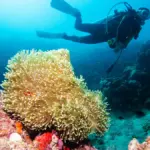
The reef remains open to diving and snorkeling, but coral condition varies greatly from one area to another. Before booking, ask the operator which site they target, what skill level the outing is for, how they manage currents and weather, and who supervises in the water.
Start with the skill level. An outing from Cairns or the Whitsundays may target an outer reef exposed to wind. For what level? The answer changes everything, and it is up to the operator to provide it in writing. A turquoise photo on a booking platform does not describe swell, trip duration, or number of divers per guide.
Then consider the season. Heat waves that trigger bleaching occur in the Australian summer, and the 2026 cyclones arrived in January and March according to AIMS. Currents depend on site and tide. We do not publish visibility or current ranges here, due to lack of dated and sourced data (impossible to decide here). The day’s briefing and supervision matter more than the brochure.
Thus, forget the promised encounter.
No operator can guarantee a turtle, ray, or dugong. On site, keep your distance from coral and wildlife, and reread why you should never touch marine life. The real cost of a bad outing is measured in lost safety margin and wasted day, much more than in euros.
FAQ
What is the size of the Great Barrier Reef?
It stretches about 2,300 kilometers along Queensland and covers 344,400 km², according to GBRMPA. It includes about 3,000 reefs and approximately 900 islands and cays.
Is the Great Barrier Reef dying?
The AIMS report of August 2026 shows an increase in hard coral in the north and center, and low stability in the south. The reef has undergone six mass bleaching episodes since 2016, and researchers still describe it as under pressure.
Is the Great Barrier Reef listed as “in danger” by UNESCO?
No. In July 2026, the World Heritage Committee decided not to list it as in danger. Australia must submit a progress report in December 2028 and a full report in December 2029.
Can the Great Barrier Reef be seen from space?
Yes, its outlines are visible from Earth’s orbit due to its size. The entire reef can be distinguished, but not the detail of colonies.
Sources
- Annual Summary Report of Coral Reef Condition 2025/26 (Australian Institute of Marine Science, 2026)
- World Heritage Committee decision on the Great Barrier Reef (Great Barrier Reef Marine Park Authority, 2026)
{“@context”:”https://schema.org”,”@type”:”FAQPage”,”mainEntity”:[{“@type”:”Question”,”name”:”Quelle est la taille de la Grande Barrière de corail ?”,”acceptedAnswer”:{“@type”:”Answer”,”text”:”Elle s’étend sur environ 2 300 kilomètres le long du Queensland et couvre 344 400 km², selon la GBRMPA. Elle compte quelque 3 000 récifs et environ 900 îles et cayes.”}},{“@type”:”Question”,”name”:”La Grande Barrière de corail est-elle en train de mourir ?”,”acceptedAnswer”:{“@type”:”Answer”,”text”:”Le rapport AIMS d’août 2026 montre une remontée du corail dur au nord et au centre, et une stabilité basse au sud. Le récif a subi six épisodes de blanchissement de masse depuis 2016, et les chercheurs le décrivent toujours comme sous pression.”}},{“@type”:”Question”,”name”:”La Grande Barrière est-elle classée « en péril » par l’UNESCO ?”,”acceptedAnswer”:{“@type”:”Answer”,”text”:”Non. En juillet 2026, le Comité du patrimoine mondial a décidé de ne pas l’inscrire sur la liste en péril. L’Australie doit rendre un rapport d’étape en décembre 2028 et un rapport complet en décembre 2029.”}},{“@type”:”Question”,”name”:”Peut-on voir la Grande Barrière depuis l’espace ?”,”acceptedAnswer”:{“@type”:”Answer”,”text”:”Oui, ses contours sont visibles depuis l’orbite terrestre grâce à sa taille. On distingue l’ensemble du récif, pas le détail des colonies.”}}]}