Between early 2023 and mid-2025, 84% of the world’s coral reef area experienced heat intense enough to cause bleaching. The figure comes from NOAA. The American agency announced in June 2026 the likely end of this fourth global episode.
This guide covers the basics of coral, from polyp biology to the right practices when swimming over a reef. Each detailed topic has its own article on the site.
Here, we keep the overview (with dated figures).
Is coral an animal or a plant?
Coral is an animal. Each colony gathers hundreds to thousands of polyps, small cnidarians related to jellyfish and sea anemones. In reef-building corals, each polyp hosts microalgae, zooxanthellae, in its tissues, which provide most of its energy through photosynthesis.
The polyp looks like a small sac topped with tentacles. At night, it captures plankton with its stinging cells. It also secretes a limestone skeleton beneath it, layer by layer, which eventually forms a reef when thousands of colonies stack up over centuries on the same base. Growth rates vary greatly between species. Massive forms gain a few millimeters per year. Some branching forms exceed ten centimeters per year under good conditions, to be taken as a rough order of magnitude.
This polyp and algae pair has a very simple limit: when the water stays too warm for too long, it breaks down.
Regarding reproduction, coral plays on two fronts. The asexual route occurs through budding or by a broken fragment that attaches elsewhere and regrows. The sexual route produces the famous synchronized spawning, when many colonies release eggs and sperm during the same night, often a few days after a full moon. The larvae then drift with the current. Few find a hard substrate.
What are the main types of corals?
First, we distinguish hard corals, or scleractinians, which build reefs with their limestone skeleton. Then come soft corals, without a rigid skeleton. Black coral forms a separate group, and the “fire coral” feared by divers actually belongs to hydrozoans, another branch of cnidarians than true corals.
| Group | Skeleton | Where to find it | Key points |
|---|---|---|---|
| Hard corals (scleractinians) | Limestone, rigid | Shallow tropical reefs, some cold-water species | They build reefs |
| Soft corals and gorgonians (octocorallians) | Small calcareous pieces in soft tissues | Tropics, Mediterranean for gorgonians | No reef building |
| Red coral (Corallium rubrum) | Red limestone | Mediterranean, shaded areas | Slow growth, long harvested for jewelry |
| Black coral (antipatharians) | Dark and flexible axis | Mostly deep water | Black skeleton under colored tissues |
| Fire coral (Millepora) | Limestone | Tropical reefs | Highly stinging hydrozoan |
Black coral deserves a detour. Its dark skeleton has long ended up in jewelry, while its living tissues are often light or colored, and most species live far from the surface, out of reach of recreational divers. We dedicate a full article on black coral and its particularities. But not all corals live in the tropics, since cold-water corals without zooxanthellae form deep massifs even in the North Atlantic, far from light. They are almost completely out of public view.
For lighter anecdotes, the page of 10 interesting things to know about corals is a good complement.
Where are the largest coral reefs?
Reefs concentrate in clear, shallow tropical waters, where light reaches the zooxanthellae. They are found in the Indo-Pacific, Red Sea, Indian Ocean, and the Caribbean. The often cited order of magnitude for their total area is around 280,000 km², a very small fraction of the seafloor.
- The Great Barrier Reef in Australia exceeds 2,000 km in length. It is the largest reef system in the world.
- The Mesoamerican Reef, whose Belize Barrier Reef is the best known part, runs along the coasts of Mexico to Honduras.
- The lagoons of New Caledonia have been UNESCO-listed since 2008.
- Fiji presents itself as the “world capital of soft corals,” a nickname from tourism promotion not based on any ranking published by a scientific organization.
- The Andros Barrier Reef, in the Bahamas, borders blue holes.
- In the Red Sea, several studies suggest that northern corals resist heat better than those in other regions.
Yet, the size of a reef tells nothing about its condition. A huge barrier may have lost a good part of its living cover in some areas while remaining spectacular in photos, because a well-framed shot always shows the best massif. Brochures almost never date their images. Before a trip, rather look for the latest surveys published by local monitoring organizations, which indicate if the area has recently bleached. One too-hot summer is enough.
The reef in a postcard may be ten years old.
What threatens corals today?
Heat comes first. According to the IUCN, 44% of reef-building coral species were threatened with extinction in November 2024, compared to one-third in the 2008 assessment. Climate change is the leading cause, ahead of pollution, agricultural runoff, diseases, and unsustainable fishing.
Bleaching occurs when water too warm for several weeks pushes the polyp to expel its zooxanthellae, the algae that gave it both its color and food. The white skeleton then appears through tissues that have become transparent. A bleached coral remains alive for a time. It can recover its algae if the temperature drops quickly enough, but it starves if the stress lasts. The details of mechanisms and threats facing corals are covered in a dedicated article.
The pace has changed. NOAA counts four global bleaching events: 1998, 2010, 2014 to 2017, then 2023 to 2025. Its Coral Reef Watch program coordinator estimates reefs will now bleach almost every year, leaving little time for colonies to recover between heat waves.
Other pressures add up locally.
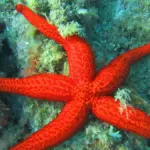
For example, the crown-of-thorns starfish (Acanthaster) devours polyps and can devastate entire reef sections during outbreaks. Sediments and wastewater smother coastal colonies. Some sunscreen filters, like oxybenzone, are toxic to coral larvae in labs. Their real effect on an open reef remains debated, and we detail the state of knowledge in our article on sunscreen and the seafloor. Hawaii has nevertheless banned the sale of sunscreens containing oxybenzone and octinoxate since 2021.
Can a coral reef be restored?
Yes, on a small scale. Coral farming grows fragments in nurseries, at sea or in tanks, before replanting them on the reef. Other teams collect gametes during spawning to raise larvae, or test 3D-printed structures that serve as support for young colonies.
These techniques work on modest areas. A restoration site often covers a few hundred square meters, sometimes a few hectares, while reefs affected by heat waves extend over thousands of square kilometers. And a replanted colony bleaches like the others if the water heats up. Researchers know this. Many bet on corals selected for thermal tolerance, with results still difficult to assess long-term.
3D-printed artificial reefs are a good example, and we follow the topic in our article on 3D printing to the rescue of coral reefs.
However, our view is summed up in one sentence. Restoration buys time and produces knowledge, but it does not replace emission reductions that will decide the fate of reefs. Which technique will scale to an entire reef? Impossible to decide yet.
How to observe corals without damaging them?
Touch nothing, keep your distance, and work on your buoyancy before approaching a drop-off. Damage caused by divers and snorkelers mostly comes from a fin kick, a knee resting, or a grabbing hand. A crushed polyp leaves a wound that algae and diseases can colonize.
For what level? A beginner diver often struggles to stabilize at first, and that’s normal. The right reflex is to stay above sand or in open water as long as buoyancy isn’t fine-tuned, then gradually approach fragile massifs over outings. Ask at the briefing where sandy zones are to rest if needed. In snorkeling, the classic trap remains the reef flat at low tide. You quickly find yourself standing there.
In short, shallow water demands as much vigilance as open water, because coral is within knee reach.
But actions on land also matter. A lycra suit or thin wetsuit limits sunscreen you leave in the water. Do not collect any fragment, even dead, as it serves as support for larvae and its removal is prohibited in many countries. And keep your gloves for sites where the club deems them useful, as they encourage grabbing.
Once underwater, everything depends on your finning technique. The concrete cost remains modest: one or two dives dedicated to buoyancy before departure, and a lycra suit costing a few tens of euros. A massive colony, however, sometimes took centuries to grow.
FAQ
Is coral an animal, a plant, or a mineral?
Coral is an animal from the cnidarian family, like jellyfish. In reef-building species, it lives in association with microalgae that provide energy. The limestone skeleton it produces explains the confusion with a mineral.
Is a bleached coral dead?
Not necessarily. A bleached coral has expelled its algae but remains alive for a time. If the temperature drops quickly enough, it can recolor in a few weeks or months. If the heat persists, it eventually dies and becomes covered with algae.
Can you pick up a piece of dead coral on the beach?
Better leave it in place. Coral debris contributes to sand formation and serves as support for reef life. In many countries, removing coral is prohibited, even a dead fragment.
Where to see corals without scuba diving?
Snorkeling suffices on many fringing reefs accessible from the beach, provided you choose the tide and entry time well. Large public aquariums also display tanks of living corals. In both cases, keep your distance and never step on a massif.
Sources
- Over 40% of coral species face extinction – IUCN Red List (IUCN, 2024)
- World’s Fourth Mass Coral Bleaching Event Likely Ended in 2025 (NOAA NESDIS, 2026)