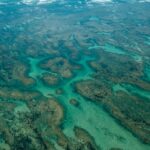
In 2012, in the Marquesas, the children of the Vaitahu primary school wanted to protect the bay located in front of their school. The French Office for Biodiversity (OFB) presents this project as the starting point of educational marine areas.
A bay, children, a council that decides. Nothing spectacular, and that is precisely what lasts over time.
Our old page spoke of young “ambassadors of the sea,” partnerships, and a program credited with at least 550 participants, without saying where these numbers came from. We kept the idea and removed what we could not verify. Here is what exists, dated, with its limits.
Does diving really change the way we see the ocean?
It can change it, because it puts names and shapes on an environment that most people only see on the surface. Alone, the emotion of a baptism is not enough. What remains is a repeated practice: observing, noting, understanding a local rule and seeing that it makes sense.
The Brazilian project TransforMAR illustrates this logic well. Founded by engineer Alexandre Silva, it offers young people from traditional coastal communities (indigenous, quilombolas, caiçaras) a Discovery Scuba baptism coupled with marine biology and conservation activities, according to an article from DeeperBlue published on May 28, 2025. The article does not give any number of participants. So we do not invent any.
This point applies to the whole subject.
Yet, it is often read that a sensitized diver necessarily becomes an “agent of change.” It is possible. Nothing guarantees it, and no study cited in our old version measured this transition from wonder to behavior. Measuring this effect over several years remains impossible to decide from here, due to the lack of published follow-up that can be compared from one program to another. Serious programs know this.
In short, diving opens a door. What follows depends on what is done once out of the water.
Which citizen science programs are open to divers?
Three programs are often mentioned and well documented: Reef Check for reef status, REEF for fish inventory, and DORIS, the identification database of the FFESSM. Each requires a different level of commitment, from simple species surveys to training in the protocol.
Reef Check is based on a protocol designed by Gregor Hodgson. Its goal was to be rigorous enough for scientists and simple enough for a recreational diver without researcher training. The first global survey took place in 1997, the International Year of the Reef, on more than 300 reefs in 31 countries and territories, according to an article published by Reef Check on June 26, 2026. The protocol follows indicator species easy to recognize and signs of human impact. Volunteers undergo training in the protocol before their first survey, which requires real commitment.
REEF, founded in 1990, works differently.
You dive as usual and note every fish species you see, without transect or imposed route. In 2018, Scuba Diving magazine mentioned more than 225,000 surveys and more than 15,000 volunteers in its database, one of the largest marine observation databases.
On the French side, DORIS was created in 2004 and depends on the underwater environment and biology commission of the FFESSM. The site is open to everyone. A summary presented in 2025 at the One Ocean Science Congress spoke of 3,090 species sheets and 1,089 contributors. If you photograph while diving, it is a good starting point to learn to identify what you have seen before submitting an observation.
Where to follow an underwater trail in France?
The best known is the one at Palud beach, on Port-Cros island, managed by the National Park. The Cerbère-Banyuls marine nature reserve also offers a trail starting from Peyrefite beach. Both are done with fins, mask, and snorkel, without a tank.
At Palud, the 2024 documentation from the National Park describes six buoys equipped with submerged explanatory panels, for a route of about 40 minutes. Access is free for any equipped autonomous swimmer. The same document lists about ten trails in the park territory and neighboring municipalities, some with free access, others only with a guide from 8 years old. Check the conditions before you go.
Thus, the trail serves as a first class.
In Banyuls, the Pyrénées-Orientales tourist office announces five observation points, free access, and an opening from June 13 to September 13, 2026. The trail is located in a marine nature reserve. It has its own rules. For what level? Both routes are intended for autonomous swimmers with fins, mask, and snorkel, and the wind as well as the swell of the day matter more than the clear water photo in the brochure.
Clear water says nothing about the current.
What is an educational marine area?
It is a small coastal zone managed participatively by a class, based on the model born in Vaitahu. The students form a “sea council” that decides on actions. The OFB coordinates the system with the National Education, from CE2 to high school.
The figures are public. As of June 12, 2026, the OFB recorded 1,942 active educational areas, including 399 educational marine areas and 1,543 terrestrial areas, for more than 250,000 students. The office offers aid of €5,000 for a new project and €4,000 for a renewal over two school years. Experiments exist outside France, in Spain, Greece, Canada, or Brazil. The system does not require diving.
Yet that is its strength.
A class can work on a cove while staying on the sand, observe from the shore, then discover the bottom on a guided snorkeling hike if the project and the teacher provide for it. For a diving club near a school, partnering with an educational marine area provides a more solid framework than a one-off “eco” labeled outing without follow-up.
Green Fins and waste collection: how valid are these commitments?
Green Fins is the most measurable tool for a diving center. Created in 2004 by the Reef-World Foundation and the United Nations Environment Programme, it is based on a 15-point code of conduct. Certified members are evaluated annually on site by assessors.
The effect has been measured. A study published in 2016 in Environmental Management (Roche et al.) followed 100 divers in the Philippines. 88% touched the reef at least once, and fins accounted for 45.5% of contacts. Divers supervised by centers most compliant with the Green Fins code touched the reef about twice less often (0.19 versus 0.40 contacts per minute). The study does not measure the effect of the briefing alone.
However, a logo is not enough.
Since 2022, Green Fins also offers a digital membership based on self-assessment, without a minimum required score, according to the program’s website. Ask the center if it is a certified member, with on-site evaluation, or a digital member. The two approaches do not say the same thing, and an operator page displaying the logo without specifying leaves full doubt.
Waste collection poses the same proof problem. A useful cleanup dive is prepared: chosen zone, buoyancy instructions, sorting on return, and data sent to a program that exploits them. A net or already colonized waste can harbor organisms, and removing it sometimes causes more damage than leaving it in place, especially when no one has checked what lives on it. To get started, our guide on cleanup dives and how to join a local ecological project details the steps.
What are the limits of “educational” diving?
The first limit is simple: every diver adds pressure on the site they visit, even when they come to learn. Contacts, moorings, sunscreen, attendance. An educational discourse that ignores this cost amounts to greenwashing, even with good intentions.
Tourism can also close sites. In Cozumel, sectors were partially closed starting in October 2019 due to the hard coral disease SCTLD, as explained in our article on diving on the reefs of Cozumel. Such decisions remind us that a manager can remove a reef from the map when deemed necessary, and a traveler must accept it without seeing it as a punishment.
But basic actions remain the most effective.
Good buoyancy, fins held away from the bottom, and hands that don’t touch anything matter more than any badge, as our page on the reasons to never touch marine life reminds us. Some parks prohibit gloves for this reason. Our article on diving gloves and their prohibitions reviews the rules of some well-known marine parks. The question of sunscreen and its effect on the seabed remains. This is addressed before boarding.
If you want to go beyond your own practice, our file on the role of citizen divers lists other avenues. The cost is concrete: a few extra minutes of briefing, sometimes a less prestigious site, and a club chosen for its practices rather than its welcome photo.
FAQ
Is a diving level required to participate in citizen science?
Not always. REEF accepts surveys conducted during an ordinary recreational dive, and DORIS is primarily used to identify species. Reef Check trains its volunteers on the protocol before surveys.
Is the underwater trail of Port-Cros free?
The 2024 documentation from the National Park indicates free access for any autonomous swimmer equipped with fins, mask, and snorkel. Check the conditions for the year before crossing.
Can a school create an educational marine area without diving?
Yes. The OFB system is based on a coastal zone managed by students, not on diving. A grant of €5,000 is planned for a new project.
How to know if a center really applies Green Fins?
Ask if it is a certified member, evaluated on-site every year, or a digital member, who self-assesses without a minimum score. Certified members are ranked bronze, silver, or gold.
Is collecting trash while diving always useful?
Not always. A colonized piece of trash can shelter organisms, and poorly prepared collection can damage the seabed. It is better to join a supervised operation that shares its data.
Sources
- Educational areas (French Office for Biodiversity, updated June 12, 2026)
- Recreational Diving Impacts on Coral Reefs and the Adoption of Environmentally Responsible Practices within the SCUBA Diving Industry (Roche et al., Environmental Management, 2016)
{“@context”:”https://schema.org”,”@type”:”FAQPage”,”mainEntity”:[{“@type”:”Question”,”name”:”Faut-il un niveau de plongée pour participer à des sciences participatives ?”,”acceptedAnswer”:{“@type”:”Answer”,”text”:”Pas toujours. REEF accepte des relevés faits pendant une plongée loisir ordinaire, et DORIS sert d’abord à identifier des espèces. Reef Check forme ses volontaires au protocole avant les relevés.”}},{“@type”:”Question”,”name”:”Le sentier sous-marin de Port-Cros est-il gratuit ?”,”acceptedAnswer”:{“@type”:”Answer”,”text”:”La documentation 2024 du Parc national indique un accès libre pour tout nageur autonome équipé de palmes, masque et tuba. Vérifie les conditions de l’année avant de traverser.”}},{“@type”:”Question”,”name”:”Une école peut-elle créer une aire marine éducative sans plongée ?”,”acceptedAnswer”:{“@type”:”Answer”,”text”:”Oui. Le dispositif de l’OFB repose sur une zone littorale gérée par les élèves, pas sur la plongée. Une aide de 5 000 € est prévue pour un nouveau projet.”}},{“@type”:”Question”,”name”:”Comment savoir si un centre applique vraiment Green Fins ?”,”acceptedAnswer”:{“@type”:”Answer”,”text”:”Demande s’il est membre certifié, évalué chaque année sur place, ou membre numérique, qui s’autoévalue sans score minimum. Les membres certifiés sont classés bronze, argent ou or.”}},{“@type”:”Question”,”name”:”Ramasser des déchets en plongée, est-ce toujours utile ?”,”acceptedAnswer”:{“@type”:”Answer”,”text”:”Pas toujours. Un déchet colonisé peut abriter des organismes, et un ramassage mal préparé abîme le fond. Mieux vaut rejoindre une opération encadrée qui transmet ses données.”}}]}