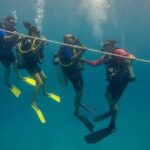
On April 18, 1974, 1.53 hectares of Saint-Nicolas Island, in the Glénan archipelago, became a national nature reserve to protect a daffodil that grows nowhere else. It is on this same island that the CIP Glénan has housed and trained its divers since 1956.
This sheet only includes what the club publishes on its website, what the Fouesnant tourist office displays, and what the reserve’s management plan states, all consulted in early October 2026. No opinions, no visits.
The club does not publish its rates clearly. Therefore, none are cited.
What is the CIP Glénan and where is it located?
The CIP Glénan, standing for Centre international de plongée des Glénan, is a non-profit association under the 1901 law founded in 1956. Volunteers manage it and a small team of permanent staff runs it daily. The center is located on Saint-Nicolas Island, off the coast of Fouesnant, and hosts its members on a full-board basis.
The previous version of this article dated its creation to 1960. The club’s website states 1956 right on its homepage, and that is the date retained here. It also mentioned an affiliation with PADI. However, no page consulted on the site shows any affiliation, neither federal nor agency, while the courses bear French titles, from Level 1 to MF1, specific to the federal system. Therefore, PADI is removed. Ask the club under which federation it issues its certificates, as the answer matters if you dive elsewhere afterward.
The center also presents itself as a member of the ambassador network of the nature reserve managed by Bretagne Vivante.
Regarding labels, the Fouesnant tourist office sheet mentions a European ecolabel. The club’s website does not mention it.
What training does CIP Glénan offer?
The club displays a complete pathway, from Level 1 up to MF1, the first degree of federal instructor. It announces Level 2 up to 40 meters, Level 3 and Level 4 up to 60 meters, and also welcomes DEJEPS trainees for practical internships. Online registration concerns levels 1 to 3 only.
The old article listed nitrox, rebreathers, marine biology, RIFAP, and “management of physiology during immersion.” The training page consulted in October 2026 does not mention these. These lines are removed. They may have existed or still exist in another form, but nothing dated allows presenting them as a current offer from the club, and a sheet promising a rebreather course absent from the schedule is costly for anyone who took time off for it. Ask the question in writing.
For leadership training, the site does not publish an online calendar and refers to direct contact with the team.
But membership and the course are paid separately. The site specifies this without giving an amount. The annual fee applies to the calendar year, from January 1 to December 31, even if you only come for a week in September.
How do exploration dives at the Glénan work?
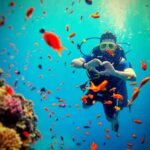
The club offers two exploration packages, always full board. The first lasts 2 days for 3 dives, the second 5 days for 7 dives. The exploration boat is open to all levels, either autonomous or supervised, and the “Adventure” package, towards wrecks and canyons of the West, requires at least a supervised Level 2.
Its group-dedicated page announces “more than 30 dive sites accessible in less than 45 minutes.”
The previous version spoke of 59 sites and 15 wrecks, with ship names and hull lengths. None of these figures were found on the club’s website. They disappear. Yet, the southern Brittany Atlantic remains a tidal sea, and the time to enter the water on a wreck or canyon depends on the current and tide reversal far more than on the photo of the site in a brochure. This choice is up to the dive director on the day.
If the idea of a wreck in cold, dark water knots your stomach, our article on stress management in diving helps you recognize the signs before they escalate. Talk about it at the briefing.
How to reach Saint-Nicolas Island and what to prepare?
The CIP boat departs from the Aiguillon slipway, in the port of Concarneau. Other companies serve the archipelago, such as Vedettes de l’Odet from June 1 to September 15, from several ports including Bénodet and Port-la-Forêt. The Fouesnant tourist office indicates an opening from April 1 to October 31, 2026.
For training or exploration, the club requires a medical certificate less than one year old and proof of level. Level 1 is an exception, with no proof required. For an introductory dive, your contact details and an emergency contact are sufficient. The certificate model published by the FFESSM, June 2026 version, can be signed by a general practitioner, a sports doctor, a doctor specialized in underwater medicine, or a federal doctor, and its validity is suspended in case of a change in health status or a diving accident. No one decides remotely that you are fit.
The packing list reminds that you sleep in a group setting, with a sleeping bag, fitted sheet 90 × 200, pillowcase, towel or poncho, water bottle, lamp, and gloves if you fear the cold.
Thus, if you arrive from afar, your stay starts the day before. The site mentions a youth hostel, a hotel, and guest rooms in Concarneau for the previous night.
What to ask CIP Glénan before booking?
Four points remain to be confirmed in writing: the price of membership and the course, the federation issuing the certificates, the exact dates of your session on the 2026 schedule, and what is planned if the weather blocks the boat. These answers weigh more on your budget than the archipelago map.
The 2026 schedule exists, but it is published as a downloadable document, and we could not read it entirely. Impossible to decide from here on session dates. On an island, the weather rules. A west wind can cancel the crossing or the day’s outing, and you then spend a day of the course on land, on a small island, with dives that may not be made up before your departure. Ask what the club plans in this case.
The reserve’s management plan reminds visitors on land of two simple rules: keep dogs on a leash and respect protected habitats.
However, the reserve covers the island’s land. At sea, common sense rules remain the same, and we gathered them in our guide to observe marine life without disturbing it, with reasons why you should never touch marine life. If you hesitate with another center, we reviewed with the same criteria Archipel Plongée in Argelès-sur-Mer and l’Argonaute near Toulouse.
In short, the archipelago is dreamy, logistics decide.
And the actual cost can be summed up in a few lines, between the crossing from Concarneau, the night before, the annual membership, and a week of full board on a car-free island, whose fate you still ignore if the wind keeps the boat in port. Would you book it like this?
FAQ
Where is CIP Glénan located?
The center is on Saint-Nicolas Island, in the Glénan archipelago, in the municipality of Fouesnant. The club’s boat departs from the Aiguillon slipway, in Concarneau. The Fouesnant tourist office indicates an opening from April 1 to October 31, 2026.
Is CIP Glénan an FFESSM or PADI club?
The club pages consulted in early October 2026 show no affiliation. The courses have French titles, from Level 1 to MF1. Ask the club which federation issues your certificates before registering.
Is membership required to dive at CIP Glénan?
Yes, for training and explorations, the site indicates that membership in the association is required. The fee is valid for the calendar year and is paid in addition to the course. Its amount is not published on the pages consulted.
What documents must be provided?
For training or exploration, the club requires a medical certificate less than one year old and proof of level, except for Level 1. For an introductory dive, it is enough to provide your contact details and an emergency contact.
Can you dive at the Glénan with children?
The club’s site does not publish a minimum age. The previous version of this sheet indicated 8 years, information we did not find again. Ask the club before booking an introductory dive.
Sources
- Simplified management plan of the Saint-Nicolas des Glénan Nature Reserve (Bretagne Vivante, 2026)
- Medical certificate of absence of contraindication to the practice of underwater activities (FFESSM, June 2026 version)
{“@context”:”https://schema.org”,”@type”:”FAQPage”,”mainEntity”:[{“@type”:”Question”,”name”:”Où se trouve le CIP Glénan ?”,”acceptedAnswer”:{“@type”:”Answer”,”text”:”Le centre est sur l’île Saint-Nicolas, dans l’archipel des Glénan, sur la commune de Fouesnant. Le bateau du club part de la cale de l’Aiguillon, à Concarneau. L’office de tourisme de Fouesnant indique une ouverture du 1er avril au 31 octobre 2026.”}},{“@type”:”Question”,”name”:”Le CIP Glénan est-il un club FFESSM ou PADI ?”,”acceptedAnswer”:{“@type”:”Answer”,”text”:”Les pages du club consultées début octobre 2026 n’affichent aucune affiliation. Les cursus portent les intitulés français, du Niveau 1 au MF1. Demande au club quelle fédération délivre tes brevets avant de t’inscrire.”}},{“@type”:”Question”,”name”:”Faut-il être adhérent pour plonger au CIP Glénan ?”,”acceptedAnswer”:{“@type”:”Answer”,”text”:”Oui pour les formations et les explorations, le site indique que l’adhésion à l’association est requise. La cotisation vaut pour l’année civile et se paie en plus du stage. Son montant n’est pas publié sur les pages consultées.”}},{“@type”:”Question”,”name”:”Quels documents faut-il fournir ?”,”acceptedAnswer”:{“@type”:”Answer”,”text”:”Pour une formation ou une exploration, le club demande un certificat médical de moins d’un an et un justificatif de niveau, sauf pour le Niveau 1. Pour un baptême, il suffit de donner tes coordonnées et un contact d’urgence.”}},{“@type”:”Question”,”name”:”Peut-on plonger aux Glénan avec des enfants ?”,”acceptedAnswer”:{“@type”:”Answer”,”text”:”Le site du club ne publie pas d’âge minimum. L’ancienne version de cette fiche indiquait 8 ans, une information qu’on n’a pas retrouvée. Demande-le au club avant de réserver un baptême.”}}]}