In 1950, a small lava dome emerged from Nea Kameni, the black islet resting in the middle of Santorini Bay. It is the latest eruption recorded by the Smithsonian Institution’s Global Volcanism Program. The cliffs that divers now follow were born from this history.
The setting is attractive. However, a photo of red rock in blue water says nothing about the wind, the current, or the supervision.
This guide reviews sourced geology, what can reasonably be expected from the seabed, and the questions to ask before booking. The Greeks entrusted the sea to Poseidon and about a dozen other Greek sea deities. Here, we stick to the rocks.
How was the Santorini caldera formed?
Santorini is a group of volcanic islands arranged in a ring. According to the Global Volcanism Program, several shield volcanoes overlap there, cut by at least four overlapping calderas. The most recent dates back to around 1600 BCE, during the Minoan eruption of the Bronze Age, which forced the inhabitants to leave the island.
The sea then flooded the collapsed crater.
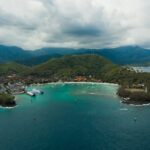
The result can still be seen from the boat. Thira, Thirassia, and the small Aspronisi form the remnants of the ring, while in the center of the bay two islets, Palea Kameni and Nea Kameni, were built by lava flows and domes starting from 197 BCE, according to the same database. The last activity dates back to 1950. It produced a small dome and a flow, with explosions. These dates matter to you. They explain why the caldera’s rocks appear so young and raw.
But the Minoan eruption also fueled much less solid hypotheses, such as the Santorini trail of Atlantis, between myth and underwater research, which is often classified among stories.
What can be seen while diving around the caldera?
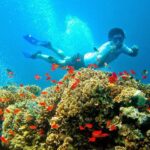
The setting is mainly mineral. You follow dark rock walls, frozen lava flows, collapsed blocks, and small cavities. The fauna is that of the eastern Mediterranean, with common species like moray eels, octopuses, or groupers, with no guarantee of encounters on the day you dive. Swimmers also know the warm, reddish waters of Palea Kameni, linked to hydrothermal activity.
Dive centers often mention the same names. Nea Kameni for volcanic rock, the Vlychada and Akrotiri area to the south, the surroundings of Thirassia and Aspronisi. These names vary from one operator to another and no public registry fixes their depths (so nothing is quantified here). One thing is consistent everywhere: the caldera wall drops quickly offshore, well beyond recreational diving limits, which requires strict management of depth and buoyancy. It does not forgive distractions.
Thus, your computer counts more than the color of the water.
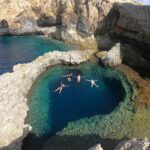
If you like rocky walls, the Blue Hole of Malta, in Gozo offers another Mediterranean setting, limestone this time, with its own swell constraints. The two compare poorly in photos.
What level and season to dive in Santorini?
Centers generally offer guided outings in the sheltered areas of the caldera for beginners and reserve the walls and exposed points for more autonomous divers. The season usually runs from spring to autumn. Precise conditions (wind, current, temperature) remain impossible to determine from here: they must be read day by day.
For what level? It all depends on the day.
In summer, the Aegean Sea experiences the meltemi, a north wind that can raise a short sea in a few hours. However, Santorini offers several faces, and a serious center chooses the sheltered side rather than the scheduled site. This fallback plan should be requested before paying. Also ask what happens if no site is accessible: postponement, refund, or credit. The answer says a lot.
Regarding temperature, a 5 mm wetsuit often appears on equipment lists for the warm season, but this is a general indication and a cold person or someone doing two dives a day may prefer thicker.
The wind decides more than the photo.
How to choose a diving center in Santorini?
Choose a center that clearly displays its affiliation (PADI, SSI, or CMAS depending on the case), the required level for each site, the size of the dive groups, and its weather cancellation policy. No names are mentioned here: we were unable to cross-check dated public information on active centers on the island in 2026.
Before booking, ask your questions in writing. How many divers per guide? What maximum depth does the center set for your level on wall sites, and who monitors it during the dive, the guide or each diver with their computer? Is there oxygen on board? And what is the fallback site if the meltem wind rises? Without answers, skip it.
The briefing remains your best indicator on site.
Arrive with equipment you know well. A well-adjusted buoyancy compensator before the dive makes buoyancy control easier along a wall with no visible bottom, and knowing when and how to use a safety sausage helps the boat locate you if you surface far from the planned point.
How long to wait before flying again?
The Divers Alert Network recommends at least 12 hours between a single dive without mandatory decompression stop and a flight, and 18 hours after multiple dives in one day or several days of diving. After dives with decompression stops, the delay should be significantly longer.
The last day should therefore be planned on land.
Santorini is well suited for this. You can save the perched villages and the ancient site of Akrotiri for the end of your stay. However, many travelers do the opposite and squeeze in a last dive on the morning of departure due to lack of time, even though the flight time often requires stopping the day before if you have done several days of diving. These guidelines apply to air dives. For a specific case, consult a diving doctor.
One last point to check before departure: in early 2025, a long series of earthquakes off Santorini led Greek authorities to take emergency measures on the island. Check the official instructions in force at the time of your trip.
One less dive on the last day is the price of a return without unresolved questions.
FAQ
Can you do a beginner diving session in Santorini?
Yes, centers offer supervised beginner dives in the sheltered areas of the caldera. The minimum age depends on the organization and the program, and a medical questionnaire is generally required. Check these conditions directly with the center before booking.
What is the best time to dive in Santorini?
The season generally runs from spring to autumn, when the centers are open. Summer brings warmer water but also the meltem wind, which can close certain sites. Ask the center how they handle windy days.
Are the underwater sites in Santorini dangerous?
The main hazard is the depth: the caldera wall descends well beyond recreational diving limits. Wind and sharp rocks add to the risk. A clear briefing and a maximum depth set in advance reduce this risk.
How long to wait before flying after diving?
The DAN recommends at least 12 hours after a single dive without mandatory stops and 18 hours after multiple dives or several days of diving. After dives with stops, the delay should be significantly longer.
Sources
- Santorini (Global Volcanism Program, Smithsonian Institution, accessed in 2026)
- Flying After Diving (Divers Alert Network, 2026)
{“@context”:”https://schema.org”,”@type”:”FAQPage”,”mainEntity”:[{“@type”:”Question”,”name”:”Peut-on faire un baptême de plongée à Santorin ?”,”acceptedAnswer”:{“@type”:”Answer”,”text”:”Oui, des centres proposent des baptêmes encadrés dans les zones abritées de la caldeira. L’âge minimum dépend de l’organisme et du programme, et un questionnaire médical est en général demandé. Vérifie ces conditions directement auprès du centre avant de réserver.”}},{“@type”:”Question”,”name”:”Quelle est la meilleure période pour plonger à Santorin ?”,”acceptedAnswer”:{“@type”:”Answer”,”text”:”La saison s’étend en général du printemps à l’automne, quand les centres sont ouverts. L’été apporte une eau plus chaude mais aussi le meltem, qui peut fermer certains sites. Demande au centre comment il gère les jours de vent.”}},{“@type”:”Question”,”name”:”Les fonds de Santorin sont-ils dangereux ?”,”acceptedAnswer”:{“@type”:”Answer”,”text”:”Le principal piège tient à la profondeur : la paroi de la caldeira descend bien au-delà des limites de la plongée loisir. Le vent et la roche coupante s’y ajoutent. Un briefing clair et une profondeur maximale fixée à l’avance réduisent ce risque.”}},{“@type”:”Question”,”name”:”Combien de temps attendre avant de prendre l’avion après une plongée ?”,”acceptedAnswer”:{“@type”:”Answer”,”text”:”Le DAN recommande au minimum 12 heures après une plongée unique sans palier obligatoire et 18 heures après plusieurs plongées ou plusieurs jours de plongée. Après des plongées avec paliers, le délai doit être nettement plus long.”}}]}