Imagine you find a course called “Open Water Diver Online” and want to know if you can complete it without entering the water. The available information does not confirm online courses linked to a municipality called Casco Antiguo: the identified public offers correspond to Torrejón de Ardoz, the Community of Madrid, and Alicante. If you are referring to the Casco Antiguo diving school, its course pages show diving options, but the current availability and conditions of each modality must be checked in the official catalog.
The difference matters: studying theory online can facilitate preparation, but a diving certification that includes aquatic skills requires clarification on how they are practiced and evaluated. The commercial name of a course is not enough to know if it includes pool sessions, natural environment dives, instructor accompaniment, or only digital materials.
What Casco Antiguo offer can be identified
Casco Antiguo can refer to a city area or to the brand linked to a diving school; these are different searches. The catalog and course archive of the school show names such as Open Water Diver Online, Open Water in-person and theory and pool, but these records alone are not enough to confirm that each course has spots, dates, or the same conditions now.
The geographic distinction avoids attributing courses from one administration to another. Among the identified public pages are a virtual school of Torrejón de Ardoz, programs from the Community of Madrid, and municipal activities of Alicante. These are offers from those organizations and territories, not proof that there is a call in any neighborhood called Casco Antiguo.
At the diving school, the page of Casco Antiguo courses and modalities allows you to compare the published names. It is advisable to open the specific record and not deduce the complete modality from the title. A course with “Online” in the name may refer to the theoretical part, while the aquatic skills are organized separately.
The course record, not the commercial label, must describe what is included. Look for a date or an indication of an open call, the entity providing the training, and the way to contact the school. If this data is missing, the current offer remains to be confirmed.
But local search requires additional precision: city, municipality, or specific school. Without that data, a list of public courses from other locations may seem relevant by accident and make you waste time trying to enroll.
What theory can be studied remotely
Distance training can serve to prepare the theoretical knowledge of a diving course when the record confirms digital materials and a remote or in-person evaluation. The format allows progress without always coinciding with the instructor, but it does not prove by itself that the student masters the skills practiced in the water.
The theory may cover concepts such as equipment, planning, or the effects of pressure, according to the published program. It should not be assumed that all Casco Antiguo modalities cover the same content: compare them with the syllabus of the specific course and ask how doubts are resolved.
The format also changes the learning experience. A self-study platform usually allows progress with materials available on demand; a live class, if included, adds interaction at a set schedule. Tutoring, technical support, and work pace are conditions of each course, not features to be taken for granted.
Guide your check with these points:
- Which theoretical units the digital access includes and how long they are available.
- If there is an exam or quizzes, when they are held and who grades them.
- If you can ask questions to an instructor and through which channel.
- What part of the learning must be completed before the in-person sessions.
A name like “Open Water Online” does not automatically mean the entire course is remote. The school also publishes in-person and theory with pool modalities; ask them to explain in writing which components correspond to the option you are going to contract.
To understand the scope of initial training, this explanation of the fundamentals of scuba diving may be useful. It is complementary information: it does not replace the syllabus or enrollment conditions of a specific course.
Why Supervised Practice Changes Training
In a diving certification, the skills performed underwater require a practical session when the program includes them. The sheet must clarify where they take place, who supervises them, and how the learning is verified; without this information, it cannot be concluded that a digital modality meets the certification requirements.
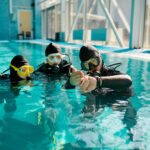
In a pool or open water, the student practices skills that are not accredited by having completed a reading or a theoretical exam. The instructor can observe the execution and decide if the program objectives are met. The sessions, environment, and concrete evaluation must be confirmed with the school and the corresponding certifying entity.
Online theory does not replace a practical evaluation required by the course. Do not choose a certification based solely on the convenience of remote access. If the offer does not identify the aquatic sessions and their supervision, request that information before paying.
The step to open water deserves its own verification. Check how the practice is organized in the natural environment, what equipment is provided or must be brought by the student, and how the dates are agreed upon. The school must explain the session plan before enrollment, not leave it as a mystery until the online module ends.
Training in natural environment diving allows a deeper understanding of why practice outside the pool presents different conditions. For the specific decision, the certification level, the departure location, and the briefing matter more than a general promotional description.
And the starting level also counts. Check which certification is sought, what prior experience is required, and what skills are evaluated. The certification that appears in the advertising must match the one the entity will issue upon completing the program.
How to Compare Modality, Certification, and Enrollment
A useful comparison separates what is published from what remains to be confirmed. For each course, note the theoretical modality, practices, evaluation, certifying entity, and enrollment status; if a sheet does not provide a piece of data, record that you must request it instead of filling the gap with an assumption.
| Aspect | What to Check | What Remains Unresolved if Not Provided |
|---|---|---|
| Online Theory | Curriculum, access to materials, and evaluation format | Which contents and evaluations are included |
| Practice | Pool or open water, supervision, and organization | Where and how skills are acquired |
| Certification | Entity issuing it and name of the certification | What accreditation is obtained upon completion |
| Enrollment | Call, availability, price, and requirements | If you can enroll and under what conditions |
This table does not replace official conditions. It serves to compare the sheets without mixing a confirmed feature with one that has not yet been published. Price, dates, and places are changing data: consult them directly on the official page or with the school before organizing the schedule.