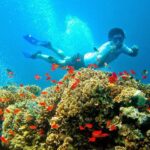
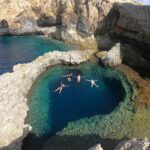
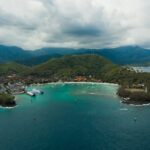
Since December 2017, the Bazaruto Archipelago National Park has been managed by the NGO African Parks together with ANAC, the Mozambican authority for conservation areas. This administrative detail says a lot: rangers patrol, rules exist, and your diving trip takes place in a protected area, not on an open-access reef.
Our old page promised a dugong “less than ten meters” from divers, cited 75% of Indian Ocean species on a single reef, and recommended lodges located hundreds of kilometers from the archipelago. We have completely revised it.
The framework remains the same: level, current, season, supervision, and fallback plan.
What does the Bazaruto Archipelago National Park protect?
The park covers about 1,430 km² of sea and islands off Vilanculos, in the Inhambane province, according to African Parks. It was declared a protected area in 1971. Since December 2017, African Parks has managed it with ANAC under a 25-year agreement, and a portion of tourism revenue funds local projects.
The archipelago consists of five islands: Bazaruto, Benguerra, Magaruque, Santa Carolina, and Bangué, according to ANAC. Three are inhabited, by about 7,000 people according to African Parks. Fishermen therefore live within the park, and their nets still kill dugongs and turtles, deaths that the manager is trying to reduce with the maritime authority and local police. You dive in an inhabited area.
Our old page claimed that Bazaruto was the only park in the country protecting both sea and land.
We found no source for this statement, so we removed it. The same goes for the 75% of Indian Ocean species attributed to Two Mile Reef, a figure circulating on many travel sites without any reference. However, there are still enough solid facts. African Parks presents Bazaruto as one of the major marine sanctuaries on the East African coast.
Can you see dugongs while diving at Bazaruto?
No one can promise you that. African Parks describes the Bazaruto population as the last known viable dugong population in East Africa, tracked by satellite tags. The IUCN classified this sub-population as critically endangered in December 2022. Such a rare animal is encountered by chance, never by reservation.
The dugong grazes on seagrass beds, often in shallow, murky waters that are nothing like a postcard reef. It surfaces to breathe, moves around, and avoids noisy boats. An outing built around it pushes boat pilots to search for it for hours, follow it when it surfaces, then approach too closely to satisfy paying customers. This disturbance weighs on a population already threatened by nets. If an operator promotes the dugong as a selling point, ask what approach rules they apply.
But you can do a lot without it.
Rays, turtles, and reef sharks are cited by ANAC among the park’s wildlife. And the behavior rules remain the same everywhere, summarized in our article on observing without disturbing marine life. Do not chase, do not touch.
Which dive sites for which level at Bazaruto?
Two Mile Reef, off Benguerra, is the reef most often cited by operators for a first dive, because it offers several depths on the same outing according to their descriptions. Other names that circulate, like Manta Reef, Rainbow Runner, or Brindle Bass Ridge, are reefs more exposed offshore. Depths and required levels vary by operator, so we do not specify them here.
| Criterion | What we know | What you should ask beforehand |
|---|---|---|
| Level | Two Mile Reef often presented as accessible | Maximum depth planned for your certification |
| Current | Offshore reefs reputed to be more exposed | Drift or anchored dive, boat pickup |
| Season | Cyclones from December to March (France Diplomatie) | Cancellation rate of outings on your dates |
| Supervision | Boat trips from Vilanculos or the islands | Group size, oxygen on board |
| Fallback plan | Site choice day-to-day depending on weather | Alternative site if the sea closes offshore |
The boat trip is part of the dive.
From Vilanculos, you have to cross the channel before reaching the reefs, and this crossing depends on the wind and tide. Thus, a trip canceled in the morning is not a bad service. The offshore reefs are often drift dives, with a boat following the bubbles. For a beginner, this is new. Our guide to drift diving against the current details what this entails.
The current dictates more than the photo. If the operator is vague about the water entry, the parachute, and the recovery, choose a simpler reef.
When to go and what safety measures in Mozambique?
France Diplomatie classifies the province of Inhambane, where Bazaruto is located, as yellow, meaning heightened vigilance. The province of Cabo Delgado, in the far north, is orange, and several of its districts are red. The same sheet generally places the cyclone season from December to March. Bazaruto is not Cabo Delgado.
This detail matters because many travelers confuse the two. The Quirimbas Islands, in red, are another archipelago located more than 1,000 km to the north. However, yellow vigilance does not mean no risk. France Diplomatie reports numerous serious road accidents related to road conditions and driving, and advises against driving at night outside cities or exceeding 500 km per day. It also reminds that malaria requires mosquito protection and a treatment prescribed by a doctor before departure.
For the season, our old page recommended May to January for “perfect visibility.”
We have removed that promise. January falls right in the cyclone season, and no dated source guarantees visibility. Humpback whales pass during the southern winter, but their presence on any given day remains impossible to determine from here. Ask your center for the expected water temperature and the number of canceled trips last year on your dates.
How to reach the archipelago and organize the stay?
ANAC indicates three accesses to the park: charter flights from Vilankulo airport, boats from Vilankulo or Inhassoro, and the national road EN1 to reach the coast. Most divers stay in Vilanculos and do day trips, or sleep on the islands, which shortens the journey.
Our old page mentioned Nuarro Lodge and the Pinda reserve.
However, these addresses are in the province of Nampula, far to the north. We have removed them. To choose a center, check its official page, the date of its schedule update, and how it handles the park entry fee. Also look at the location of the nearest hyperbaric chamber, since distance changes everything in case of an accident. If the center does not respond, that is also an answer.
To compare with another marine area in East Africa, our guide to diving at Mafia Island in Tanzania applies the same criteria. On the Indian Ocean side, the Sainte-Anne Marine Park in the Seychelles offers a simpler setting. If you stay on the surface, Bazaruto does not appear in our list of the best snorkeling destinations in the world, but the lagoon reefs are suitable. Use a sunscreen less toxic to corals.
There remains the concrete cost. A base in Vilanculos costs less than a lodge on the islands, but each trip adds the channel crossing and the risk of cancellation due to wind. Would you book it that way?
FAQ
Is Bazaruto a national park?
Yes. The archipelago is a protected area declared in 1971, now managed by ANAC and African Parks. The park covers about 1,430 km² of sea and islands according to African Parks.
Are you sure to see a dugong in Bazaruto?
No. The population is the last known viable one in East Africa, and the IUCN classified it as critically endangered in 2022. An observation is a matter of luck, and a good operator does not promise it.
Is Bazaruto in a zone discouraged by France?
No. The province of Inhambane is under heightened vigilance (yellow) on the France Diplomatie map. The red and orange zones concern the north of the country, especially Cabo Delgado. Check the updated sheet before leaving.
What level is required to dive at Bazaruto?
Two Mile Reef is often presented as accessible, while the offshore reefs are rather drift dives. The required level depends on the site and the operator. Only the on-site instructor decides if a dive suits you.
Sources
- Mozambique, travel advice (France Diplomatie, accessed October 3, 2026)
- Bazaruto (African Parks, accessed October 3, 2026)
{“@context”:”https://schema.org”,”@type”:”FAQPage”,”mainEntity”:[{“@type”:”Question”,”name”:”Bazaruto est-il un parc national ?”,”acceptedAnswer”:{“@type”:”Answer”,”text”:”Oui. L’archipel est une aire protégée déclarée en 1971, aujourd’hui gérée par l’ANAC et African Parks. Le parc couvre environ 1 430 km² de mer et d’îles selon African Parks.”}},{“@type”:”Question”,”name”:”Est-on sûr de voir un dugong à Bazaruto ?”,”acceptedAnswer”:{“@type”:”Answer”,”text”:”Non. La population est la dernière viable connue en Afrique de l’Est, et l’UICN l’a classée en danger critique en 2022. Une observation relève de la chance, et un bon opérateur ne la promet pas.”}},{“@type”:”Question”,”name”:”Bazaruto est-il en zone déconseillée par la France ?”,”acceptedAnswer”:{“@type”:”Answer”,”text”:”Non. La province d’Inhambane est en vigilance renforcée (jaune) sur la carte de France Diplomatie. Les zones rouges et orange concernent le nord du pays, en particulier Cabo Delgado. Vérifie la fiche à jour avant de partir.”}},{“@type”:”Question”,”name”:”Quel niveau faut-il pour plonger à Bazaruto ?”,”acceptedAnswer”:{“@type”:”Answer”,”text”:”Two Mile Reef est souvent présenté comme accessible, alors que les récifs du large se plongent plutôt en dérive. Le niveau exigé dépend du site et de l’opérateur. Seul l’encadrant sur place décide si une plongée te convient.”}}]}