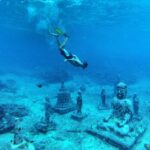
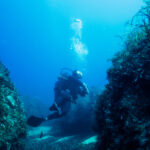
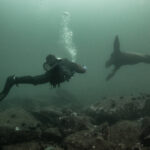
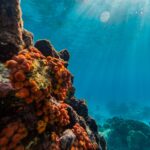
On November 3, 2007, the former frigate HMNZS Canterbury was scuttled in Deep Water Cove, in the Bay of Islands, to become a diving site. Twenty years earlier, on December 12, 1987, Greenpeace’s Rainbow Warrior met the same fate off Matauri Bay, near the Cavalli Islands.
Our old page talked about coral reefs, turtles, and whales in spring, without a single source. It even placed an arch in the bay that is actually located at the Poor Knights. We have completely revised everything.
Here you will find the three main dives of Northland, a grid for level, current, season, supervision, and fallback plan, the rules of the Poor Knights reserve, and updated entry formalities.
Which wrecks and sites to dive around the Bay of Islands?
Three names come up. The wreck of the HMNZS Canterbury rests in the Bay of Islands, near Cape Brett. The Rainbow Warrior wreck is further north, near the Cavalli Islands. The Poor Knights Islands marine reserve is accessed from the Tutukaka marina, about 22 km offshore according to the DOC.
These three sites therefore do not depart from the same port.
The Canterbury served in the New Zealand Navy before being deliberately sunk at the initiative of a local foundation, the Bay of Islands Canterbury Charitable Trust, once pollutants and recoverable parts were removed. The hull is intact. Its lowest point is around 38 m, an indicative order of magnitude taken from reports of the time. The superstructures are much shallower. But the bottom of the wreck remains a deep dive, with all that implies in terms of gas and time.
The Rainbow Warrior has a different story. On July 10, 1985, French secret service agents sank it in Auckland harbor, and photographer Fernando Pereira died in the attack. Two years later, the hull was scuttled near the Cavalli Islands to become a dive site, according to NZHistory, the history site of the New Zealand Ministry of Culture. Operator sheets place it between about 18 and 27 m, a figure to be confirmed.
Finally, the Poor Knights are outside the bay, further south. The Maomao arch that our old version placed in the Bay of Islands belongs to these islands. The DOC describes arches where nutrient-rich water flows, with walls covered in sessile animals, and recalls that Jacques Cousteau ranked the site among the ten most beautiful dives in the world. A reputation says nothing about the sea conditions of the day. If you are looking for warm shallow waters, our selection of the best snorkeling destinations in the world follows a different logic.
What level and current to expect on these wrecks?
No page can judge from a distance whether a wreck suits you. The Canterbury goes down to about 38 m, the Rainbow Warrior is rather between 18 and 27 m, and the Poor Knights require an offshore crossing. For the current, we found no dated public data. The center briefing decides.
| Site | Level | Current | Season | Supervision | Fallback plan |
|---|---|---|---|---|---|
| HMNZS Canterbury (Bay of Islands) | bottom around 38 m (indicative), accessible part to be specified according to your certification | impossible to decide from here | recent data to request | boat trip with a center from the bay | another sheltered site in the bay according to briefing |
| Rainbow Warrior (Cavalli Islands) | between about 18 and 27 m according to operators | impossible to decide from here | recent data to request | boat trip, departure to confirm | neighboring reef of the Cavalli if swell is problematic |
| Poor Knights Islands (marine reserve) | depends on chosen site, to request in writing | undocumented, offshore site | crossing sensitive to weather | departure from Tutukaka, DOC rules | postponement of the trip, plan free days |
The current decides more than the photo.
For what level? Compare the maximum depth of your certification with that of each wreck, then ask in writing how far the center will take you with this level. On a tiered wreck like the Canterbury, the question concerns a specific part of the ship. Also ask about the number of divers per guide. And ask about recovery, because a boat following a drifting dive group offshore from Cape Brett or the Poor Knights must be able to spot them on the surface. Our guide on the diving surface marker buoy explains when to deploy it.
A recently certified diver is not automatically excluded. Penetration of a wreck requires separate training, and no photo of a corridor published by an agency replaces this qualification. The final decision rests with the professional on site, after the briefing. To compare with another Pacific spot, our article on diving in Rarotonga, Cook Islands applies the same criteria.
What season and what wetsuit for the temperate waters of Northland?
Northland is bathed in temperate water, warmer in February than in August, and warmer in the north of the country than in the south according to the public encyclopedia Te Ara. We could not verify any monthly temperature or visibility figures for these three sites. So we give you the trend.
For the rest, ask the center for the readings from the week before your arrival.
Our old page promised optimal visibility from May to September, whales in spring, and sharks all year round. None of these statements had a source. We removed them. Te Ara notes that warmer waters bring subtropical reef fish passing through the north. The DOC mentions stingrays under the arches of the Poor Knights during the warm months, which remains a possible observation and never a promise that could be included in a travel program. None of this is guaranteed.
However, the practical question remains the cold. Our old version mentioned a 7 mm wetsuit loaned by the centers, without specifying which ones. Before leaving, ask about the thickness provided, the presence of a hood and gloves, and the possibility to rent a drysuit, since the cold weighs more on a deep and long dive like the bottom of the Canterbury. Clear water says nothing about the current.
For tropical water in the same part of the world, our guide to diving at Île des Pins, New Caledonia asks the same questions about a classified lagoon.
What rules to follow in the Poor Knights marine reserve?
The Poor Knights Islands marine reserve was created in 1981 and covers 2,410 hectares, according to the DOC. Fishing is not allowed there, neither from a boat nor from the shore. No animals, shells, algae, rocks, or shells may be taken, and fish must not be fed.
The islands themselves remain closed to landing.
The DOC forbids setting foot on the islands and rocks, and mooring a boat to the shore. It requests careful anchoring, with the minimum chain. No waste, ballast, or sewage discharge is allowed in the reserve. Throughout the country, boat speed is limited to 5 knots within 200 m of the shore or a boat flying a diving flag. Vessels longer than 45 m cannot cross an area extending 9 km from the islands. Penalties range from confiscation of equipment or boat to fines, or even imprisonment.
The operator Dive! Tutukaka dates the full reserve status to 1998, extended to 800 m around the islands. Yet the rule that concerns you most is about your buoyancy control, since you do not pilot the boat and your fin brushes the walls covered with sponges and sessile animals at every arch passage. We detailed why you should never touch marine life, including cases where contact also injures the diver. Adjust your buoyancy before the arch.
NZeTA and IVL: what formalities before booking?
With a French passport, you enter New Zealand without a visitor visa, but with an NZeTA, the electronic travel authorization. According to the Immigration New Zealand fee schedule effective from October 1, 2024, the application costs 17 NZD via the app and 23 NZD via the website. The IVL tourist levy adds 100 NZD.
The IVL is never refunded, even in case of refusal.
This fee schedule dates from October 2024. It was reviewed on October 3, 2026, without being able to guarantee that it has not changed since then, so check the amount displayed at the time of payment. Make your request on the Immigration New Zealand app or official website, as intermediary sites sell the same form at a higher price. Australian citizens and those from many Pacific countries are exempt from the IVL. Keep the receipt.
However, entry into the territory does not resolve anything regarding diving. Check that your insurance covers diving to the targeted depth and repatriation, allow a margin between your last dive and your return flight, and ask the center where the nearest decompression chamber is located (the answer says a lot about the seriousness of a briefing).
In short, the Bay of Islands offers diving on two wrecks at very different depths, with an offshore reserve that depends on the sea. The price is paid in margin: free days for the weather, a qualification to be confirmed before the Canterbury, a thick wetsuit, and 117 to 123 NZD in formalities before the first tank. Would you book it this way?
FAQ
Where is the Rainbow Warrior wreck located?
It lies off Matauri Bay, near the Cavalli Islands, north of the Bay of Islands. It was scuttled there on December 12, 1987, two years after the Auckland harbor bombing. Operators place it between approximately 18 and 27 m, a figure to be confirmed with the center.
At what depth is the HMNZS Canterbury wreck?
The frigate was scuttled on November 3, 2007, in Deep Water Cove, in the Bay of Islands. Its lowest point is around 38 m, an indicative order of magnitude. The superstructures are shallower, and the center will indicate the accessible part according to your level.
Can you land on the Poor Knights Islands?
No. The DOC prohibits landing on the islands and rocks of the reserve, and mooring a boat to the shore. Fishing and any removal are forbidden there, as is feeding the fish.
How much do the NZeTA and IVL cost?
According to the Immigration New Zealand fee schedule effective from October 1, 2024, the NZeTA costs 17 NZD via the app and 23 NZD via the website. The 100 NZD IVL is added for most visitors and is non-refundable. Check the amount at the time of payment.
Sources
- Poor Knights Islands Marine Reserve: Places to go in Northland (Department of Conservation, New Zealand, accessed October 3, 2026)
- Immigration fee and levy table: rates from 1 October 2024 (Immigration New Zealand, 2024)
{“@context”:”https://schema.org”,”@type”:”FAQPage”,”mainEntity”:[{“@type”:”Question”,”name”:”Où se trouve l’épave du Rainbow Warrior ?”,”acceptedAnswer”:{“@type”:”Answer”,”text”:”Elle repose au large de Matauri Bay, près des îles Cavalli, au nord de la baie des Îles. Elle y a été sabordée le 12 décembre 1987, deux ans après l’attentat du port d’Auckland. Les opérateurs la situent entre 18 et 27 m environ, chiffre à confirmer avec le centre.”}},{“@type”:”Question”,”name”:”À quelle profondeur se trouve l’épave du HMNZS Canterbury ?”,”acceptedAnswer”:{“@type”:”Answer”,”text”:”La frégate a été sabordée le 3 novembre 2007 dans Deep Water Cove, dans la baie des Îles. Son point le plus bas se situe vers 38 m, un ordre de grandeur indicatif. Les superstructures sont moins profondes, et le centre t’indique la partie accessible avec ton niveau.”}},{“@type”:”Question”,”name”:”Peut-on débarquer sur les Poor Knights Islands ?”,”acceptedAnswer”:{“@type”:”Answer”,”text”:”Non. Le DOC interdit de débarquer sur les îles et les rochers de la réserve, et d’amarrer un bateau au rivage. La pêche et tout prélèvement y sont interdits, et nourrir les poissons aussi.”}},{“@type”:”Question”,”name”:”Combien coûtent la NZeTA et l’IVL ?”,”acceptedAnswer”:{“@type”:”Answer”,”text”:”Selon le barème d’Immigration New Zealand en vigueur depuis le 1er octobre 2024, la NZeTA coûte 17 NZD par l’application et 23 NZD par le site. L’IVL de 100 NZD s’ajoute pour la plupart des visiteurs et n’est pas remboursable. Vérifie le montant au moment de payer.”}}]}