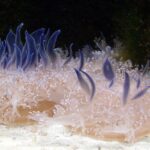
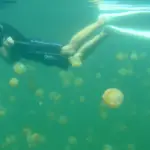
On January 6, 2026, the journal Nature Communications published a study conducted both in the laboratory and in the wild, in Key Largo, Florida. The jellyfish Cassiopea andromeda and the sea anemone Nematostella vectensis sleep about one third of the day.
One third. About the same as us.
In 2017, the question was whether a jellyfish could sleep without a brain. Nine years later, researchers are mainly wondering what this sleep is for. Here we review the key studies, in order, with what they show and their limitations. For the general biology of the animal, its body, and its life cycle, our complete guide on jellyfish takes over.
Do jellyfish really sleep?
Yes, at least one species, and the evidence is solid. Cassiopea, the upside-down jellyfish, meets the three criteria biologists require to talk about sleep in an animal: quickly reversible rest, slower response to stimuli during this rest, and a need to recover when deprived of it.
These criteria are behavioral. They do not require a brain or electrical recording, which allows them to be applied to animals very distant from us, such as flies or worms. An immobile animal is not necessarily sleeping. It can be waiting, digesting, or watching for prey. Thus, it is the combination of the three signs that matters, and a jellyfish that simply slows down at night would not be enough to convince a review committee.
For the vast majority of other jellyfish, no published study on the subject has been found.
The honest answer is therefore “yes for Cassiopea, unknown for the others.” The lists of facts circulating online often write “jellyfish sleep” as a generality. We prefer to stick to what has been measured.
How did the Caltech team demonstrate Cassiopea’s sleep in 2017?
By filming jellyfish day and night for several days, then disturbing them. Ravi Nath and his colleagues at the California Institute of Technology published their results on September 21, 2017, in Current Biology. At night, the pulsations of the bell slow down significantly, around 39 per minute compared to 58 during the day.
The choice of species was no accident. Cassiopea lives resting on the bottom, bell down and arms turned toward the light, so that a camera placed above the tank is enough to count each contraction for days. The researchers first measured this rhythm. Then they tested reactivity. During nocturnal rest, the jellyfish reacted more slowly and required stronger stimulation to resume movement. Finally, 10-second water jets repeated at night prevented them from resting.
The next day, the sleep-deprived jellyfish were less active and less reactive.
But the team went further, testing two molecules known to induce sleep in other animals, including melatonin, which triggered this resting state in jellyfish during the day. An antihistamine, pyrilamine, had the same effect. This jellyfish, whose biology is detailed in our species sheet on Cassiopea, has only a diffuse neural network. No brain.
Why does Cassiopea take a nap at noon?
According to the study published in January 2026, Cassiopea andromeda sleeps mainly at night and adds a short nap around noon. In this jellyfish, light regulates the rhythm, with sleep pressure accumulated during wakefulness. The anemone Nematostella sleeps more during the day and follows its internal clock more closely.
The team of Raphaël Aguillon and Lior Appelbaum set a precise threshold. A Cassiopea is considered asleep when it drops below 37 pulsations per minute for at least 3 minutes. For the anemone, it is 8 minutes of immobility. The observations at sea took place in Key Largo, with about 15 hours of daylight and 9 hours of night. Field measurements matched those from the laboratory, making the result more credible than a simple aquarium experiment.
As for the reason for this midday nap, it remains impossible to decide from here.
However, one thing is certain for those who snorkel above a bottom covered with Cassiopea (this is often the case in shallow lagoons). A jellyfish that pulses slowly does not tell you anything about its state. The rule remains the same: do not touch. We explain why in our article on the reasons why you should never touch marine life, and our page on what to do in case of a jellyfish sting covers the rest.
What is the purpose of sleep when you don’t have a brain?
A serious lead appeared in 2026: protecting the DNA of neurons. In Cassiopea and Nematostella, prolonged wakefulness and sleep deprivation increase DNA damage markers in nerve cells, while sleep, spontaneous or induced by researchers, reduces them. These markers are measured with a marker called γH2AX.
The most telling test uses ultraviolet light. After 15 minutes of exposure to 312-nanometer UVB, the DNA of neurons shows more damage. Both species then sleep more. And melatonin, again, increased sleep time, episode duration, and their number during the active phase, in both the jellyfish and the anemone. The link between stress, damage, and the need to sleep is therefore found in two animals with opposite rhythms.
In short, sleep would have initially served to maintain neurons.
This “would have” matters. The study concerns two species and shows a strong relationship, without proving that DNA repair is the sole function of sleep. The previous version of this article spoke of accelerated “cellular regeneration” during rest, without any reference, and we removed it. What is measured is narrower and more interesting.
Hydra, anemone, jellyfish: who sleeps how?
Three cnidarians now have sleep described in peer-reviewed journals. Their rhythms differ greatly. Cassiopea follows day and night, Nematostella sleeps during the day, and the hydra, a small freshwater polyp, alternates activity and rest according to a cycle of about 4 hours, without a 24-hour rhythm.
| Animal | Group | Study | Observed rhythm | Sleep sign retained |
|---|---|---|---|---|
| Cassiopea (upside-down jellyfish) | Jellyfish | Current Biology, 2017 | Rest at night | Slowed pulsations, delayed reaction, rebound after deprivation |
| Cassiopea andromeda | Jellyfish | Nature Communications, 2026 | Night and nap around noon, about one third of the day | Less than 37 pulsations per minute for at least 3 minutes |
| Nematostella vectensis | Sea anemone | Nature Communications, 2026 | Mostly during the day, about one third of the day | Immobility of at least 8 minutes |
| Hydra | Freshwater polyp | Science Advances, 2020 | Cycle of about 4 hours | Melatonin, GABA, and dopamine increase sleep |
The hydra study comes from Kyushu University in Japan, with researchers from UNIST in South Korea. Melatonin slightly increases sleep, GABA much more. Yet dopamine, which keeps many animals awake, puts the hydra to sleep. Depriving the hydra of sleep alters the expression of 212 genes, including one linked to a protein that also regulates sleep in other species. The authors draw a strong hypothesis: the need to sleep appeared before the brain.
We find the argument convincing.
A jellyfish, an anemone, and a hydra share sleep molecules with vertebrates, even though their common ancestors with us date back several hundred million years. For the long history of jellyfish, our 10 amazing things to know about jellyfish give the orders of magnitude. One limitation remains. Three species do not make a rule.
FAQ
Do jellyfish really sleep?
Yes for Cassiopea, the upside-down jellyfish, studied in 2017 and then in 2026. It meets the three behavioral criteria of sleep: reversible rest, slower reaction, and need to recover after deprivation. For most other jellyfish species, no study has yet decided.
How long does a jellyfish sleep?
According to the study published in Nature Communications in January 2026, Cassiopea andromeda sleeps about one third of the day. It sleeps mostly at night and takes a short nap around noon. This figure applies to this species, not all jellyfish.
How do we know a jellyfish is sleeping?
We count its pulses and disturb it. A sleeping Cassiopea pulses more slowly, reacts with a delay to stimulation, and if prevented from resting at night, is less active the next day.
Do jellyfish dream?
No study allows us to say. In humans, dreaming is mainly identified by the report upon waking and brain activity, two tools unusable in a jellyfish. The question therefore remains open, and any assertion one way or the other is speculative.
Sources
- The Jellyfish Cassiopea Exhibits a Sleep-like State (Current Biology, Caltech, 2017)
- DNA damage modulates sleep drive in basal cnidarians with divergent chronotypes (Nature Communications, 2026)
Photo: Emőke Dénes, Wikimedia Commons, CC BY-SA 4.0
{“@context”:”https://schema.org”,”@type”:”FAQPage”,”mainEntity”:[{“@type”:”Question”,”name”:”Les méduses dorment-elles vraiment ?”,”acceptedAnswer”:{“@type”:”Answer”,”text”:”Oui pour Cassiopea, la méduse à l’envers, étudiée en 2017 puis en 2026. Elle remplit les trois critères comportementaux du sommeil : repos réversible, réaction plus lente et besoin de récupérer après une privation. Pour la plupart des autres espèces de méduses, aucune étude n’a encore tranché.”}},{“@type”:”Question”,”name”:”Combien de temps dort une méduse ?”,”acceptedAnswer”:{“@type”:”Answer”,”text”:”Selon l’étude publiée dans Nature Communications en janvier 2026, Cassiopea andromeda dort environ un tiers de la journée. Elle dort surtout la nuit et fait une courte sieste vers midi. Ce chiffre vaut pour cette espèce, pas pour toutes les méduses.”}},{“@type”:”Question”,”name”:”Comment sait-on qu’une méduse dort ?”,”acceptedAnswer”:{“@type”:”Answer”,”text”:”On compte ses pulsations et on la dérange. Une Cassiopea endormie pulse plus lentement, réagit avec retard à une stimulation et, si on l’empêche de se reposer la nuit, se montre moins active le lendemain.”}},{“@type”:”Question”,”name”:”Les méduses rêvent-elles ?”,”acceptedAnswer”:{“@type”:”Answer”,”text”:”Aucune étude ne permet de le dire. Chez l’humain, le rêve se repère surtout par le récit au réveil et par l’activité du cerveau, deux outils inutilisables chez une méduse. La question reste donc ouverte, et toute affirmation dans un sens ou dans l’autre relève de la spéculation.”}}]}