In September 2017, a team from the California Institute of Technology published a study on Cassiopea, the upside-down jellyfish, in the journal Current Biology. Its conclusion is brief: an animal without a brain can exhibit a state close to sleep.
This kind of dated result is often missing from the lists of “incredible facts” circulating online about jellyfish. You read that they are made of 98% water or that one species never dies, without any reference.
So we reviewed ten facts, one by one. The two sources are the Smithsonian fact sheet and the 2017 study. For the general biology of the animal, its habitat, and its diet, our comprehensive guide on jellyfish takes over.
What is a jellyfish’s body made of?
Mostly water. The Smithsonian fact sheet, reviewed by a cnidarian specialist from the Washington Natural History Museum, states 95% water. The rest forms a jelly, the mesoglea, trapped between two thin layers of cells. No skeleton either.
1. A jellyfish contains about 95% water
The figure of 98% is widespread, including in the previous version of this article. The Smithsonian fact sheet, updated in May 2023, gives 95%. The difference seems small. We correct it anyway because a list of facts is only as good as its numbers, and a percentage copied from site to site ends up being taken as a measurement when no one knows its origin. This water explains the transparency of many species.
It also explains why a stranded jellyfish shrivels so quickly in the sun.
2. No brain, but a network of neurons
A jellyfish does not have a brain in the sense we understand it in a fish or in you. Its neurons form a net spread throughout the body, which biologists call a nerve net. But this net is enough to swim, catch prey, and react to the slightest contact with an object. It is even sufficient to alternate activity and rest.
How long have jellyfish existed?
For at least 500 million years, according to the Smithsonian. Jellyfish fossils date from the Cambrian, and the oldest ancestors of current jellyfish could go back 700 million years. This second figure remains a high hypothesis, while the first is based on dated fossils.
3. At least 500 million years of history
The old article gave 700 million years without nuance.
We keep the museum’s range. A body made almost entirely of water fossilizes very poorly, and the few imprints found in rock are enough to place jellyfish in the seas long before the appearance of the first dinosaurs. The rest is estimation.
4. A life in two forms, polyp then jellyfish
In many species, the swimming jellyfish is only a stage. The larvae, called planulae, attach to a hard surface and become flower-shaped polyps. Later, the polyp segments into a stack of 10 to 15 discs, a process called strobilation, and each disc detaches to grow into the umbrella shape. Biologists call these young jellyfish ephyrae. Thus, a single polyp can produce several jellyfish.
Can a jellyfish rejuvenate or sleep?
To some extent, yes to both. Turritopsis, a small hydrozoan jellyfish, can revert to the polyp stage after adulthood. Cassiopea shows a sleep-like state, described in 2017. Neither of these facts makes a jellyfish immortal nor gives it a hidden brain.
5. Turritopsis, the so-called immortal jellyfish
The Smithsonian presents Turritopsis nutricula as the only known animal capable of reverting to the polyp stage after reaching the adult form. The mechanism has a name, transdifferentiation. Already specialized cells change function. (The species studied in the Mediterranean is now often called Turritopsis dohrnii, hence the confusion of names from one site to another.)
However, “immortal” remains a shortcut.
An individual can always end up in a fish’s stomach or die from an infection.
6. Cassiopea sleeps without a brain
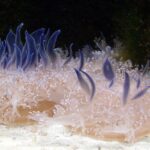
The Caltech team continuously monitored Cassiopea for several days and nights in laboratory tanks. At night, their pulsations slow down, around 39 per minute versus 58 during the day, and they react more slowly when disturbed. Deprived of rest, they are less active the next day. This is a sign of a need for recovery. These are the three criteria researchers use to talk about sleep in an animal, and we detail the entire experimental protocol in our article answering the question do jellyfish sleep.
This jellyfish resting upside down on the bottom also has its own species fact sheet on Cassiopea.
Which jellyfish are really dangerous to humans?
Only a small number. The Smithsonian cites the box jellyfish Chironex fleckeri and the Irukandji jellyfish (Carukia barnesi), capable of causing severe and sometimes fatal reactions. Other species do not reach this level of danger. They still sting occasionally.
7. The most potent venom comes from a box jellyfish
Chironex fleckeri, nicknamed sea wasp, produces according to the Smithsonian one of the most powerful venoms known. The venom comes from stinging cells, cnidocytes, which trigger on contact. A simple brush is enough. A stranded jellyfish can still sting as long as its tentacles keep these cells intact, which aligns with our advice to never touch marine life, even if apparently dead. Do not pick it up with bare hands.
This article provides information and does not replace the advice of a competent diving medicine doctor.
If you get stung, our overview on actions that relieve a jellyfish sting details what to do. Pain spreading or difficulty breathing requires emergency services.
8. The largest jellyfish measures about 1.8 m wide
The lion’s mane jellyfish, Cyanea capillata, holds the size record. The Smithsonian gives it an umbrella nearly 1.8 m wide and tentacles exceeding 15 m. The old article mentioned 35 m. We found no published measurement for this figure, so we stick to the museum’s, more cautious and verifiable, pending better data.
Why do some jellyfish glow and others proliferate?
Many jellyfish and comb jellies produce their own light, called bioluminescence. Proliferations depend on the animal’s life cycle and environmental conditions, which vary from coast to coast. Both phenomena can be seen from the beach or boat. Their causes have nothing in common.
9. A jellyfish protein won a Nobel Prize
Aequorea victoria, a jellyfish from the North Pacific, emits blue light thanks to a protein, aequorin. A second protein, GFP, transforms this blue into green. Isolated in the early 1960s, GFP is now used as a marker in laboratories, so much so that the 2008 Nobel Prize in Chemistry rewarded its discovery and development. In short, a discreet jellyfish changed the way cells are observed under the microscope.
10. Proliferations cause problems well beyond the beach
The Smithsonian reminds that a jellyfish bloom can disrupt fishing and clog the seawater intake of power plants that use seawater for cooling.
However, causes vary by region. The old article blamed pollution wholesale, without source. We removed this claim. The leads studied by researchers are detailed in our file on jellyfish invasions and their causes. Before swimming or diving on an affected coast, the simplest is to check with the lifeguard station or club the same day. A forecast from the day before tells nothing of what the wind pushed ashore overnight.
FAQ
Do jellyfish have a brain?
No. They have a network of neurons spread throughout the body. This network is enough for them to swim, hunt, and even alternate activity and rest, as shown by the 2017 study on Cassiopea.
Does the immortal jellyfish really exist?
Turritopsis can revert to the polyp stage after adulthood, which earned it this nickname. It remains vulnerable to predators and diseases. The word “immortal” is therefore a shortcut.
Is a jellyfish and a ctenophore the same thing?
No. Ctenophores have eight rows of fused cilia forming combs, and their tentacles do not sting. The Smithsonian counts 100 to 150 described species of ctenophores, versus fewer than 4,000 species of jellyfish.
Can a jellyfish stranded on the beach still sting?
Yes, as long as its stinging cells remain intact. Do not touch it with bare hands and keep an eye on children playing at the water’s edge.
Sources
- Jellyfish and Comb Jellies (Smithsonian Ocean, 2023)
- The Jellyfish Cassiopea Exhibits a Sleep-like State (Nath et al., Current Biology, Caltech, 2017)
{“@context”:”https://schema.org”,”@type”:”FAQPage”,”mainEntity”:[{“@type”:”Question”,”name”:”Les méduses ont-elles un cerveau ?”,”acceptedAnswer”:{“@type”:”Answer”,”text”:”Non. Elles possèdent un réseau de neurones réparti dans le corps. Ce réseau leur suffit pour nager, chasser et même alterner activité et repos, comme l’a montré l’étude de 2017 sur Cassiopea.”}},{“@type”:”Question”,”name”:”La méduse immortelle existe-t-elle vraiment ?”,”acceptedAnswer”:{“@type”:”Answer”,”text”:”Turritopsis peut revenir au stade de polype après l’âge adulte, ce qui lui a valu ce surnom. Elle reste vulnérable aux prédateurs et aux maladies. Le mot « immortelle » est donc un raccourci.”}},{“@type”:”Question”,”name”:”Une méduse et un cténaire, est-ce la même chose ?”,”acceptedAnswer”:{“@type”:”Answer”,”text”:”Non. Les cténaires portent huit rangées de cils soudés en peignes et leurs tentacules ne piquent pas. Le Smithsonian compte 100 à 150 espèces de cténaires décrites, contre moins de 4 000 espèces de méduses.”}},{“@type”:”Question”,”name”:”Une méduse échouée sur la plage peut-elle encore piquer ?”,”acceptedAnswer”:{“@type”:”Answer”,”text”:”Oui, tant que ses cellules urticantes restent intactes. Ne la touche pas à mains nues et garde un œil sur les enfants qui jouent au bord de l’eau.”}}]}
Photo: Olivier Dugornay (IFREMER, Pôle Images, Centre Bretagne – ZI de la Pointe du Diable – CS 10070 – 29280 Plouzané, France), Wikimedia Commons, CC BY 4.0