This article provides information and does not replace the advice of a qualified diving medicine doctor.
35 centimeters. That is the maximum size given by the FFESSM’s DORIS fact sheet for the uranoscope, Uranoscopus scaber, the member of the Uranoscopidae family you can encounter in the Mediterranean. It spends almost its entire life buried in the sand, its eyes facing the surface.
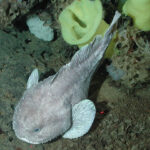
Its face earns it a place in the rankings of the ugliest fish. But the media title goes to the blobfish, voted the ugliest fish in the world in 2013, and the other candidates are listed in our top 10 ugliest fish in the world.
Here, we stick to the uranoscope itself. Its appearance, the truth about stories of luminous lures and electric shocks, then what to do if its spines sting you.
What does the Mediterranean uranoscope look like?
The uranoscope has a massive pear-shaped body, a huge flattened head, and a tapered tail. Its bulging eyes are placed on top of the skull and its very wide mouth opens upwards. Its brownish-yellow coat, marbled with black on the sides, blends with the sand. Its first dorsal fin is black.
It belongs to the Uranoscopidae family, the “star gazers,” which includes about fifty species worldwide (approximate figure). In the Mediterranean and eastern Atlantic, it is Uranoscopus scaber that is encountered. DORIS places it on sandy and muddy bottoms, most often between 10 and 50 meters, from the Bay of Biscay to Morocco and the western Mediterranean. FishBase extends the range up to 400 meters. So nothing abyssal, contrary to what the previous version of this page stated.
It has no swim bladder and, once buried, irrigates its gills through two tubular nostrils.
Reproduction takes place from April to August according to DORIS. Males mature around one year, females around two years, and a female can lay up to 125,000 eggs whose larvae first live in open water before burying themselves. Females also live longer. More than six years, compared to about four for males.
Is its filament luminous, and is the uranoscope electric?
No, the filament does not light up anything. It is a fleshy outgrowth, supported by a thin filament attached to the lower lip, which the fish waves above the sand to mimic a worm. Regarding electricity, shocks capable of stunning prey are described in Astroscopus, another genus of the family, which lives in the western Atlantic.
The previous version spoke of a lure “crescent-shaped.” Reference sheets describe a single worm-like bait. The fish remains motionless, waits for a small fish or crustacean to approach, then suddenly opens its mouth. It also captures worms, mollusks, and buried crustaceans. Yet, none of these sheets mention any light.
The case of Uranoscopus scaber is less clear-cut than often written, since DORIS and FishBase attribute to it an apparatus located behind the eyes that produces brief sound and electric impulses when stimulated, longer during spawning. Neither of these two sheets describes any shock felt by a diver. The shocks that made the family’s electric reputation remain those of Astroscopus.
In short, no lantern.
Is the uranoscope dangerous for a diver?
It carries two venomous spines above the pectoral fins, connected to venom glands. DORIS describes the sting as venomous but not serious for humans. It causes a painful swelling, and sometimes discomfort or dizziness, especially during the fish’s breeding period.
The risk almost always comes from accidental contact. The fish is buried, only its eyes and mouth protrude, and a hand placed on the sand to stabilize or a knee touching the bottom is enough to encounter it. It does not chase anyone. A fisherman who unhooks it from a line is more exposed, since he holds it in hand. Thus, your best protection while diving remains buoyancy that keeps you away from the bottom.
Otherwise, the reaction varies depending on the person and the amount of venom, and what a fact sheet describes does not predict your own reaction.
What to do in case of an uranoscope sting?
Finish the dive without skipping decompression stops, report the sting to the dive group or boat leader, then immerse the area in water as warm as you can tolerate without burning yourself. DAN gives a reference of about 43 °C (110 °F) and notes that relief can last up to 90 minutes.
Then, clean it. Remove visible spine debris, wash the wound with soap and rinse it with warmed fresh water. DAN advises leaving it exposed to air unless a dressing is needed to stop bleeding. Then keep an eye on it in the following days. A deep wound, damaged tissues, or weakened immunity (diabetes, long-term corticosteroids) justify medical advice, which may lead to antibiotics.
And any malaise, respiratory discomfort, or pain that does not subside justifies calling emergency services: in France, 196 connects to the CROSS from the sea and 112 remains valid on land.
This protocol applies to venomous spined fish in general. It does not replace an examination.
How to observe it on the sand without confusing it with a weever or a scorpionfish?
Look for two eyes and an inverted U-shaped mouth that barely protrude on a sandy or muddy bottom. The weever buries itself in the same way, also with a first black dorsal fin, but its body is elongated and its head much thinner. The scorpionfish, meanwhile, stays on the rock or in the seagrass, camouflaged without being buried.
| Fish | Where it stays | What you see | Venomous spines |
|---|---|---|---|
| Stargazer (Uranoscopus scaber) | Buried in sand or mud | The eyes, the mouth, sometimes the lure | Two spines above the pectorals |
| Weever (Trachinus draco, Trachinus radiatus) | Buried in sand | The eyes and the first black dorsal fin | First dorsal and opercula (indicative) |
| Scorpionfish (Scorpaena) | Resting on rock, rubble, or seagrass | The whole fish, very camouflaged | Rays of several fins (indicative) |
The trap also comes from the names. DORIS lists “white scorpionfish” among the common names of the stargazer, although it does not belong to the scorpionfish family, so two very different fish can end up under the same label in a boat conversation.
To spot it, fin slowly at a good distance from the bottom, without stirring up sand. A disturbed bottom blurs visibility and encourages touching the ground. But no one can promise you’ll see one, even on a site known for its sandy bottoms. Keep your distance and remember why you should never touch marine life. Digging it up for a photo won’t teach you anything.
This care costs little: a few extra minutes scrutinizing the sand, and a slower finning pace than planned.
Does it really deserve the title of ugliest fish?
No scientific ranking designates the ugliest fish. The only publicized vote, organized in 2013 by the Ugly Animal Preservation Society, crowned the blobfish, based on a photo taken after its ascent from the deep sea. The stargazer has won no contest; it appears on lists because of its face.
This face fits its ambush lifestyle. Eyes on top of the skull watch what passes above, an upward-facing mouth snaps prey without the body moving, and everything else can remain buried. However, the ranking says more about our tastes than about the animal. The abyssal anglerfish also hunts by ambush with a lure, luminous in its case, in depths the stargazer does not frequent. Other strategies appear in our 10 extraordinary defense mechanisms in marine animals.
In our opinion, it mainly deserves to be looked at from afar.
FAQ
Is the stargazer venomous?
Yes. It has two venomous spines above the pectoral fins. According to DORIS, the sting is painful but not serious for humans, sometimes causing malaise or dizziness.
Does the stargazer deliver electric shocks?
Electric shocks capable of stunning prey are described in Astroscopus, in the western Atlantic. For Uranoscopus scaber, DORIS and FishBase mention sound and electric impulses produced behind the eyes. None of these files describe a shock felt by a diver.
What to do after a uranoscope sting?
Immerse the area in water as hot as you can tolerate without burning yourself, around 43 °C according to DAN, then clean the wound with soap. See a doctor if the wound is deep, if the pain persists, or in case of discomfort.
Where to see a uranoscope while diving?
On sandy or muddy bottoms of the Mediterranean and the eastern Atlantic, most often between 10 and 50 meters according to DORIS. It is almost always buried, only the eyes and mouth protrude. No observation is guaranteed.
How to distinguish a uranoscope from a weever fish?
Both bury themselves in the sand and have a first black dorsal fin. The weever has an elongated body, the uranoscope has a massive head and an upward-facing mouth. Both sting, so do not touch either.
Sources
- Uranoscopus scaber, Uranoscope (DORIS, FFESSM, 2025)
- Marine Envenomations: Vertebrates (Divers Alert Network, Alert Diver, 2011)
{“@context”:”https://schema.org”,”@type”:”FAQPage”,”mainEntity”:[{“@type”:”Question”,”name”:”L’uranoscope est-il venimeux ?”,”acceptedAnswer”:{“@type”:”Answer”,”text”:”Oui. Il porte deux épines venimeuses au-dessus des nageoires pectorales. Selon DORIS, la piqûre est douloureuse mais sans gravité pour l’humain, avec parfois un malaise ou des vertiges.”}},{“@type”:”Question”,”name”:”L’uranoscope envoie-t-il des décharges électriques ?”,”acceptedAnswer”:{“@type”:”Answer”,”text”:”Les décharges capables d’étourdir une proie sont décrites chez Astroscopus, dans l’Atlantique ouest. Pour Uranoscopus scaber, DORIS et FishBase mentionnent des impulsions sonores et électriques produites derrière les yeux. Aucune de ces fiches ne décrit de choc ressenti par un plongeur.”}},{“@type”:”Question”,”name”:”Que faire après une piqûre d’uranoscope ?”,”acceptedAnswer”:{“@type”:”Answer”,”text”:”Plonge la zone dans une eau aussi chaude que supportable sans te brûler, vers 43 °C selon le DAN, puis nettoie la plaie au savon. Consulte si la plaie est profonde, si la douleur persiste ou en cas de malaise.”}},{“@type”:”Question”,”name”:”Où voir un uranoscope en plongée ?”,”acceptedAnswer”:{“@type”:”Answer”,”text”:”Sur les fonds de sable ou de vase de Méditerranée et de l’Atlantique est, le plus souvent entre 10 et 50 mètres selon DORIS. Il est presque toujours enfoui, seuls les yeux et la bouche dépassent. Aucune observation n’est garantie.”}},{“@type”:”Question”,”name”:”Comment distinguer un uranoscope d’une vive ?”,”acceptedAnswer”:{“@type”:”Answer”,”text”:”Les deux s’enfouissent dans le sable et ont une première dorsale noire. La vive a un corps allongé, l’uranoscope une tête massive et une bouche tournée vers le haut. Les deux piquent, alors on n’en touche aucun.”}}]}