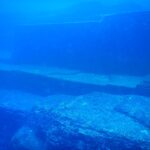
In the Gulf of Pozzuoli, about 7 meters deep, a statue of Ulysses still holds out a cup of wine in the apse of an imperial nymphaeum. It is a replica. The original rests in the museum, a few hundred meters above, in the castle of Baia.
Baia, the Baiae of the Romans, was the seaside resort of the imperial elite, west of Naples. The ground of the Phlegraean Fields caused it to sink beneath the sea, and a 2002 decree transformed its ruins into a protected park.
Here, we separate what is documented from what belongs to the brochure. The rest must be requested at the diving center (and they will tell you what).
Why did Baia end up under the sea?
Baia sank due to bradyseism, a slow ground movement specific to the caldera of the Phlegraean Fields. The crust rises or falls depending on deep volcanic activity. Over centuries, the descent prevailed and the ancient coast slipped below sea level.
Forget the image of a city swallowed in one night. The sinking happened in phases, over a long period after Antiquity, and the waterfront villas found themselves under a few meters of water with their mosaic floors, baths, and pools. This is what makes the site readable. The walls remained more or less in place. Sand and marine organisms did the rest, covering the remains layer upon layer for centuries.
However, the movement continues today, but in the opposite direction: the ground has been rising around Pozzuoli for several years, and the Vesuvius Observatory (INGV) monitors swarms of tremors, some of which have been felt as far as Naples.
Baia is not the only submerged landscape studied in Europe. Doggerland, the sunken continent of the North Sea, tells another story, that of rising waters after the last glaciation. The mechanism differs.
What remains to be seen in the Baia underwater park?
The park stretches along the coast of Bacoli and Pozzuoli and descends to about 15 meters, according to the Italian Ministry of Culture. It includes the nymphaeum of Punta Epitaffio, the villa dei Pisoni, the villa “a protiro,” an urban sector with shops and baths, and the remains of Portus Julius.
Each site has its own logic. The nymphaeum of Punta Epitaffio served as a banquet hall. The villa “a protiro” owes its name to its portico entrance, and its floors are covered with geometric mosaics. The villa dei Pisoni is attributed to the Pison family, involved in a failed conspiracy against Nero in 65 AD. Portus Julius, finally, was a military port built under Agrippa at the end of the 30s BC, where a large rectangular warehouse with a central courtyard can still be identified.
Yet, not everything is accessible to everyone.
Routes, depths, and open sites vary according to the protection zone, sea conditions, and the authorization of the center that takes you there. Beware of online lists that line up five or six sites like an all-you-can-eat menu. Ask which one is planned for the day.
Are the statues in the Baia nymphaeum originals?
No. The statues you encounter in the nymphaeum of Punta Epitaffio are replicas placed on their original locations. The originals were brought up, some in 1969, the others in the early 1980s, then exhibited at the Phlegraean Fields Archaeological Museum, located in the castle of Baia.
The old article on this site spoke of “cyclops statues.” This is false. The group in the apse depicts a scene from the Odyssey, where Ulysses makes the cyclops Polyphemus drink to escape with his companions, and it is Ulysses who is seen holding the cup. Around, replicas represent Dionysus and members of the imperial family. Archaeology Magazine identifies among others Antonia the Younger, mother of Emperor Claudius, possibly with her granddaughter Claudia Octavia, who died young. The sculptural program thus mixes myth and dynastic propaganda.
But where is Neptune?
Because the nymphaeum primarily celebrated the family of Claudius and the pleasures of the banquet. If the place of the Roman god in the sea imagination interests you, we have dedicated a dossier on the influence of Neptune on the marine imagination. The replicas have a concrete advantage. They keep the originals safe from concretions and clumsy fins.
What does the decree of August 7, 2002 say about the Baia park?
The ministerial decree of August 7, 2002, created the submerged park of Baia and divided it into three zones. In zone A, the integral reserve, swimming is prohibited and diving is only allowed during authorized guided tours, limited in number and supervised by the managing organization. Zone B allows swimming and freediving.
Thus, two visitors in the same place may have different rights depending on their activity. Spearfishing remains prohibited in all three zones, including zone B where swimming is permitted. In zone C, mooring is done on the buoys of equipped sectors. The 2002 text entrusted management to the archaeological superintendence of Naples and Caserta, with the harbor master’s office and the carabinieri for surveillance. Today, the site falls under the Phlegraean Fields Archaeological Park, attached to the Ministry of Culture.
This is consistent with what we write in our top sunken cities to explore.
One rule applies to all zones. Do not touch the remains, do not take anything, and keep your fins away from the mosaics, because a fin kick stirs up sediment that falls back onto fragile floors. The reasons also apply to fixed fauna, as explained in why you should never touch marine life.
Diving or snorkeling at Baia: what to ask before booking?
First ask in which zone the outing takes place, then the required level and the planned depth. Diving in zone A necessarily involves an authorized guided tour, whereas snorkeling falls under zone B, where freediving is allowed. The center judges on site whether the outing suits you.
However, shallow depth says nothing about safety. The Gulf of Pozzuoli is a busy body of water, with boat traffic, and the swell can resuspend sediment. Visibility varies from day to day and no dated data can predict it from here. So ask simple questions. How many divers per guide? And what happens if the sea is rough on the scheduled day, or if visibility drops to almost nothing?
The fallback plan is as important as the site.
If you want to film the mosaics, a lamp helps bring out the colors, and our comparison of dive cameras will help you choose without overloading your setup. Before departure, take a look at the Vesuvio Observatory bulletins on the activity of the Phlegraean Fields.
In short, Baia is worth the effort. The real cost is an outing to be booked in advance on limited slots, a guided group moving at the guide’s pace, and sometimes a lost day if the sea refuses. We find this price reasonable for a site we want to still see in twenty years.
FAQ
Do you need to be a certified diver to visit Baia?
To dive in zone A, yes in practice, since the 2002 decree only authorizes guided tours supervised by authorized structures. The required level depends on the center and the outing. In zone B, swimming and freediving are allowed, which opens snorkeling in part of the park.
At what depth is the nymphaeum of Claudius?
The nymphaeum of Punta Epitaffio lies at about 7 meters deep, according to the official park website. The entire park descends to about 15 meters. The actual depth of your outing depends on the route chosen by the guide.
Where can you see the original statues of Baia?
At the Phlegraean Fields Archaeological Museum, in the castle of Baia, in Bacoli. The statues from the nymphaeum were transferred there after their recovery, in 1969 and then in the early 1980s. On site, they are copies.
Is the ground of Baia still moving?
Yes. The bradyseism of the Phlegraean Fields remains active and the ground has been rising around Pozzuoli for several years. The Vesuvio Observatory (INGV) publishes monitoring bulletins to consult before your trip.
Sources
- Decree August 7, 2002: Establishment of the submerged park located in the waters of Baia in the Gulf of Pozzuoli (Italian Ministry of Environment, 2002)
- Slideshow: Italy’s Underwater Sculpture Garden (Archaeology Magazine, Archaeological Institute of America, 2023)
{“@context”:”https://schema.org”,”@type”:”FAQPage”,”mainEntity”:[{“@type”:”Question”,”name”:”Faut-il être plongeur certifié pour visiter Baia ?”,”acceptedAnswer”:{“@type”:”Answer”,”text”:”Pour plonger en zone A, oui dans les faits, puisque le décret de 2002 n’y autorise que des visites guidées encadrées par des structures autorisées. Le niveau exigé dépend du centre et de la sortie. En zone B, la baignade et l’apnée sont permises, ce qui ouvre la randonnée palmée sur une partie du parc.”}},{“@type”:”Question”,”name”:”À quelle profondeur se trouve le nymphée de Claude ?”,”acceptedAnswer”:{“@type”:”Answer”,”text”:”Le nymphée de Punta Epitaffio repose à environ 7 mètres de fond, selon le site officiel du parc. L’ensemble du parc descend jusqu’à environ 15 mètres. La profondeur réelle de ta sortie dépend de l’itinéraire choisi par le guide.”}},{“@type”:”Question”,”name”:”Où voir les statues originales de Baia ?”,”acceptedAnswer”:{“@type”:”Answer”,”text”:”Au musée archéologique des Champs Phlégréens, dans le château de Baia, à Bacoli. Les statues du nymphée y ont été transférées après leur récupération, en 1969 puis au début des années 1980. Sur le site, ce sont des copies.”}},{“@type”:”Question”,”name”:”Le sol de Baia bouge-t-il encore ?”,”acceptedAnswer”:{“@type”:”Answer”,”text”:”Oui. Le bradyséisme des Champs Phlégréens reste actif et le sol remonte autour de Pouzzoles depuis plusieurs années. L’Observatoire du Vésuve (INGV) publie des bulletins de surveillance à consulter avant ton voyage.”}}]}