On April 21, 1934, the Daily Mail published a photo of a small head with a long neck emerging from Loch Ness. Sixty years later, one of the authors admitted that the “creature” was a toy.
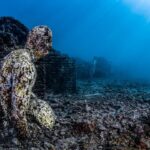
In the meantime, the Scottish lake has become the favorite setting for monster hunters. And the question often arises among divers: can one go see for oneself what lies beneath?
Our former page promised “areas known for their sightings” and local centers with tailor-made packages. We have revised everything from the lake’s measurements, the 1994 confession, and the DNA study conducted in 2018 by the University of Otago.
What is the depth and temperature of Loch Ness?
Loch Ness reaches about 230 meters at its deepest point and 132 meters on average, according to the World Lake Database of ILEC. Approximately 39 kilometers long, it contains nearly 7.45 km³ of fresh water. In 1977-1978, its surface temperature ranged from 5.6 °C in winter to 13.5 °C in August.
Lower down, the water moves little. At 75 meters, readings from the same series remain between 5.6 and 8.0 °C year-round, and a thermocline forms from May to October, separating a slightly warmer surface layer from a deep mass that stays cold. The figure of 230 meters comes from Sir John Murray’s survey in 1903. And a survey by the Loch Ness Project measured 227 meters in 1991. For a recreational diver, the difference changes nothing, since both values far exceed any recreational diving limits.
What remains is the color.
The rivers feeding the lake pass through peat bogs and bring brown water. In the 1977-1978 measurements, Secchi disk transparency was around 3.6 to 4.6 meters. This figure is nearly fifty years old. It is given as a rough estimate.
What did the 1934 “surgeon’s” photo really show?
The so-called “surgeon’s” photo showed a toy submarine topped with a sculpted head and neck. It was attributed to London physician Robert Kenneth Wilson and published in 1934. In 1994, Christian Spurling, stepson of Marmaduke Wetherell, admitted to having made the model.
Family revenge. A few months earlier, Wetherell believed he had found monster footprints on the shore, and the Daily Mail ridiculed him when it was understood they came from a stuffed hippopotamus foot. The family allegedly staged the photo to get revenge. They entrusted the picture to Dr. Wilson, whose name lent credibility to the image. Spurling was 93 years old at the time of his confession. For six decades, the photo served as evidence in books and documentaries about the Scottish monster.
But the legend does not begin in 1934.
In the Life of Saint Columba, written by Abbot Adomnan around the year 700, the saint drives away an aquatic beast from the River Ness, which flows out of the lake. The text places the scene around 565. This hagiographic account was written more than a century after Columba’s death to celebrate his miracles. It can be read as a testimony to local imagination, not as a dated observation.
What did Neil Gemmell’s environmental DNA study find?
In June 2018, Professor Neil Gemmell’s team (University of Otago) collected 250 water samples throughout the loch, both at the surface and at depth. The results, announced in September 2019, showed no trace of reptile or plesiosaur DNA. However, they found a lot of eel DNA.
The principle is simple. Each organism leaves fragments of DNA in the water (skin, mucus, excrement). These are filtered, sequenced, and then compared to global databases. The team also ruled out sturgeon, catfish, and Greenland shark, three candidates often cited by enthusiasts. They found DNA from terrestrial animals, such as deer, sheep, and badger.
Yet, the eel does not explain everything.
Environmental DNA indicates that a species is present and gives an idea of its abundance, but it says nothing about the size of individuals, as Gemmell himself pointed out when presenting the results. He believes that giant eels cannot be ruled out and calls for further research before concluding anything. In short, the study removes the plesiosaur from the list and leaves an open hypothesis. We find this honesty more interesting than any blurry photo.
Before this, the 1987 Deepscan operation swept the lake with sonar using a fleet of boats. Some echoes remained unexplained. None provided proof of a large unknown animal.
Can one dive in Loch Ness?
Yes, there is nothing in principle that forbids diving in Loch Ness, but it is a cold, dark freshwater dive reserved for divers already comfortable in these conditions. On the agenda are rocky slopes covered with mud and rapidly decreasing light.
For what level? The question matters more here than on a tropical reef. The lake walls are steep and descend to a flat muddy bottom, according to the Loch Ness Project, so the depth can come faster than expected if you follow the slope without reference points. The brown water cuts the light. A lamp becomes essential as soon as you leave the surface. The cold reduces autonomy and finger dexterity, complicating every action on the equipment, from inflating the buoyancy compensator to adjusting the drysuit.
Yet none of these constraints are visible in a postcard photo.
We have not found any “in the footsteps of Nessie” diving offers that can be described based on reliable public information, and we will not mention any center at random. If an organizer offers you a trip, ask where you depart from and how you get out of the water. Also ask who stays on the surface and what is planned if the wind raises a short swell on the lake. Impossible to decide from here. The briefing must answer these questions before entering the water.
One last point matters: good visibility would not make the dive safer, because here it is the cold and the slope that set the margin.
What equipment for cold and dark water?
For water that remains below 10 °C at depth all year round, a drysuit with a warm undergarment is the basis. Add a regulator designed for cold water, a main lamp and a backup lamp, a dive computer, and a compass. Gloves and a hood are not a luxury.
Ballast also changes. In freshwater, you float less than in the sea, so you need less weight, and our guide on diving ballast and buoyancy balance details how to redo a weighting. Do it on site with the drysuit, never with the numbers from your sea vacations. On the instruments side, a reliable dive computer displays depth continuously, which helps when you no longer see the bottom. The compass is used for the return. A camera can wait.
Thus, everything depends on the equipment you already have.
If you already dive in a drysuit in a cold lake, Loch Ness remains a demanding but manageable outing. If you have never worn a drysuit, training and renting a complete set of equipment cost time and money, for a dive without any promised animal.
Why does the myth still hold?
The myth holds because the lake is immense and opaque. A boat wake or a floating log can create, seen from the shore on a windy day, a shape that looks like a moving hump on dark water.
Nessie joins the long list of aquatic monsters from ancient stories, which we partly present in our selection of the most impressive mythological creatures. For the chronology of testimonies and expeditions, our file Nessie, myth or reality goes further. And if the hypothesis of a large fish interests you, real giants exist elsewhere. Our list of the largest freshwater fish in the world gives an idea, with species from rivers and lakes much warmer than Scotland. None live in Loch Ness.
However, we can keep the pleasure of the legend.
The monster is part of the lake’s landscape like a character from a novel, and no one is obliged to choose between legend and measurements. For a diver, the useful question changes in nature. Are you ready for water at 6 or 7 °C where the lamp illuminates two meters of mud? The price of this answer is counted in hours of drysuit training, well before the ticket to Inverness.
FAQ
What is the maximum depth of Loch Ness?
About 230 meters according to Sir John Murray’s survey in 1903, taken up by the World Lake Database of ILEC. A survey by the Loch Ness Project measured 227 meters in 1991. The average depth is about 132 meters.
Was the 1934 monster photo a fake?
Yes. In 1994, Christian Spurling admitted to having made the model, a toy submarine topped with a sculpted head and neck. The photo had been presented under the name of the doctor Robert Kenneth Wilson.
What did the 2018 DNA study show?
The 250 samples taken in June 2018 by Neil Gemmell’s team contained no reptile DNA. They contained a lot of eel DNA. The study does not allow determining the size of these eels.
What is the temperature of the Loch Ness water?
According to the 1977-1978 measurements cited by ILEC, the surface ranged from 5.6 °C in winter to 13.5 °C in August. At 75 meters, the water remained between 5.6 and 8.0 °C all year round. Plan for a dry suit regardless of the season.
Sources
- First eDNA study of Loch Ness points to something fishy (University of Otago, 2019)
- Loch Ness, World Lake Database (International Lake Environment Committee, 1977-1978 data)
{“@context”:”https://schema.org”,”@type”:”FAQPage”,”mainEntity”:[{“@type”:”Question”,”name”:”Quelle est la profondeur maximale du Loch Ness ?”,”acceptedAnswer”:{“@type”:”Answer”,”text”:”Environ 230 mètres selon le relevé de Sir John Murray en 1903, repris par la World Lake Database de l’ILEC. Un sondage du Loch Ness Project a mesuré 227 mètres en 1991. La profondeur moyenne est d’environ 132 mètres.”}},{“@type”:”Question”,”name”:”La photo du monstre de 1934 était-elle un faux ?”,”acceptedAnswer”:{“@type”:”Answer”,”text”:”Oui. En 1994, Christian Spurling a avoué avoir fabriqué la maquette, un sous-marin jouet surmonté d’une tête et d’un cou sculptés. La photo avait été présentée sous le nom du médecin Robert Kenneth Wilson.”}},{“@type”:”Question”,”name”:”Qu’a montré l’étude ADN de 2018 ?”,”acceptedAnswer”:{“@type”:”Answer”,”text”:”Les 250 échantillons prélevés en juin 2018 par l’équipe de Neil Gemmell ne contiennent aucun ADN de reptile. Ils contiennent beaucoup d’ADN d’anguille. L’étude ne permet pas de connaître la taille de ces anguilles.”}},{“@type”:”Question”,”name”:”Quelle est la température de l’eau du Loch Ness ?”,”acceptedAnswer”:{“@type”:”Answer”,”text”:”Sur les mesures de 1977-1978 citées par l’ILEC, la surface allait de 5,6 °C en hiver à 13,5 °C en août. À 75 mètres, l’eau restait entre 5,6 et 8,0 °C toute l’année. Prévois une combinaison étanche quelle que soit la saison.”}}]}