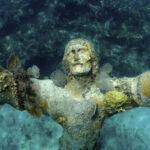
S. Latitude 47° 9′, W. Longitude 126° 43′. These coordinates appear in black and white in “The Call of Cthulhu,” the short story Lovecraft wrote in 1926 and which the American magazine Weird Tales published in February 1928. They designate a point in the South Pacific where a stone city supposedly rose from the waves on March 23, 1925.
This city is called R’lyeh. Its occupant, Cthulhu, sleeps there waiting for his time.
The old version of this page mixed fiction, approximations, and some clear errors, such as a Bloop heard “not far from Point Nemo.” We have checked every claim at the source. What did not hold up has disappeared.
Where is R’lyeh according to Lovecraft?
In the short story, R’lyeh emerges at 47° 9′ south latitude and 126° 43′ west longitude, right in the South Pacific, far from any inhabited coast. It is the journal of the Norwegian sailor Gustaf Johansen, found aboard the yacht Alert, that gives this position to the narrator.
August Derleth, editor and successor of Lovecraft, later placed the city a bit further south in his own texts, around 49° 51′ S and 128° 34′ W. Both positions remain in the South Pacific. The old page referred to the Southern Ocean for the latter. However, this ocean starts much further south, at the 60th parallel south in the most common delimitation. For fiction, the difference matters little. For a map, it does.
There remains Point Nemo, which the old version confused with R’lyeh.
Point Nemo designates the place in the ocean farthest from any landmass, around 48° 52′ S and 123° 23′ W. It was calculated in 1992 by engineer Hrvoje Lukatela, more than fifty years after Lovecraft’s death in 1937. The writer could therefore not have used it as a reference. The coincidence remains amusing, since the coordinates in the story fall just over 300 kilometers from this point, and those of Derleth less than 400 kilometers (indicative calculation on the Earth’s sphere).
What does “The Call of Cthulhu” say about the sunken city?
The short story reconstructs an investigation from the papers of a dead professor. The heart of the narrative lies in Johansen’s journal, whose crew lands on an island risen from the sea, covered with huge blocks, and unwittingly awakens the creature that slept there.
Lovecraft emphasizes an architecture that goes off the rails. He writes that the geometry of the place is “abnormal, non-Euclidean.” Later, it becomes “all wrong,” with angles that appear convex then concave and surfaces that no one can say anymore whether they are horizontal or tilted. The sailors lose their bearings. This loss of balance carries the horror of the text more surely than the description of the monster, which remains vague until the end. Johansen himself does not recover from it.
And one sentence sums up the creature’s waiting.
“Ph’nglui mglw’nafh Cthulhu R’lyeh wgah’nagl fhtagn” is translated, in the story, as “In his house at R’lyeh, dead Cthulhu waits dreaming.” The followers of his cult repeat it without necessarily understanding its meaning. This dead one who dreams sets up a suspended threat, that nothing extinguishes and that nothing truly awakens, except the chance of a lost crew.
Did Nan Madol inspire R’lyeh?
Nothing proves it. To our knowledge, no text by Lovecraft mentions Nan Madol, and the connection mainly comes from his readers. The lead remains plausible, as the writer admired Abraham Merritt, whose novel “The Moon Pool” (1918) takes place in the ruins of Ponape, present-day Pohnpei.
The site itself exists. According to UNESCO, Nan Madol comprises more than 100 artificial islets off the southeast coast of Pohnpei, in the Federated States of Micronesia. Their walls mix basalt and coral blocks. Palaces, temples, tombs, and residential quarters were built there between 1200 and 1500 AD, and the whole formed the ceremonial center of the Saudeleur dynasty. None of this is submerged at the bottom of the Pacific.
In short, the stone city floats on the water, not at the bottom.
The site has been on the World Heritage List since 2016, and on the List of World Heritage in Danger since the same year, which says a lot about its state of conservation. UNESCO cites the silting of the canals, which allows the mangrove to spread unchecked and weakens the walls. No official dated information has been found about diving in these canals. Impossible to decide from here.
However, truly sunken cities exist elsewhere. Our tour of sunken cities where you can dive details for each the real access points and the required permissions.
Did the NOAA’s Bloop come from R’lyeh?
No. The Bloop is a very low-frequency sound recorded in the summer of 1997 by NOAA’s hydrophones. The American agency now classifies it among icequakes, these vibrations produced when large icebergs crack and fracture. Its probable source is near Antarctica, far from the coordinates of the story.
The NOAA PMEL laboratory page places the origin zone between the Bransfield Strait and the Ross Sea, or even at Cape Adare. Researchers compared the signal with that of iceberg A53a, acoustically tracked during its disintegration near South Georgia Island, in the South Atlantic, in early 2008. The two sounds are similar. The old version of this page placed the Bloop near Point Nemo. Nothing supports that.
However, the legend had time to take hold.
For years, forums and videos linked this sound to a giant creature, sometimes to Cthulhu himself. The temptation is understandable, as a huge noise captured by an official organization in the southern seas resembled a pre-written scenario. The only thing missing was the monster.
Why does R’lyeh resonate so much with divers?
Because Lovecraft pushes to the brink of madness sensations that many divers experience in a mild form: darkness, relative silence, loss of bearings. Real diving frames these sensations with training, a buddy system, and briefing. The story, however, lets them grow unchecked.
The text even opens with a famous sentence: “The most merciful thing in the world, I think, is the inability of the human mind to correlate all its contents.” Everything else follows from this. Thus, the myth quickly left the page. In 1981, the publisher Chaosium released the role-playing game “The Call of Cthulhu,” where characters lose sanity points when facing the unknown. Video games, movies, and comics followed, and R’lyeh often serves as the final setting.
The city joins a long line of sea monsters.
One thinks of the Kraken of Scandinavian sailors, the most impressive mythological creatures, or the sea gods that each civilization created. Lost continents like Lemuria and Mu come up in the same discussions. Lovecraft adds a modern idea. For him, the ocean hides things that the human mind cannot bear, and science only approaches the threshold.
Underwater, the real risk is more about disorientation, which is managed by staying close to your buddy and following the planned dive. If you are looking for a sunken city with a dark and well-documented past, Port Royal, the former pirate haven in Jamaica, listed as a World Heritage site since July 2025, tells a real disaster story. Lovecraft, however, remains an evening read. It costs a night of sleep, rarely more.
FAQ
Does R’lyeh really exist?
No. R’lyeh is an invention of Lovecraft, appearing in “The Call of Cthulhu,” published in 1928 in Weird Tales. The story’s coordinates fall right in the South Pacific, over several thousand meters deep, where no ruins have been reported.
What is R’lyeh’s position in the story?
Lovecraft gives 47° 9′ S and 126° 43′ W. August Derleth later proposed 49° 51′ S and 128° 34′ W. Both positions fall a few hundred kilometers from Point Nemo, which was only calculated in 1992.
What was the Bloop recorded by NOAA?
A very low-frequency sound captured by NOAA’s hydrophones in the summer of 1997. The agency attributes it to icequakes, that is, the fracturing of large icebergs. Its probable source is between the Bransfield Strait and the Ross Sea, near Antarctica.
What does “Ph’nglui mglw’nafh Cthulhu R’lyeh wgah’nagl fhtagn” mean?
In the story, the phrase translates as “In his house at R’lyeh, dead Cthulhu waits dreaming.” It is the ritual phrase of the cult’s followers. It does not belong to any real language.
Can you visit Nan Madol?
Nan Madol is located off the coast of Pohnpei, Micronesia, and has been a UNESCO World Heritage site since 2016. The site is also listed as endangered due to the silting of the canals. Check the current access conditions with local authorities before you go.
Sources
- Acoustics Monitoring Program – Icequakes (Bloop) (NOAA PMEL, accessed in 2026)
- Nan Madol: Ceremonial Centre of Eastern Micronesia (UNESCO, 2016)
{“@context”:”https://schema.org”,”@type”:”FAQPage”,”mainEntity”:[{“@type”:”Question”,”name”:”R’lyeh existe-t-elle vraiment ?”,”acceptedAnswer”:{“@type”:”Answer”,”text”:”Non. R’lyeh est une invention de Lovecraft, apparue dans « L’Appel de Cthulhu », publiée en 1928 dans Weird Tales. Les coordonnées de la nouvelle tombent en plein Pacifique Sud, sur des fonds de plusieurs milliers de mètres, où aucune ruine n’a été signalée.”}},{“@type”:”Question”,”name”:”Quelle est la position de R’lyeh dans la nouvelle ?”,”acceptedAnswer”:{“@type”:”Answer”,”text”:”Lovecraft donne 47° 9′ S et 126° 43′ O. August Derleth a proposé plus tard 49° 51′ S et 128° 34′ O. Les deux positions tombent à quelques centaines de kilomètres du point Némo, qui n’a été calculé qu’en 1992.”}},{“@type”:”Question”,”name”:”Qu’était le Bloop enregistré par la NOAA ?”,”acceptedAnswer”:{“@type”:”Answer”,”text”:”Un son très grave capté par les hydrophones de la NOAA à l’été 1997. L’agence l’attribue à des icequakes, c’est-à-dire à la fracture de grands icebergs. Sa source probable se trouve entre le détroit de Bransfield et la mer de Ross, près de l’Antarctique.”}},{“@type”:”Question”,”name”:”Que signifie « Ph’nglui mglw’nafh Cthulhu R’lyeh wgah’nagl fhtagn » ?”,”acceptedAnswer”:{“@type”:”Answer”,”text”:”Dans la nouvelle, la formule se traduit par « Dans sa demeure de R’lyeh, Cthulhu mort attend en rêvant ». C’est la phrase rituelle des adeptes du culte. Elle n’appartient à aucune langue réelle.”}},{“@type”:”Question”,”name”:”Peut-on visiter Nan Madol ?”,”acceptedAnswer”:{“@type”:”Answer”,”text”:”Nan Madol se trouve au large de Pohnpei, en Micronésie, et figure au patrimoine mondial de l’UNESCO depuis 2016. Le site est aussi classé en péril à cause de l’envasement des canaux. Vérifie les conditions d’accès du moment auprès des autorités locales avant de partir.”}}]}